Data has become the fuel of every modern operation. Whether it is an e-commerce brand tracking customer behavior in real time, a financial firm analyzing thousands of transactions daily, or a logistics company verifying proof-of-delivery records, the demand for fast, accurate data processing has never been higher.
Yet, internal teams are overwhelmed. Skilled analysts and back-office specialists are hard to hire. Labor shortages persist. Operating costs keep climbing. And as companies scale, the volume of raw data grows faster than most teams can keep up with.
This is the turning point where many businesses choose to outsource data processing services to nearshore teams—especially in high-demand hubs like Colombia. The model offers the perfect blend of cost savings, skilled talent, time-zone alignment, and operational flexibility. More importantly, it helps companies turn raw, unstructured data into actionable insights without slowing down the core business.
This blog explores why industries across the board are rapidly embracing nearshore data processing and how this strategy is changing the game for modern operations.
Why Businesses Are Now Forced to Rethink Data Processing
Across industries, the same challenges appear:
- Data volumes are exploding.
Even small businesses handle more data today than large companies did a decade ago. - Data accuracy is non-negotiable.
A single error in billing, reporting, or customer records can cause financial loss or regulatory exposure. - U.S. talent shortages continue.
Companies struggle to hire data processors, analysts, and compliance-oriented roles fast enough. - Automation still needs human oversight.
AI tools can extract and categorize data, but humans ensure accuracy, context, and verification.
These realities make the case for outsourcing—not as a stopgap solution but as a long-term operational strategy.
When companies outsource data processing services to nearshore teams, they gain capacity, speed, accuracy, and cost efficiency, all while retaining control and real-time collaboration.
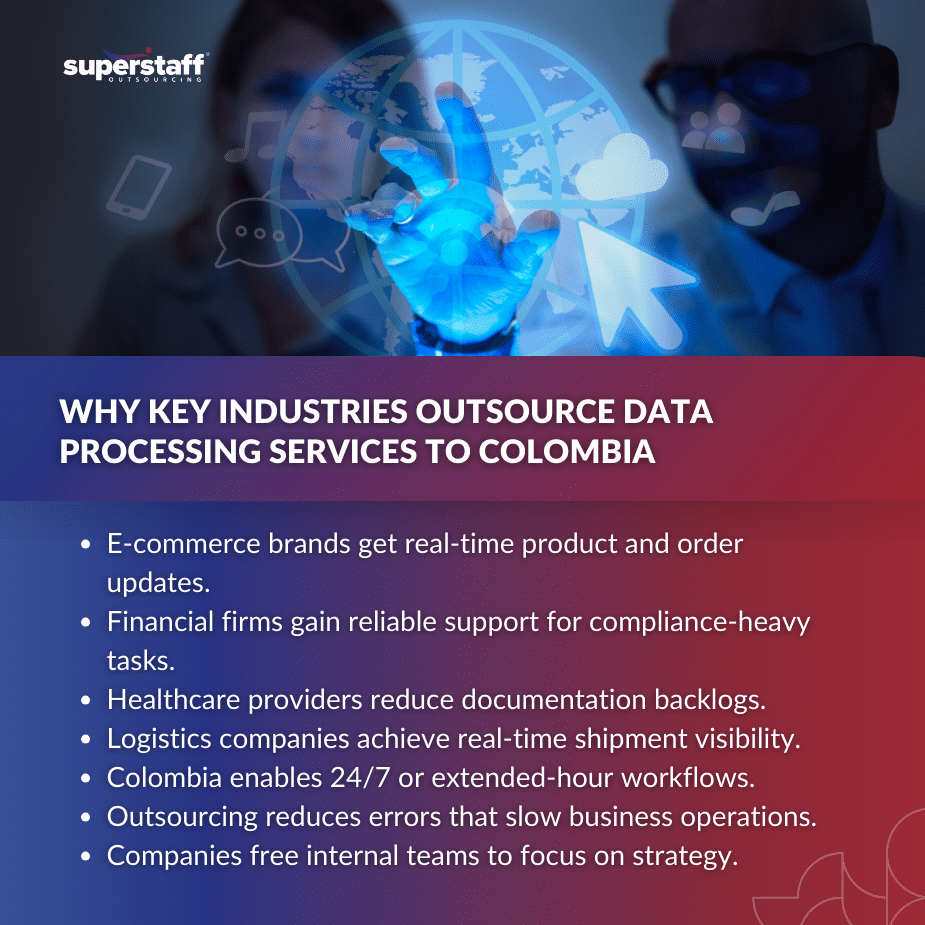
How Nearshore Teams Transform Data Processing Across Key Industries
1. E-Commerce: Faster Orders, Cleaner Catalogs, Better CX
E-commerce is one of the biggest adopters of outsourced back-office functions. Online brands must constantly process:
- Product listings
- Inventory updates
- Customer records
- Order verification
- Returns and refunds data
- Sales reporting
- User behavior analytics
With thousands of SKUs and transactions happening daily, accuracy matters. A misplaced decimal in pricing or a delay in listing updates can trigger customer complaints, cart abandonment, or financial discrepancies.
This is why fast-moving online brands outsource data processing services to nearshore teams that:
- Update product catalogs in real time
- Manage pricing accuracy
- Process order data across different platforms
- Validate customer information
- Filter fraudulent transactions
- Provide clean, structured data for analytics
Nearshore teams in Latin America work in the U.S.-aligned time zones, making collaboration seamless for e-commerce brands that need daily, high-volume support.
2. Financial Services: Compliance-Ready and Error-Free Operations
Finance generates some of the most sensitive and complex data in any industry.
Banks, fintech firms, lenders, insurance companies, and investment groups must process:
- Transactions
- Claims
- KYC/AML data
- Risk profiles
- Financial reporting
- Account updates
- Payment history
Every step requires precision, confidentiality, and regulatory compliance.
Financial institutions choose to outsource data processing services to nearshore teams for three key reasons:
- Regulatory knowledge:
Nearshore teams are trained in compliance requirements, including AML, PCI DSS, and financial data security protocols. - Reduced risk:
Outsourcing reduces manual errors that lead to audits, penalties, or customer loss. - Speed and scalability:
Growing transaction volumes no longer overwhelm in-house teams.
Nearshore and offshore data processing teams ensure that financial firms can manage daily operations without delays—while compliance remains intact.
3. Healthcare: Accurate Patient Records and Faster Claims
Healthcare organizations produce enormous amounts of data every hour:
- Patient intake records
- Medical billing and coding
- Insurance verification
- Claims documentation
- Appointment histories
- Treatment logs
Processing this data in-house requires trained specialists who understand compliance and medical terminology. However, the U.S. is experiencing severe labor shortages in healthcare administration roles.
Hospitals, medical groups, and insurance providers outsource data processing services to nearshore teams to:
- Improve turnaround times for claims
- Eliminate documentation backlogs
- Reduce administrative overhead
- Protect PHI data through compliant processes
- Maintain accuracy in medical coding and billing
This allows healthcare providers to shift staff back to clinical support—improving patient experience and reducing burnout.
4. Logistics & Transportation: Real-Time Data for Real-Time Movement
The logistics sector depends on accurate, time-sensitive data:
- Track & trace data
- Bill of lading (BOL) documentation
- Proof of delivery (POD) verification
- Dispatch details
- Carrier updates
- Shipment status records
- Customs documentation
Errors slow everything down—from warehouse workflows to trucking operations to cross-border shipments.
This is why logistics companies outsource data processing services to nearshore teams that:
- Update shipment information instantly
- Validate POD and BOL documents
- Clean and structure dispatch data
- Process carrier invoices
- Maintain real-time visibility across systems
With nearshore alignment, these teams work the same hours as U.S. operations, ensuring zero downtime and fast issue resolution.
5. Real Estate, Insurance, Legal, and Beyond
Other industries relying heavily on outsourcing for data processing include:
Real Estate
- Lease agreements
- Property listings
- Mortgage data
- Title documentation
Insurance
- Policy updates
- Claims files
- Risk assessment data
- Customer records
Legal Services
- Discovery data
- Case files
- Contract management
- Legal research documentation
Any industry that manages sensitive, repetitive, or document-heavy workflows benefits when they outsource data processing services to skilled nearshore teams.
Why Nearshore Makes More Sense Than Offshore or In-House
Companies have three options: keep everything in-house, opt for outsourced data entry offshore, or partner with nearshore teams. Increasingly, nearshore wins because it offers the best hybrid of value and control. Here’s why:
1. Time-Zone Alignment = Faster Workflows
Unlike offshore teams with a 10–12 hour gap, nearshore teams operate during U.S. business hours. That means:
- Instant collaboration
- Real-time fixes
- Faster turnaround
- Smoother communication
2. Cultural Compatibility
Latin American teams have strong cultural alignment with U.S. businesses, reducing miscommunication and increasing efficiency.
3. Cost Savings Without Quality Loss
Nearshore teams deliver up to 50–70 percent cost reductions while maintaining high levels of accuracy, security, and expertise.
4. Higher Talent Availability
Countries like Colombia have booming BPO sectors, producing thousands of skilled data processing specialists every year.
5. Easier Oversight
Nearshore locations allow:
- Video conferencing at normal hours
- Regular alignment meetings
- Hands-on training sessions
- Travel-friendly proximity
The result: companies get the benefits of outsourcing without losing the ability to manage quality.
The Competitive Advantage of Outsourcing Data Processing Today
Companies that outsource data processing services gain an operational edge:
- They scale without hiring pressure
- They reduce overhead expenses
- They eliminate processing backlogs
- They improve accuracy across departments
- They unlock analytics insights faster
- They centralize and clean their data
- They empower local teams to focus on strategy and innovation
In a world where growth depends on speed and clarity, nearshore data processing is no longer optional—it is strategic.
Outsource Data Processing Services Today: The Industries That Win Are the Ones That Move Data Faster
From e-commerce to finance, healthcare to logistics, companies are under pressure to make decisions quickly, manage customers efficiently, and operate with accuracy.
Nearshore outsourcing delivers the people, the skills, the accuracy, and the flexibility businesses need. When companies outsource data processing services, they unlock:
- Faster workflows
- Better customer experience
- Stronger compliance
- Greater operational stability
- Data that actually drives decisions
The businesses that win in 2025 and beyond are the ones that treat data as a strategic advantage—not an administrative burden.
Ready to get started? SuperStaff offers a wide range of outsourcing solutions, including data processing services.
If you want to learn how nearshore teams streamline back office data operations, connect with our reliable Colombian BPO team today!