
Businesses today move faster than ever. Deadlines are tighter. Client expectations are higher. Leaders are stretched thinner. And whether you’re a founder running a lean startup or an operations leader guiding a midmarket company, one truth is universal: you can’t scale sustainably when your team is drowning in admin, coordination, and follow-ups.
This is where outsourcing virtual assistant services has quietly become a modern productivity game-changer. What started as simple administrative support has evolved into a strategic, ROI-driven solution powering growth across industries—from e-commerce and healthcare to finance, real estate, consulting, logistics, and tech.
In an era where efficiency is currency, outsourcing beats hiring in-house for many teams that want speed, cost savings, skill depth, and flexibility. Below is a deep look at why.
The Modern Productivity Stack Has Changed—And VAs Are at the Center of It
Today’s business environment isn’t the same as even five years ago. Workstreams are more complex. Tools are more advanced. Customer expectations are higher. And leaders need real-time responsiveness across multiple platforms.
This shift has pushed many companies to redesign their productivity stack, with three major realities driving the move:
- Teams must stay lean to remain competitive.
Over-hiring early creates unnecessary overhead and payroll drag. - 24/7 responsiveness is now a baseline.
Customers expect immediate support, across chat, email, and social channels. - The best talent is global—not limited to one ZIP code.
Outsourcing virtual assistant services unlocks talent pools that most small and midmarket firms simply can’t access domestically.
Today, virtual assistant outsourcing is no longer about simply hiring “task people.” VAs have become workflow stabilizers. They take the repetitive, predictable, always-on work that keeps businesses running—and execute it with precision, consistency, and speed.
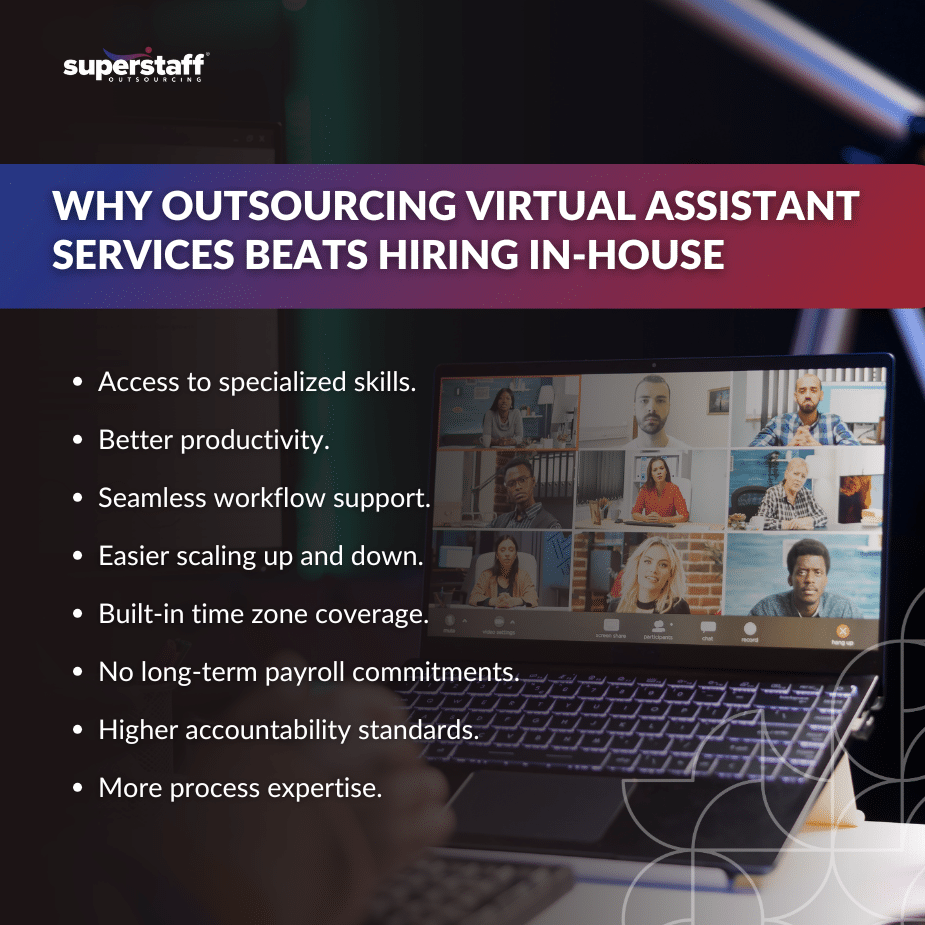
Why Outsourcing Virtual Assistant Services Wins Over Hiring In-House
1. Lower Costs Without Lower Quality
Hiring locally comes with unavoidable long-term expenses:
- Salaries
- Benefits
- Training
- Equipment
- Office space (or remote setup reimbursement)
When you compare that to outsourcing virtual assistant services, the financial picture becomes clear quickly: you only pay for the work you need, and a fully equipped, trained assistant comes built in.
Companies often cut administrative labor costs by 60% when outsourcing cost-effective virtual assistants compared to hiring in-house.
Cost efficiency is the earliest win—but far from the only one.
2. Scale Up or Down Instantly
In-house hiring locks you into payroll obligations even if demand dips. But through outsourcing virtual assistant services, scaling becomes as simple as:
- Adding a new assistant during seasonal spikes
- Reducing hours during slower quarters
- Expanding into weekend or evening shifts without hiring multiple employees
- Quickly onboarding additional support when you launch a new project or service line
This flexibility is a major reason why startups, e-commerce brands, and consulting firms lean heavily on outsourced VAs—they can adapt capacity as fast as market conditions change.
3. Access to Specialized Skill Sets
Today’s virtual assistants go far beyond admin work. Many are trained in:
- CRM management
- Lead generation
- Calendar coordination across time zones
- Customer service and live chat
- Social media scheduling
- Market research
- Bookkeeping support
- Data processing
- Inbox management
- Project coordination
- Travel planning
- Cold outreach support
- E-commerce store management
- SOP documentation and workflow optimization
When you hire in-house, you’re limited to one person’s skill set. By outsourcing virtual assistant services, you gain access to a full bench of specialists you wouldn’t be able to hire individually.
This is why many companies treat outsourced VAs as “micro-teams” rather than single contributors.
4. No Recruiting Bottlenecks
Finding a qualified in-house admin assistant can take months. Job boards are saturated. Talent competition is steep. And hiring is slow, expensive, and unpredictable.
Outsourcing removes all the friction:
- No sourcing
- No screening
- No background checks
- No onboarding delays
- No uncertainty about performance
Staffing providers deliver trained, ready-to-operate VAs, so your team can focus on execution rather than recruitment cycles.
5. Increased Productivity Through Process Expertise
The best offshore and nearshore VA teams have supported hundreds of businesses before yours. Here’s how virtual assistant services boost productivity for busy teams:
- Proven workflows
- Documented SOPs
- Productivity tool mastery
- Familiarity with cross-functional operations
- Experience handling large task volumes
Most U.S.-based in-house hires—especially entry-level admin roles—don’t bring this level of operational fluency.
By outsourcing virtual assistant services, productivity is not something you have to build from scratch. It’s something you inherit.
6. Better Coverage Across Time Zones
Every business eventually hits the same bottleneck: Your clients and operations won’t stop moving just because your team is offline.
Outsourced virtual assistants provide built-in time zone coverage that is difficult and expensive to replicate in-house. This matters for:
- Global communications
- E-commerce order updates
- Customer service coordination
- Calendar management for busy executives
- Real-time inbox triage
- After-hours inquiries
- Weekend or holiday coverage
Businesses in the U.S. often find that assistants in the Philippines and Colombia offer the perfect blend of alignment, cultural fluency, and extended coverage.
7. Reduced Risk Compared to Hiring Employees
Business leaders underestimate how much liability comes from hiring full-time staff. With employees come:
- Labor law compliance
- Benefits management
- PTO and sick leave
- Probationary evaluations
- HR conflicts
- Termination risk
- Payroll compliance
- Workers’ compensation issues
Outsourcing eliminates all of this. Your staffing partner handles employment law, compliance, and HR responsibility. You simply focus on the output.
8. Faster Training and Smoother Onboarding
Onboarding an in-house assistant often takes weeks. They need:
- Process training
- Culture integration
- Tool setup
- Workflow familiarization
By outsourcing virtual assistant services, companies gain access to professional teams already come trained on:
- CRM tools
- Ticketing systems
- Project management apps
- Communication platforms
- Standard admin tools
- Data entry best practices
- Customer communication etiquette
Your onboarding becomes plug-and-play: Show your preferences → assign tasks → get results.
9. A Higher Standard of Accountability
In-house employees are harder to evaluate consistently. Performance issues escalate slowly. There’s reluctance to discipline. And metrics often get blurred.
Outsourced VAs operate within a structured accountability framework:
- Daily or weekly reporting
- Task tracking
- Performance dashboards
- QC reviews
- SLA-based expectations
- Oversight from a team lead or operations manager
You get transparency, not guesswork.
10. You Get Your Time Back—The Most Valuable Benefit of All
Founders, CEOs, consultants, and senior leaders often lose 30–40% of their week to:
- Inbox triage
- Scheduling
- Administrative tasks
- Follow-ups
- Document organization
- Data updates
- Low-level research
- Manual coordination
This is opportunity cost at its worst. Every hour spent on admin is an hour not spent on:
- Sales
- Growth
- Strategy
- Client relationships
- Product innovation
- Team leadership
Outsourcing virtual assistant services gives leaders their time back. And time is the one resource no business can afford to waste.
The Modern Productivity Playbook for 2025 and Beyond
The companies winning today share something in common: they don’t try to do everything in-house. They build hybrid, adaptive teams. They use specialized partners. They keep internal staff focused on high-value work, and they outsource the rest.
Outsourcing is no longer a cost-cutting tactic. It’s a performance strategy.
By integrating virtual assistants into their productivity stack, companies unlock:
- Faster execution
- Better operations
- Seamless workflows
- Higher revenue per employee
- Healthier teams
- Fewer bottlenecks
- More agility
- Stronger customer experience
This is why outsourcing virtual assistant services has become a foundational part of how modern businesses scale.
Thinking of Outsourcing Virtual Assistant Services? Partner With SuperStaff!
In-house hiring will always have a place. But relying solely on in-house staffing is increasingly expensive, slow, and limiting.
If you want a productivity model built for long-term growth—not just survival—then outsourcing becomes the strategic advantage you can’t ignore.
Companies adopting this model now are positioning themselves for:
- Faster scaling
- Global competitiveness
- Leaner operations
- Stronger revenue performance
- Higher customer satisfaction
And the businesses that wait? They’ll find themselves overwhelmed, understaffed, and struggling to keep pace.
The modern productivity stack belongs to companies willing to work smarter—not just harder. And outsourcing virtual assistant services to SuperStaff is the smartest move you can make.
Get in touch with our professional BPO team, and upgrade your business productivity today!