
U.S. healthcare organizations continue to face mounting pressure to improve reimbursement outcomes while managing rising administrative complexity. Payer requirements evolve constantly. Documentation standards tighten. Internal billing teams are stretched thin as claim volumes rise and experienced talent becomes harder to retain.
In this environment, medical claims processing services are no longer viewed as a tactical back-office function. They are increasingly treated as an operational control point that directly influences cash flow, compliance, and patient experience.
Colombia has emerged as a nearshore destination that aligns well with these priorities. Its healthcare-trained workforce, operational maturity, and time zone compatibility with the United States allow organizations to address denial risk at the process level rather than through reactive clean-up work.
The Real Cost of Denials Goes Beyond Revenue
Claim denials are often measured in delayed reimbursement, but the deeper cost lies in the operational drag they create. Each denied claim triggers follow-up work, staff time, and payer communication. Over time, this rework crowds out proactive tasks that could prevent future errors.
Many internal teams operate in a constant recovery mode. Processes are adjusted after denials occur instead of being designed to avoid them. This reactive pattern persists because teams lack the capacity to slow down and address root causes. Structured medical claims processing services shift that dynamic by introducing consistency, accountability, and upstream quality controls.
Why Nearshore Delivery Changes Day-to-Day Execution
Nearshore delivery in Colombia alters how claims teams function on a daily basis. Working hours overlap with U.S. operations, which improves coordination and reduces delays caused by asynchronous communication. Questions about documentation or eligibility can be resolved the same day, often before claims are submitted.
This operational proximity strengthens medical claims processing services by keeping decision-making close to execution. Supervisors can monitor performance in real time. Adjustments are implemented quickly. The result is a workflow that prioritizes prevention rather than correction.
Standardized Workflows Create Predictable Outcomes
Denials frequently stem from variation. Different staff members follow slightly different processes. Documentation checks are inconsistent. Payer-specific rules are applied unevenly. Over time, these small differences create significant denial exposure.
Nearshore teams in Colombia are typically trained within standardized operating frameworks. Tasks are clearly defined. Review steps are documented. Quality checkpoints are embedded into daily workflows. This structure allows medical claims processing services to deliver predictable outcomes even as volumes fluctuate.
Role Clarity Reduces Cognitive Overload
Generalist billing roles often require staff to juggle eligibility checks, coding validation, submission, and follow-up. This cognitive load increases error risk, especially under time pressure. Nearshore models frequently segment these responsibilities into specialized roles.
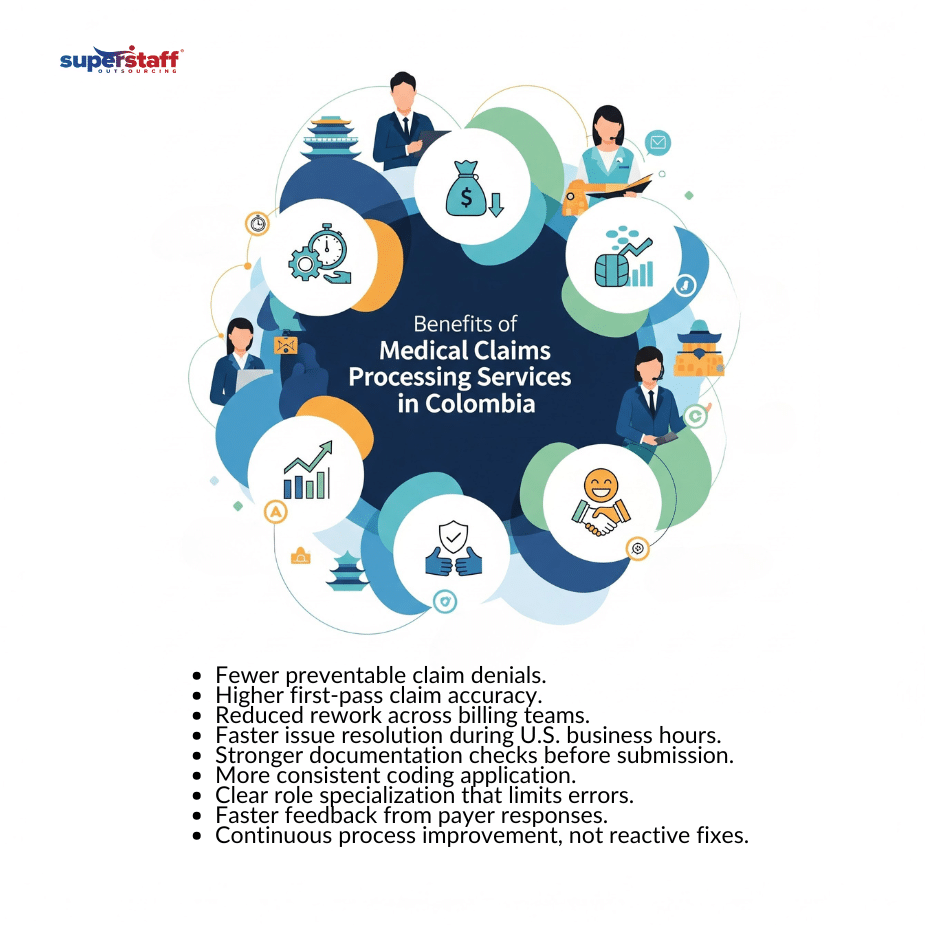
Specialization improves focus. Each team member becomes accountable for a specific outcome. Within medical claims processing services, this role clarity reduces handoff errors and supports higher first-pass accuracy. Over time, teams develop deeper expertise in their assigned functions, which further lowers denial risk.
Documentation Quality Improves with Dedicated Review
Incomplete or misaligned documentation remains a leading cause of preventable denials. Nearshore claims teams are often tasked with pre-submission documentation reviews that catch gaps before claims are sent to payers.
This approach strengthens medical claims processing services by shifting quality checks upstream. Instead of relying on post-denial audits, teams validate completeness at the point of submission. This proactive stance reduces payer rejections tied to missing or inconsistent information.
Coding Consistency Through Repetition and Oversight
Accurate coding depends on familiarity with payer rules and service-specific requirements. Nearshore teams benefit from repetition and specialization, which reinforce coding accuracy over time. Managers can track error patterns and address them through targeted retraining.
Within medical claims outsourcing models, this consistency is difficult to achieve when teams are understaffed or constantly onboarding new hires. Nearshore delivery provides workforce stability that supports continuous improvement rather than constant remediation.
Faster Feedback Loops Drive Continuous Improvement
Denial management is most effective when feedback is timely. Nearshore teams operating in Colombia can review payer responses quickly and adjust workflows without delay. Root cause analysis becomes part of daily operations rather than a monthly reporting exercise.
This responsiveness strengthens medical claims processing services by turning payer feedback into actionable insights. Process changes are tested, refined, and reinforced in near real time. Over time, denial patterns decline as teams adapt systematically.
Reducing Rework Improves Team Morale and Focus
Rework takes a toll on staff morale. Constantly fixing avoidable errors creates frustration and burnout. Nearshore models that emphasize accuracy over volume help teams focus on doing work right the first time.
As rework declines, medical claims processing services become more efficient without increasing pressure on staff. Teams spend less time chasing denials and more time supporting clean submissions and timely follow-up where needed.
Supporting a Broader Revenue Cycle Strategy
Claims processing is a critical link in the revenue cycle. Errors at this stage ripple into accounts receivable, patient billing, and financial reporting. Nearshore teams in Colombia often integrate closely with upstream and downstream functions.
This alignment makes healthcare revenue cycle outsourcing more effective. Clean claims accelerate cash posting. Fewer denials reduce aging receivables. Finance leaders gain more reliable visibility into expected reimbursement.
Governance and Transparency Remain Central
Successful nearshore models are built on governance, not distance. Clear performance metrics, audit protocols, and escalation paths ensure accountability. Leaders maintain visibility into operations without micromanaging daily tasks.
Well-structured medical claims processing services include regular reporting and quality reviews. These controls allow organizations to scale nearshore operations confidently while meeting compliance and performance expectations.
Why Colombia Fits U.S. Healthcare Operations
Colombia’s growing healthcare administration talent pool reflects increasing alignment with U.S. systems and processes. English proficiency continues to improve. Professional training programs emphasize accuracy, compliance, and process discipline.
For organizations focused on reducing healthcare claim denials with nearshore support in Colombia, the advantage lies in operational fit. Time zone alignment supports collaboration. Workforce stability supports consistency. Together, these factors create durable performance gains.
Starting Small and Scaling Intentionally
Many organizations begin with a defined scope such as secondary claims, denial follow-up, or pre-submission audits. These entry points allow leaders to validate quality and governance before expanding.
As trust builds, medical claims processing services can scale across additional workflows. This phased approach minimizes disruption while delivering measurable improvements in accuracy and turnaround time.
Streamline Healthcare Operations Through Outsourced Medical Claims Processing Services
Denials are rarely solved through technology alone. They require disciplined execution, clear accountability, and timely feedback. Nearshore delivery supports these priorities by embedding structure and responsiveness into daily workflows. When implemented thoughtfully, medical claims processing services in Colombia help organizations move from reactive rework to proactive accuracy.
SuperStaff partners with healthcare organizations to design and manage nearshore claims teams that integrate seamlessly into U.S. operations. Our focus on governance, specialization, and continuous improvement helps reduce denials while strengthening revenue cycle performance. Explore how SuperStaff can support your claims operations with a nearshore model built for long-term reliability and control.