
Agent burnout continues to disrupt contact center performance across industries. Many organizations try to address it through incentives, wellness programs, or temporary workload adjustments.
These efforts often miss the deeper issue, which is how the operation itself is structured. A nearshore contact center in Colombia offers a practical structural solution by aligning time zones, work patterns, and customer expectations in a way that reduces the daily strain placed on agents.
Agent burnout starts with operational design
Agent fatigue rarely begins with attitude. It begins with schedules that conflict with natural rhythms and workloads that never fully reset. Overnight shifts, constant queue pressure, and emotionally demanding conversations create cumulative stress that builds over time.
Many companies attempt to solve burnout through short-term engagement activities. Few step back and examine how the structure of the operation contributes to exhaustion in the first place. A nearshore contact center encourages leaders to rethink how work is designed instead of focusing only on how people cope with it.
Time zone alignment changes the agent experience
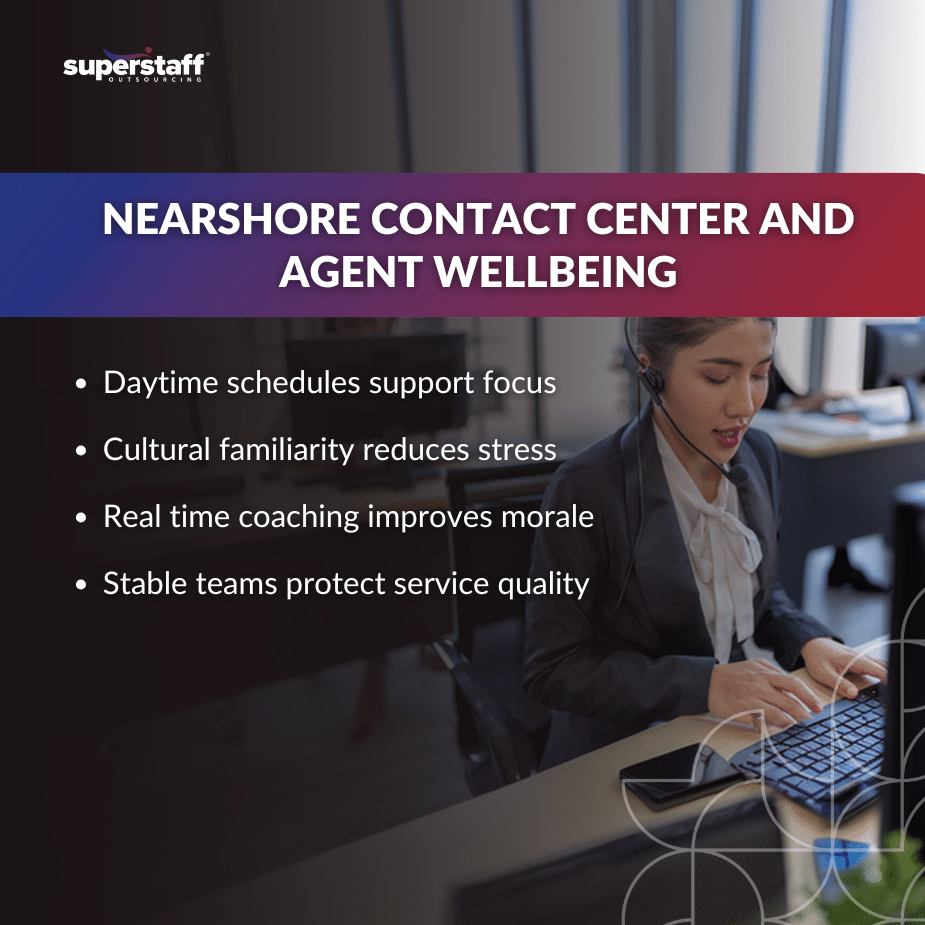
Agents who work during normal daytime hours maintain better focus and energy throughout their shifts. Sleep patterns stay consistent, which directly affects mood, patience, and concentration during customer interactions.
A nearshore contact center allows teams to serve U.S. customers without requiring employees to work overnight. This removes one of the most common and least discussed contributors to burnout. Colombia provides this alignment naturally, enabling teams to operate during business hours that match customer demand without creating unhealthy routines.
Colombia matches North American business hours
Colombia operates within U.S. time zones for most of the year. Teams work while customers are active, and supervisors can collaborate with agents in real time. This eliminates the need for graveyard scheduling and reduces the strain that irregular hours place on employees.
Attendance improves when work schedules align with normal daily life. Shift swaps decrease because employees can plan their routines with more certainty. A nearshore contact center in this region makes scheduling simpler for leaders and healthier for agents at the same time.
Cultural alignment reduces emotional strain
Agents perform better when they understand how customers communicate and what they expect during service interactions. Familiar tone, shared references, and similar communication styles reduce friction in conversations that might otherwise feel draining.
A nearshore contact center in Colombia allows agents to interact naturally with U.S. customers. Less mental effort is spent interpreting emotion or deciphering intent. More energy is directed toward solving the problem at hand.
This reduces cognitive load during every call or chat and helps agents remain calm even in difficult situations.
Lower cognitive load improves conversations
When agents do not struggle to interpret customer intent, they remain more confident and composed. Resolution becomes faster because the focus stays on the issue rather than on understanding the context. Escalations decrease, and interactions feel less stressful.
Confidence builds across the team as daily work becomes more manageable. Instead of simply trying to get through the shift, agents can concentrate on delivering quality service. This shift in experience contributes directly to higher retention and better team morale.
Sustainable schedules support long term retention
Agents are more likely to stay in roles that fit naturally into their lives. Predictable hours allow for family time, rest, and personal routines that support long term wellbeing. Work begins to feel sustainable rather than temporary.
A nearshore contact center model supports this stability. Career paths become realistic, and turnover slows as employees begin to view their roles as long term opportunities. Team knowledge deepens over time, which strengthens overall performance.
Proximity improves coaching and oversight
U.S. managers can interact with Colombian teams during the same working hours. Coaching happens in real time instead of through delayed feedback that arrives long after an issue occurs. This strengthens the connection between leadership and agents.
A nearshore contact center allows managers to be present without travel, which improves both morale and accountability. Agents feel supported because help is available when they need it, not hours later. This presence creates a more engaged and confident team.
Quality assurance becomes proactive
Real time collaboration allows supervisors to correct behaviors quickly and constructively. Coaching occurs on the same day as the issue, which helps agents learn without feeling overwhelmed by delayed criticism.
A nearshore contact center creates faster learning cycles and more consistent performance. Continuous feedback becomes part of daily work instead of a separate evaluation process. This reduces pressure while improving quality.
Customers respond to energized agents
Customers can sense when agents are alert, patient, and fully engaged in the conversation. Tone improves, listening improves, and problem solving becomes more effective when agents are not operating in a state of exhaustion.
Burnout does not only affect employees. It directly affects customer perception and loyalty. A nearshore contact center supports the energy level required for positive interactions that build trust over time.
Sustainable operations protect service continuity
Stable teams deliver consistent service because knowledge remains within the organization. Fewer disruptions occur, and leaders are not constantly focused on recruiting and training replacements.
A nearshore contact center in Colombia helps SMEs and midmarket firms build teams that last. This protects brand reputation and customer experience while reducing the operational strain caused by frequent attrition.
Operational stability reduces hidden costs
Frequent attrition creates recruiting expenses, extended training time, and temporary quality dips. These costs often go unnoticed because they are spread across departments rather than tracked as a single issue.
A nearshore contact center reduces these hidden costs by keeping teams intact. Experienced agents handle complex cases faster and require less supervision. Over time, this stability improves overall operational efficiency and service quality.
Leadership visibility strengthens engagement
When leaders can communicate with agents during shared working hours, relationships improve. Teams feel seen and heard, which strengthens commitment to their roles.
A nearshore contact center allows leadership messages, coaching sessions, and recognition programs to happen live. Engaged agents are less likely to feel overwhelmed and more likely to remain invested in their work.
Why nearshore structure supports healthier teams
Colombia addresses the root causes of agent fatigue through time zone alignment, cultural familiarity, and operational sustainability.
A nearshore contact center is not simply a geographic choice. It is a structural decision that protects people, performance, and customer experience. SuperStaff helps U.S. companies build these resilient teams in Colombia.
Contact us and explore how our nearshore solutions create healthier agents, stronger service outcomes, and long term operational stability.