U.S. SMEs and midmarket companies are operating in an environment where cost control and service performance must move together. Leaders are no longer chasing the lowest possible labor rate. They are looking for clarity, predictability, and operational leverage. This is where outsourcing cost savings become a strategic discipline rather than a procurement exercise.
The Colombia nearshore model reframes savings by aligning cost efficiency with proximity, collaboration, and execution speed. For organizations supporting U.S. customers, this model creates financial relief without introducing new operational risks.
Why Cost Reduction Alone No Longer Solves the Problem
Many early outsourcing decisions focused on wage differentials alone. That approach often ignored management burden, service inconsistency, and delayed issue resolution. Over time, those gaps quietly consumed the savings that leaders expected to realize.
Nearshore models address this challenge directly. Colombia allows companies to pursue outsourcing cost savings while maintaining operational visibility and real-time decision-making. Cost efficiency becomes sustainable because it is supported by structure, not distance.
Labor Economics That Support Efficiency at Scale
Colombia’s workforce offers strong customer service talent at compensation levels that remain favorable for U.S. companies. The advantage is not simply lower wages. It is the balance between cost and capability.
Teams reach productivity faster, which shortens the ramp period and reduces onboarding waste. This dynamic strengthens outsourcing cost savings by accelerating time to value and minimizing early-stage inefficiencies.
Time Zone Alignment Reduces Hidden Operating Costs
Nearshore alignment changes daily operations in meaningful ways. Managers can conduct live coaching sessions, respond to service spikes, and address quality issues during the same business day. Problems are resolved before they cascade.
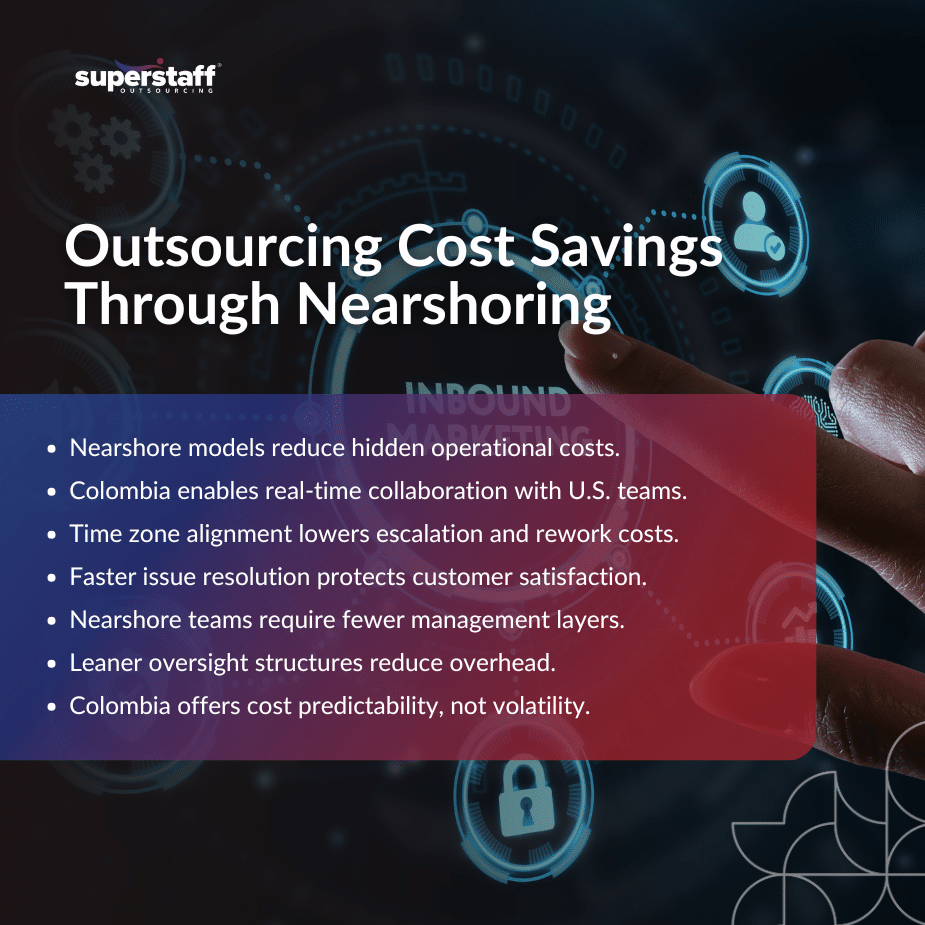
These operational efficiencies contribute directly to nearshore outsourcing cost savings. Fewer escalations and faster resolution cycles reduce the downstream costs associated with service recovery and customer dissatisfaction.
Fewer Management Layers Mean Leaner Cost Structures
Offshore operations often require additional layers of supervision to compensate for time gaps and communication delays. Nearshore teams operate with fewer intermediaries. Decisions move faster, and accountability is clearer.
This simplicity reinforces outsourcing cost savings by lowering management overhead. Leaders spend less time coordinating and more time optimizing performance outcomes.
Predictable Cost Models Support Financial Planning
Executives increasingly prioritize predictability over aggressive cost cutting. Colombia offers pricing stability that supports long-term planning. Labor markets are mature, and volatility is easier to manage.
These conditions enhance outsourcing to Colombia cost benefits by reducing budget surprises. Finance teams gain clearer forecasts, and operational leaders avoid disruptive cost swings that undermine planning confidence.
Attrition Control Protects Long-Term Savings
High attrition is one of the most overlooked cost drivers in outsourced operations. Every departure triggers recruiting, training, and productivity losses. Nearshore teams in Colombia often show stronger role continuity.
Lower turnover preserves institutional knowledge and stabilizes performance. Over time, this dynamic compounds outsourcing cost savings by reducing replacement costs and protecting service consistency.
Faster Scaling Without Cost Shock
Growth periods test whether cost structures are truly resilient. Nearshore models allow companies to scale incrementally, aligning headcount growth with actual demand. Expansion feels controlled rather than reactive.
This flexibility strengthens nearshore outsourcing cost savings. Organizations avoid overstaffing, overtime premiums, and emergency hiring cycles that inflate expenses during peak periods.
Technology Integration Without Added Friction
Modern customer support depends on shared systems, dashboards, and QA frameworks. Nearshore teams integrate smoothly into existing platforms because training and support happen in real time. Issues are identified and corrected quickly.
This operational alignment supports outsourcing cost savings by reducing implementation delays and minimizing duplicated tools or parallel workflows.
Governance That Reduces Financial Risk
Compliance and data security failures carry financial consequences that can erase years of savings. Nearshore governance structures allow closer oversight and faster intervention. Leadership remains directly engaged.
These safeguards enhance outsourcing to Colombia cost benefits by reducing exposure to fines, service disruptions, and reputational damage. Risk management becomes part of the savings equation.
Cost Savings Beyond the Contact Center
Nearshore efficiencies often extend beyond frontline roles. Quality assurance, workforce management, and reporting functions operate more smoothly when teams collaborate in overlapping hours. These support functions become more productive.
As a result, outsourcing cost savings appear across the entire service ecosystem. The organization benefits from improved coordination, not just lower labor costs.
How Decision Makers Evaluate Realistic Savings
A common executive question is how much cost savings from outsourcing to Colombia can realistically be achieved. The answer depends on scope, service complexity, and operating discipline. Savings emerge from multiple levers working together.
Leaders who view outsourcing cost savings through a total cost of ownership lens gain more durable results. The focus shifts from hourly rates to long-term operating efficiency.
When the Colombia Nearshore Model Delivers the Most Value
Colombia is particularly effective for customer-facing operations that require empathy, regulatory awareness, and real-time collaboration. Industries with dynamic demand patterns benefit from the model’s flexibility.
In these environments, outsourcing cost savings are reinforced by performance stability. The organization avoids tradeoffs between efficiency and customer experience.
Strategic Cost Control Without Cultural Distance
Cultural familiarity plays a subtle but important role in cost efficiency. Teams that understand U.S. customer expectations reduce friction and rework. Conversations resolve faster and satisfaction improves.
This alignment strengthens nearshore outsourcing cost savings by reducing repeat contacts and escalation volume. Efficiency improves organically rather than through rigid controls.
How SuperStaff Helps Companies Realize These Savings
SuperStaff approaches cost optimization as a design challenge, not a staffing exercise. We help clients structure nearshore and offshore teams that balance efficiency, quality, and scalability. Our focus is on building durable operating models.
By combining Philippine offshore expertise with nearshore options like Colombia, SuperStaff enables businesses to pursue outsourcing cost savings without compromising service integrity or growth readiness.
Outsourcing Cost Savings: Turning Cost Strategy Into a Competitive Advantage
Nearshore outsourcing changes how leaders think about financial performance. When structured correctly, outsourcing cost savings support better customer outcomes and stronger operational resilience. SuperStaff Colombia offers a practical path for companies ready to modernize their service delivery models.
If you are evaluating how outsourcing cost savings can strengthen your customer operations, explore how SuperStaff designs nearshore and offshore solutions for growing U.S. businesses. Let us help you build a cost structure that supports stability, scale, and long-term performance.