
A customer sends a message through chat. Another calls your hotline. Someone else leaves a review after a delayed delivery. Each interaction tells a story. However, without structure, these signals stay scattered and hard to act on. That is where customer satisfaction metrics become useful.
Clear data helps teams understand what customers feel. It also shows where service breaks down across channels. When used well, customer satisfaction metrics guide better decisions, improve response times, and create consistent experiences.
Service leaders who rely on data instead of guesswork often see stronger retention and higher trust. At the same time, they build systems that scale across voice, chat, email, and social platforms.
Why Customer Satisfaction Metrics Matter Across Channels
Customers do not think in channels. They expect the same level of service whether they call, chat, or send an email. Because of this, businesses need a unified view of performance.
Customer satisfaction metrics help teams:
- Track service quality in real time
- Identify weak points in specific channels
- Compare performance across touchpoints
- Align teams under one standard
Without customer satisfaction metrics, teams may rely on isolated feedback. As a result, problems repeat across channels without clear solutions.
Key Customer Satisfaction Metrics You Should Track
Not all data points are equal. Some metrics give direct insight into customer experience, while others support deeper analysis.
1. Customer Satisfaction Score (CSAT)
This metric asks customers to rate their experience after an interaction.
- Simple to collect
- Works across all channels
- Provides immediate feedback
Because of its simplicity, CSAT is one of the most used customer satisfaction metrics.
2. Net Promoter Score (NPS)
This customer satisfaction metric measures whether or not a buyer is likely to recommend your brand.
- Reflects overall loyalty
- Tracks long-term perception
- Useful for strategic decisions
Although it is broader, NPS still plays a key role in customer satisfaction metrics.
3. Customer Effort Score (CES)
Beyond directly measuring satisfaction, brands must also keep track of how easy it is for customers to resolve their issue. This essential metric:
- Focuses on friction
- Highlights process gaps
- Helps reduce repeat contacts
Low effort often leads to higher satisfaction, making CES a valuable part of customer satisfaction metrics.
4. First Response Time (FRT)
Customers value quick replies.
- Measures speed of initial response
- Impacts first impressions
- Critical for chat and social channels
FRT supports other customer satisfaction metrics by showing how quickly teams engage.
5. First Contact Resolution (FCR)
This metric tracks whether an issue is resolved in one interaction.
- Reduces customer frustration
- Improves efficiency
- Lowers operational costs
High FCR often leads to better results across all customer satisfaction metrics.
How to Apply Customer Satisfaction Metrics Across Channels
Collecting data is only the first step. The real value comes from applying insights across every channel.
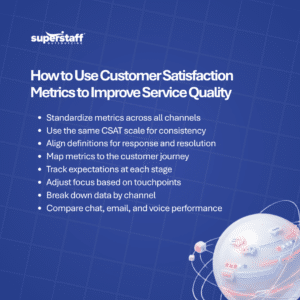
1. Standardize Measurement Across Platforms
Different channels often use different tools. However, consistency matters.
- Use the same CSAT scale across chat, email, and calls
- Align definitions of resolution and response time
- Create one reporting framework
This approach ensures customer satisfaction metrics remain comparable.
2. Map Metrics to the Customer Journey
Each stage of the journey has different expectations.
- Awareness stage: focus on response speed
- Purchase stage: focus on clarity and support
- Post-service stage: focus on resolution and follow-up
By mapping customer satisfaction metrics to each stage, teams gain better context.
3. Break Down Data by Channel
Not all channels perform the same way.
- Chat may have faster response times
- Email may show longer resolution times
- Voice calls may deliver higher satisfaction scores
Segmenting customer satisfaction metrics helps identify channel-specific gaps.
4. Use Real-Time Dashboards
Delayed data slows down action.
- Monitor live performance
- Flag sudden drops in satisfaction
- Enable quick intervention
Real-time visibility makes customer satisfaction metrics more actionable.
Turning Insights Into Service Improvements
Data without action creates no value. Once patterns appear, teams need clear steps to improve service quality.
1. Improve Training Based on Feedback
Customer comments often highlight skill gaps.
- Communication clarity
- Product knowledge
- Problem-solving ability
Using customer satisfaction metrics, managers can design targeted training.
2. Adjust Staffing Across Channels
High wait times often signal staffing issues.
- Increase agents during peak hours
- Reassign teams based on demand
- Balance workloads across channels
This ensures better performance across all customer satisfaction metrics.
3. Refine Processes and Workflows
Repeated complaints usually point to process issues.
- Simplify escalation paths
- Reduce transfer rates
- Improve internal coordination
Process improvements often lead to strong gains in customer satisfaction metrics.
4. Personalize Customer Interactions
Customers expect tailored support.
- Use customer history
- Recognize repeat issues
- Offer proactive solutions
Personalization strengthens outcomes across multiple customer satisfaction metrics.
Common Mistakes to Avoid
Even strong teams can misuse data. Avoid these common pitfalls when working with customer satisfaction metrics.
- Tracking too many metrics without focus
- Ignoring qualitative feedback from customers
- Failing to act on insights
- Treating channels separately instead of as one system
A clear strategy keeps customer satisfaction metrics useful and aligned with business goals.
Building a Culture Around Customer Satisfaction Metrics
Sustainable improvement requires more than tools. It needs a culture that values customer feedback.
Key practices include:
- Sharing performance data with teams regularly
- Recognizing agents who deliver high satisfaction
- Setting clear targets for each metric
- Encouraging accountability across departments
When teams understand the importance of customer satisfaction metrics, they become more engaged and proactive.
Aligning Customer Satisfaction Metrics With Business Goals
Service quality should support broader objectives.
- Higher satisfaction leads to better retention
- Faster resolution reduces costs
- Strong service builds brand reputation
By linking customer satisfaction metrics to outcomes, leaders can justify investments in training, tools, and staffing.
Turn Customer Feedback Into Action With the Right Partner
Customer expectations continue to evolve across channels. Businesses that rely on structured data are better prepared to respond. Customer satisfaction metrics provide the clarity needed to improve service quality, align teams, and deliver consistent experiences.
At the same time, managing multiple channels requires expertise and resources. That is where SuperStaff can help. Our teams specialize in tracking and improving customer satisfaction metrics across voice, chat, email, and social platforms.
If you want to strengthen service quality and create a better customer experience, now is the time to act. Partner with SuperStaff and build a support system that listens, responds, and improves with every interaction. Contact us today to learn how we can support your growth.