
Global hiring strategies are under pressure. Customer expectations are higher. Markets are more fragmented. Communication gaps now carry real revenue risk. For U.S. companies serving diverse customers, language capability has moved from a nice-to-have to a core operational requirement.
That shift explains why nearshore recruiting has gained traction among SMEs and midmarket firms. Leaders are no longer looking only at cost or time zone alignment. They are prioritizing teams that can communicate clearly, adapt quickly, and support customers across languages without friction.
Bilingual capability sits at the center of that conversation.
Why language fluency now shapes customer experience outcomes
Customer service failures rarely start with poor intent. They start with misunderstanding. Accents, phrasing, tone, and cultural context all affect how messages land. When customers need to repeat themselves or feel misunderstood, trust erodes fast.
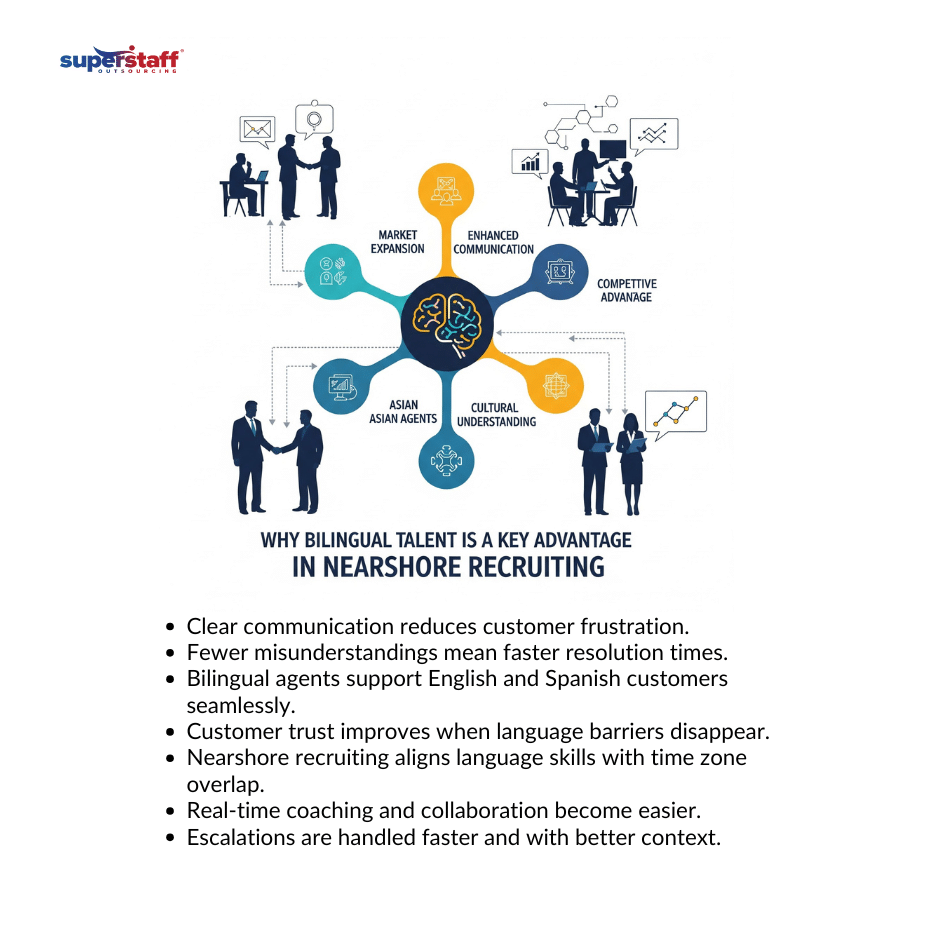
Bilingual teams reduce that risk. They shorten resolution time. They improve clarity across channels. They help brands sound consistent whether the customer speaks English, Spanish, or both.
For U.S. companies expanding into Hispanic markets or supporting multilingual customers at home, this is no longer optional. Nearshore recruiting allows businesses to build language capability into operations without overcomplicating structure.
Nearshore recruiting aligns language and geography
Nearshore locations offer a unique advantage. Language fluency often exists alongside cultural familiarity and time zone overlap. That combination improves collaboration between offshore teams and U.S. stakeholders.
In nearshore recruiting models, bilingual agents operate during overlapping business hours. Managers can coach in real time. Quality assurance happens faster. Escalations feel controlled instead of reactive.
This alignment is harder to achieve with far-off offshore models. Nearshore recruiting brings language and logistics into the same strategic frame.
Bilingual talent supports more than customer calls
Language skills extend beyond phone support. Bilingual teams strengthen chat, email, social, and back-office coordination. They reduce translation errors. They improve internal handoffs between departments.
Companies using bilingual talent hiring strategies often see better outcomes in onboarding, retention, and training. Agents feel confident. Supervisors spend less time correcting misunderstandings. Processes stabilize sooner.
Nearshore recruiting supports this by sourcing talent from regions where bilingualism is part of the education system and professional culture.
Why bilingual hiring changes operational risk profiles
Operational risk increases when communication fails. Compliance issues. Missed service levels. Brand damage. These risks compound when language barriers exist.
Bilingual talent hiring reduces exposure across regulated and customer-facing industries. Healthcare, logistics, financial services, and e-commerce all benefit from clearer communication.
Nearshore staffing solutions that integrate bilingual capability help organizations manage risk proactively. Instead of fixing issues after escalation, teams prevent them at the interaction level.
That shift matters to leaders accountable for outcomes, not activity.
Nearshore recruiting improves scalability without dilution
Growth creates pressure. Seasonal demand. Market expansion. New product lines. Scaling customer support quickly often leads to compromised quality.
Nearshore recruiting offers a controlled way to scale. Bilingual pipelines allow teams to expand without retraining existing agents to cover language gaps. Capacity grows without sacrificing consistency.
This approach also supports flexible workforce planning. Companies can deploy bilingual agents across multiple queues or regions as demand shifts.
Nearshore recruiting enables scale that stays aligned with brand standards.
Cultural fluency strengthens bilingual performance
Language fluency alone is not enough. Cultural context matters. Humor, urgency, empathy, and formality vary across markets.
Nearshore recruiting often delivers both. Agents understand U.S. business norms while speaking the customer’s language naturally. They navigate tone and expectations with fewer missteps.
This cultural fluency improves first-call resolution. It also reduces friction between offshore teams and U.S. managers, creating smoother internal operations.
The role of nearshore staffing solutions in workforce design
Strategic leaders view workforce design as a competitive lever. The goal is not to fill seats. It is to build capability.
Nearshore staffing solutions support this mindset. They allow companies to define language requirements upfront. They embed bilingual performance metrics into hiring and training. They align staffing plans with customer demographics.
Organizations that adopt nearshore staffing solutions that prioritize bilingual workforce planning gain flexibility. They respond faster to market changes. They enter new regions with confidence.
This approach reframes outsourcing as an operational extension, not a vendor transaction.
Why nearshore recruiting outperforms ad hoc bilingual hiring
Some companies attempt bilingual hiring internally. They rely on limited local talent pools. They stretch HR teams. Results are inconsistent.
Nearshore recruiting centralizes the process. Talent sourcing, language assessment, onboarding, and quality control happen within a unified system. Performance standards remain consistent across teams.
This structure reduces variance. It also frees internal leaders to focus on strategy rather than staffing logistics.
For midmarket firms without global HR infrastructure, this model delivers enterprise-level capability without added complexity.
Bilingual talent as a driver of retention and engagement
Agents who use both languages daily tend to feel more valued. Their skills are recognized. Career paths are clearer. Engagement improves.
Nearshore recruiting supports retention by placing bilingual professionals in roles that match their strengths. Training reinforces confidence rather than patching gaps.
Lower attrition stabilizes service delivery. Knowledge stays within the team. Customer relationships deepen over time.
Decision-makers are rethinking nearshore recruiting priorities
Cost still matters. Time zone alignment still matters. Language capability now sits alongside them as a strategic priority.
Executives evaluating nearshore recruiting options increasingly ask deeper questions. How is bilingual proficiency assessed? How is it maintained? How does it integrate with quality assurance?
Nearshore staffing solutions that answer these questions clearly stand out. They position language as infrastructure, not an add-on.
How SuperStaff approaches bilingual nearshore recruiting
At SuperStaff, bilingual capability is designed into our delivery model. We recruit, train, and support teams that communicate clearly across languages and cultures.
Our nearshore recruiting framework emphasizes readiness, not volume. Agents are prepared to handle real customer scenarios from day one. Managers work in sync with U.S. stakeholders.
We focus on nearshore staffing solutions that prioritize bilingual workforce alignment with business goals. That includes performance tracking, coaching, and continuous improvement.
Looking ahead
Global hiring strategies will continue to evolve. Language will remain central to customer trust, operational efficiency, and brand consistency.
Companies that treat bilingual talent as a strategic asset will outperform those that treat it as a staffing checkbox. Nearshore recruiting provides the structure to make that shift sustainable.
As markets diversify, the ability to communicate clearly becomes a differentiator.
Partner With SuperStaff Colombia for Quality Nearshore Recruiting
Nearshore recruiting has moved beyond proximity and cost considerations. Language capability now defines its true value. Bilingual teams reduce risk, improve customer experience, and support scalable growth when designed intentionally.
SuperStaff helps U.S. companies build bilingual nearshore teams that align with operational goals and customer expectations.
If your organization is ready to strengthen service quality while expanding reach, explore how SuperStaff’s nearshore staffing solutions can support your next phase of growth.