
Global expansion creates pressure on customer support teams. New markets bring new languages, time zones, and service expectations. Many SMEs and midmarket firms underestimate how quickly this complexity compounds.
A reliable customer support agency helps manage that growth with structure and discipline. Nearshore teams in Colombia are increasingly central to this strategy. They provide multilingual coverage while staying aligned with U.S. business priorities.
This shift is not about scale alone. It is about maintaining consistency as customer conversations multiply across regions.
Why Multilingual Support Is Now a Core Growth Requirement
Growth beyond a single market is no longer optional for many companies. Digital distribution removes geographic barriers. Customer expectations rise as soon as brands cross borders.
Language access becomes a first test of credibility. Customers expect support in their native language. They expect clarity, accuracy, and speed.
Without a coordinated approach, companies fragment their service model. Internal teams stretch thin. Quality becomes uneven.
A nearshore customer support agency built for multilingual delivery prevents that drift. It creates a unified operating model that supports expansion without sacrificing control.
Colombia’s Role in Nearshore Multilingual Coverage
Colombia has emerged as a strong nearshore location for multilingual customer service. Talent availability continues to improve. English and Spanish fluency is common. Additional European language skills are increasingly accessible.
Time zone alignment matters. Colombian teams operate within overlapping U.S. business hours. This simplifies coordination. It reduces delays in escalations and approvals.
Cultural alignment also plays a role. Colombian professionals adapt well to U.S. communication styles. This consistency supports smoother customer interactions across regions.
A customer support agency operating in Colombia can extend coverage without creating operational distance.
Designing Multilingual Support Without Fragmentation
Multilingual growth fails when each language operates in isolation. Separate tools. Separate rules. Separate performance standards.
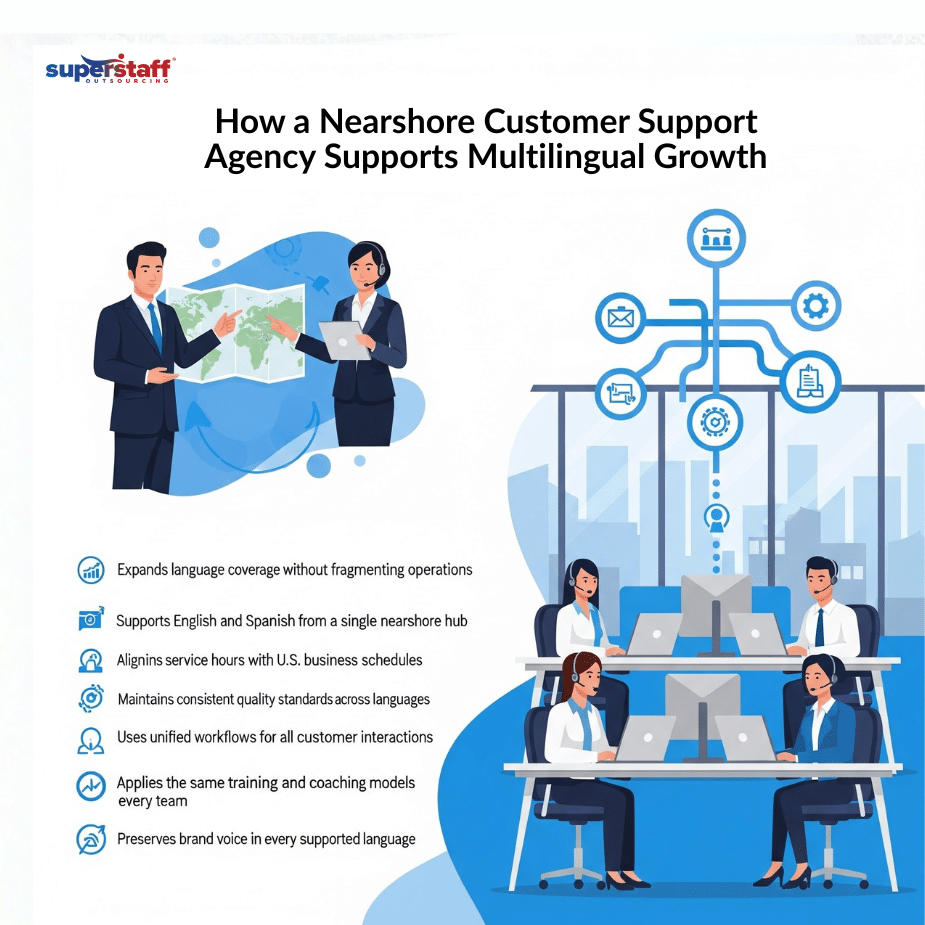
Strong agencies avoid this trap by building a single operating framework. Language becomes a layer, not a silo.
Key design principles include:
- Unified quality standards across all languages
- Centralized training with localized adaptations
- Shared reporting and performance dashboards
- Clear escalation paths regardless of language
A customer support agency that follows this structure keeps leadership visibility intact. Decision-makers see performance as a whole, not as disconnected segments.
Maintaining Brand Consistency Across Languages
Language translation alone does not preserve brand voice. Tone, phrasing, and intent matter. This becomes harder as teams scale.
With multilingual customer support services, teams require more than language skills. They need context. They need product knowledge. They need clarity on brand positioning.
Effective agencies invest heavily in onboarding. They translate style guides, not just scripts. They align agents with business goals, not just call flows.
A customer support agency that prioritizes brand alignment protects customer trust in every market.
Supporting Complex Use Cases Beyond Basic Inquiries
As companies grow globally, customer issues become more complex. Billing questions vary by region. Regulatory considerations differ. Product configurations change.
Multilingual support must handle these nuances. That requires structured knowledge management and cross-team collaboration.
Nearshore teams in Colombia can support this complexity when given the right tools and authority. They handle tiered support models. They collaborate with U.S.-based stakeholders in real time.
A customer support agency designed for growth anticipates complexity rather than reacting to it.
Scaling Without Losing Operational Control
Rapid growth often forces rushed hiring decisions. Quality suffers. Managers lose visibility.
Agencies mitigate this risk by scaling in measured phases. Capacity planning aligns with forecasted demand. Training pipelines stay ahead of volume increases.
Operational control remains centralized. Performance metrics remain consistent. Leadership retains confidence in outcomes.
A customer support agency that scales responsibly enables growth without chaos.
Integrating Multilingual Support With Broader CX Strategy
Customer support does not operate in isolation. It connects to sales, retention, and product feedback.
Multilingual teams generate valuable insight. Patterns emerge across regions. Common friction points become visible.
Agencies that capture and share these insights add strategic value. They inform product adjustments. They guide localization decisions. They support revenue teams.
A customer support agency that integrates with broader CX strategy becomes a long-term partner, not a transactional vendor.
Managing Risk and Compliance Across Regions
Global support introduces risk. Data privacy expectations differ. Regulatory environments vary.
Agencies must operate with discipline. Security protocols remain consistent. Compliance training is standardized.
Nearshore operations benefit from proximity. Audits and governance processes remain manageable. Communication gaps shrink.
A customer support agency that treats compliance as foundational protects both customers and brand reputation.
Why Nearshore Multilingual Models Outperform Fragmented Global Setups
Many companies attempt to piece together global coverage through multiple vendors. One region here. Another there. The result is fragmentation.
Nearshore multilingual models consolidate capability. Fewer handoffs. Fewer points of failure. Stronger accountability.
Colombia plays a central role in this approach. It bridges language needs while staying operationally close to U.S. teams.
A customer support agency built on this model delivers stability as companies expand.
Choosing the Right Partner for Multilingual Growth
Not all agencies are built to support multilingual expansion at scale. Many can add languages. Fewer can manage complexity without creating operational risk. Leadership teams should evaluate partners based on how work is structured, governed, and measured.
A strong partner demonstrates discipline before growth accelerates. Processes are defined. Accountability is clear. Performance expectations are consistent across languages and regions.
Key evaluation criteria include:
- Experience supporting multilingual programs at scale
The agency should show a clear operating history with multiple languages running in parallel. This includes handling varying volumes, peak demand, and region-specific customer needs without service disruption. - Clear governance and reporting models
Decision-makers need visibility across all languages. Reporting should roll up into a single view of performance, with the ability to drill down by region, channel, or issue type when needed. - Strong training and quality assurance frameworks
Multilingual agents require more than language proficiency. Training must cover products, policies, tone, and escalation standards. Quality assurance should apply the same benchmarks across all languages. - Proven nearshore operations in Colombia
Operational maturity matters. Established teams in Colombia indicate stable talent pipelines, experienced local leadership, and reliable infrastructure that supports long-term growth.
A customer support agency that meets these standards allows companies to expand confidently. Growth remains intentional. Service quality stays consistent. Leadership retains control as customer reach widens.
Moving Forward With Confidence: Partner With SuperStaff’s Customer Support Agency in Colombia Today
Global expansion tests operational discipline. Customer support often feels the pressure first.
Nearshore multilingual teams offer a practical solution. They combine language capability, time zone alignment, and operational control.
SuperStaff works with U.S. SMEs and midmarket companies to build scalable, multilingual support programs anchored in Colombia and the Philippines. Our teams operate within structured frameworks that support growth without compromise.
If your organization is evaluating how a customer support agency can support multilingual expansion, now is the time to explore a more strategic model.
Are you searching for the best nearshore customer support agency in Colombia? Connect with SuperStaff to see how nearshore teams can support your next stage of growth.