
Customer expectations have shifted. Fast replies are now a baseline requirement, not a bonus. Many companies exploring nearshore customer support services are doing so because internal teams can no longer keep up with real-time demand.
Delayed responses impact more than customer satisfaction. They affect retention, reviews, and long-term revenue. Leaders who address this early often gain a measurable advantage in customer experience maturity.
Why Response Speed Now Defines Customer Experience
Customers expect immediate answers across channels. Email delays and long hold times create friction. Even loyal buyers reconsider brands that fail to respond quickly.
Speed also shapes perception. A fast reply signals competence and reliability. A delayed response suggests operational gaps. Customers rarely separate support speed from overall brand trust.
Slow support creates cascading issues:
- Higher ticket backlogs
- Burnout among internal teams
- Increased escalation rates
- Lower CSAT and NPS
These challenges compound quickly. Companies that address response time early prevent downstream operational strain and protect long-term brand equity.
The Operational Cost of Slow Support
Many organizations underestimate how expensive slow support becomes. Missed messages often translate into missed opportunities. Sales inquiries, renewal requests, and service issues all compete for attention.
Delayed handling impacts productivity as well. Teams spend more time catching up than improving workflows. This reactive cycle limits innovation and prevents service optimization.
Leaders often discover a hidden cost. When response times slip, internal stakeholders lose confidence in support operations. This erodes alignment across departments and slows decision-making.
Executives evaluating support performance frequently realize that internal scaling alone cannot solve the problem sustainably.
Why Scaling Locally Isn’t Always the Answer
Hiring locally can be slow and expensive. Labor shortages and rising wages make rapid scaling difficult. Even well-funded companies struggle to build large support teams quickly.
Training introduces another challenge. New hires require ramp-up time and ongoing supervision. Managers must divide attention between coaching and daily operations.
Scheduling adds complexity. Providing coverage across nights and weekends strains morale. Leaders often face difficult trade-offs between service speed and employee well-being.
These constraints push many companies to evaluate nearshore customer support services as a more sustainable path to responsiveness.
The Nearshore Advantage for Faster Response Times
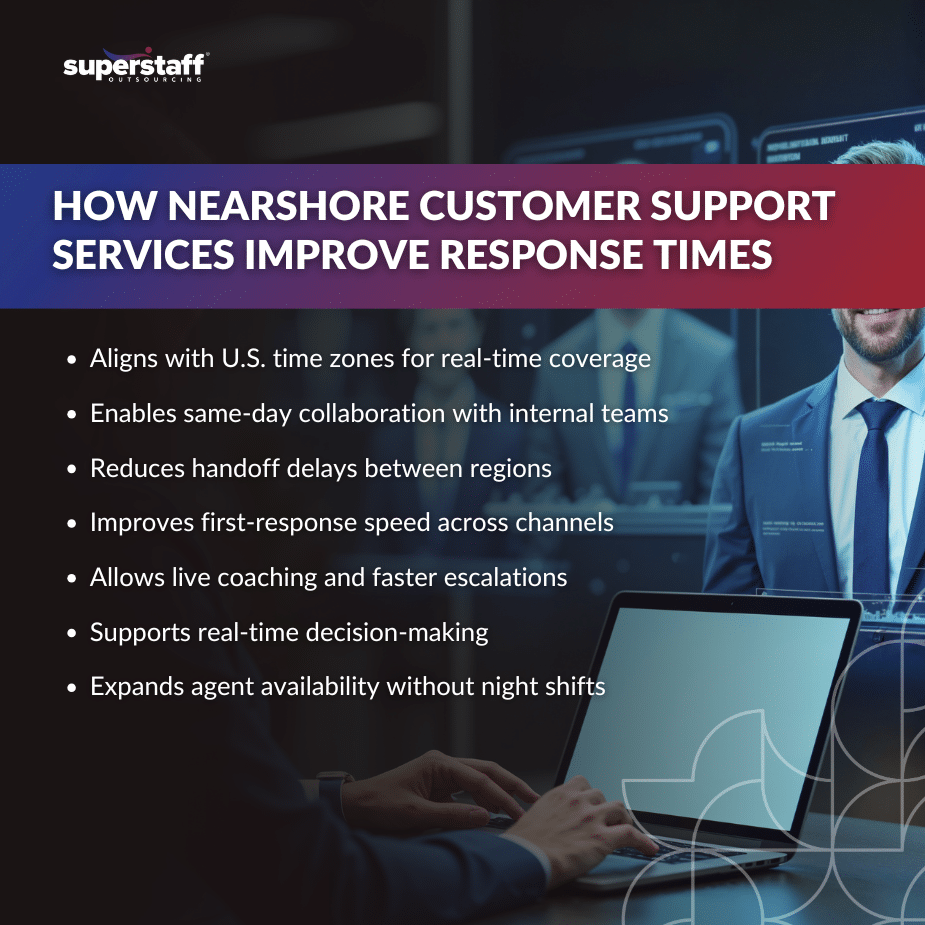
Nearshore support introduces time zone alignment. Teams operating closer to U.S. hours provide real-time coverage without overnight strain. This alignment improves responsiveness immediately.
Organizations leveraging nearshore customer support services often benefit from:
- Shorter first-response times
- Faster ticket resolution
- Improved agent availability
- Better coordination with U.S. teams
Operational simplicity becomes a major advantage. Leaders gain coverage without restructuring internal schedules or expanding office footprints.
Speed improvements are often noticeable within weeks. Customers feel the difference quickly, especially in high-volume channels like chat and email.
Real-Time Collaboration Improves Outcomes
Support quality improves when collaboration is seamless. Shared working hours enable faster decision-making. Supervisors and stakeholders can communicate without long delays.
Nearshore customer support services allow daily stand-ups and live coaching. Issues can be escalated and resolved within the same business day. This rhythm supports consistent service delivery.
Real-time collaboration strengthens cross-functional execution. Product teams can clarify features instantly. Operations leaders can adjust workflows without lag. This alignment supports better customer outcomes.
Faster feedback loops also support continuous improvement. Support teams refine scripts, update knowledge bases, and improve workflows in real time.
Cultural Compatibility Supports Customer Trust
Communication clarity matters as much as speed. Customers respond better when interactions feel natural and professional. Cultural alignment helps reduce misunderstandings and improves satisfaction.
Nearshore agents often bring strong English proficiency and familiarity with Western service expectations. This translates into smoother interactions and fewer escalations.
Many companies find that nearshore customer support services provide a balanced mix of cost efficiency and communication quality. Customers feel understood, and brands maintain consistency across markets.
Trust builds faster when conversations flow naturally. Over time, this strengthens loyalty and increases customer lifetime value.
Scaling Support Without Sacrificing Quality
Growth introduces unpredictable demand. Seasonal spikes, product launches, and promotions all increase ticket volume. Internal teams often struggle to scale at the same pace.
Nearshore models provide flexibility. Businesses can expand or contract support capacity based on demand. This elasticity supports sustainable growth.
Leaders adopting nearshore customer support services gain the ability to scale confidently without constant hiring cycles. Instead of reactive recruitment, companies move toward planned capacity management.
Scalability also supports experimentation. Businesses can test new channels or markets without committing to permanent headcount increases.
Improving Agent Performance Through Focus
When response times improve, agents perform better overall. Reduced backlog allows teams to focus on quality interactions. This improves both customer sentiment and employee engagement.
Nearshore environments often provide structured training and quality assurance programs. Dedicated teams focus exclusively on support excellence. This specialization drives consistent performance improvements.
Companies leveraging nearshore customer support services often notice stronger agent retention. Stable teams deliver more consistent service and develop deeper product familiarity over time.
Focused support environments also encourage specialization. Agents can develop expertise in specific channels or customer segments, further improving resolution quality.
Supporting Omnichannel Expectations
Modern customers interact across multiple channels. Chat, email, voice, and social media all require attention. Managing these simultaneously is challenging for small internal teams.
Nearshore teams provide dedicated channel coverage. This ensures faster responses across platforms without overwhelming in-house staff.
Organizations implementing nearshore customer support services maintain consistency across touchpoints. Customers receive timely replies regardless of channel, reinforcing a cohesive brand experience.
Omnichannel readiness also prepares companies for future growth. As communication preferences evolve, businesses already have the infrastructure to adapt.
A Strategic Approach to Global Support
Nearshore support works best as part of a broader strategy. Some companies blend nearshore and offshore models. Others use nearshore teams as a stepping stone toward global support maturity.
This layered approach strengthens resilience. If demand shifts, companies maintain continuity across regions. Leaders gain flexibility without compromising responsiveness.
Businesses evaluating nearshore customer support services often view it as a foundational step toward scalable global operations. The model creates operational stability while preserving growth optionality.
Strategic leaders treat support geography as a portfolio decision. The right mix of locations improves both cost efficiency and customer experience.
Why Colombia Strengthens Nearshore Strategies
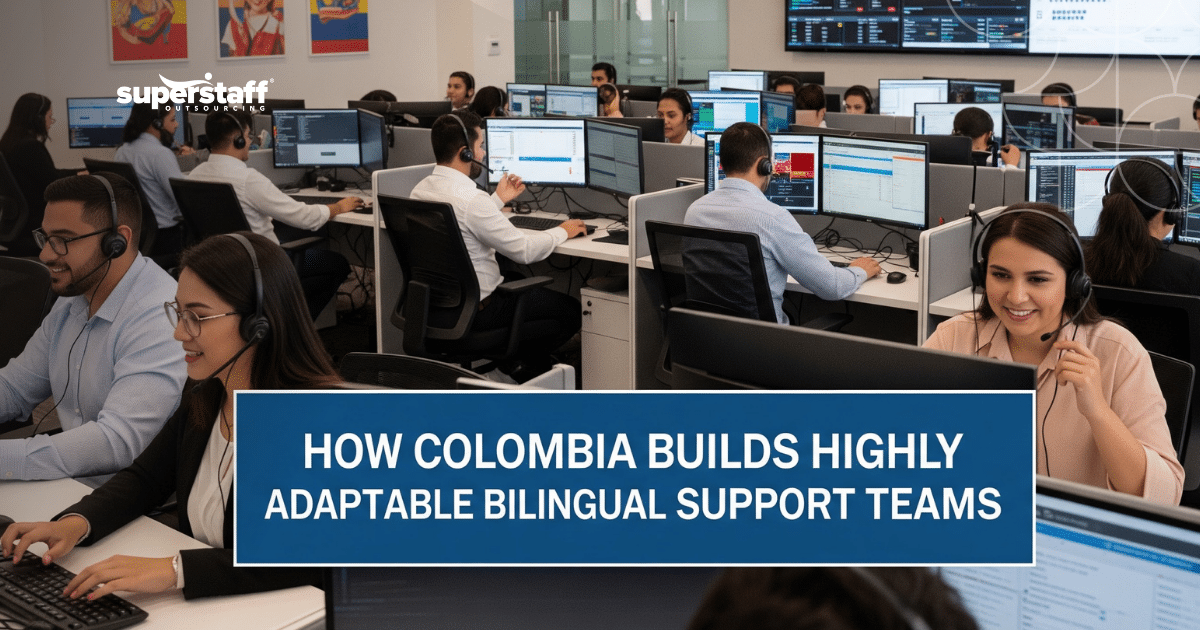
Colombia has emerged as a leading nearshore destination for U.S. companies seeking faster support delivery. Its geographic proximity enables real-time collaboration while maintaining strong service quality. Many organizations turn to Colombia to balance responsiveness with operational efficiency.
Colombian teams offer time zone alignment that mirrors North American business hours. This enables same-day collaboration, faster escalations, and smoother coordination with internal stakeholders. Companies implementing nearshore customer support services often benefit from this level of accessibility.
The country also brings strong bilingual talent and growing CX expertise. English and Spanish fluency allow brands to serve broader customer segments without adding complexity. This makes Colombia especially valuable for companies expanding into multicultural markets.
SuperStaff helps organizations build nearshore strategies anchored in Colombia’s strengths. This includes structured onboarding, performance management, and scalable team design. The result is a nearshore model that improves responsiveness while maintaining service consistency.
Making the Transition Smooth
Transitioning support models requires careful planning. Knowledge transfer, onboarding, and workflow alignment must be structured. Strong partners simplify this process.
Effective providers offer:
- Dedicated onboarding frameworks
- Transition management support
- Continuous QA and coaching
- Transparent reporting
These elements ensure continuity while improving response metrics. Companies that partner strategically experience smoother adoption and faster ROI.
Clear governance structures also matter. Defined KPIs and communication cadences help maintain alignment between internal and external teams.
Leadership Considerations Before Making the Shift
Executives evaluating support models should look beyond cost. Response speed, scalability, and operational resilience matter more over time. A strategic lens helps leaders avoid short-term decisions that limit long-term growth.
Important considerations include:
- Customer experience priorities
- Growth trajectory and seasonality
- Internal bandwidth for support management
- Long-term globalization plans
Nearshore models often perform well when companies seek faster responsiveness without losing collaboration proximity.
Leaders who treat support as a strategic function rather than a tactical expense tend to realize stronger outcomes.
Partner With SuperStaff Colombia for Nearshore Customer Support Services
Slow response times signal a deeper operational challenge. Companies that address this early position themselves for stronger customer loyalty and sustained growth. Nearshore customer support services offer a practical path toward faster, more responsive support models.
SuperStaff works with growing businesses to design tailored support strategies that balance responsiveness, scalability, and cost control. If you’re exploring ways to improve service speed without overwhelming your internal team, consider how nearshore customer support services can strengthen your customer experience strategy. Connect with SuperStaff to explore support models built for today’s response-driven market.