
Growth exposes weaknesses fast. Systems strain. Teams stretch. Customer expectations rise faster than internal capacity. Many companies respond by hiring quickly or layering short-term fixes that solve today’s problem but create tomorrow’s complexity.
A well-designed nearshore strategy offers a different path. It supports scale without forcing constant trade-offs between speed, quality, and control. When built intentionally, nearshoring becomes part of the company’s long-term operating model, not a temporary solution to labor pressure.
This article outlines how leaders can design and execute a nearshore approach that supports durable, predictable growth.
Anchor the Nearshore Strategy to Business Objectives
Nearshoring fails when it is treated as an isolated staffing decision. It succeeds when it is anchored to clear business objectives.
Leadership teams should first define what growth means operationally. Higher transaction volume. Extended service hours. Improved customer experience. Greater cost predictability. These goals determine which functions are best suited for nearshore support.
A nearshore strategy aligned with business objectives ensures that offshore capacity strengthens core operations instead of operating in parallel. Alignment reduces rework and creates clarity across teams.
Choose Functions Based on Stability and Repeatability
Not every function benefits equally from nearshoring. The strongest candidates share common traits.
They are process-driven. They have clear inputs and outputs. They follow consistent rules. Customer support, account services, billing, scheduling, and administrative workflows often meet these criteria.
A focused nearshore strategy concentrates on roles where standardization improves outcomes. This focus allows teams to scale without introducing unnecessary variability into critical operations.
Design the Operating Model Before Hiring
Hiring before designing the operating model creates inefficiencies that compound over time. Teams inherit unclear expectations and inconsistent workflows.
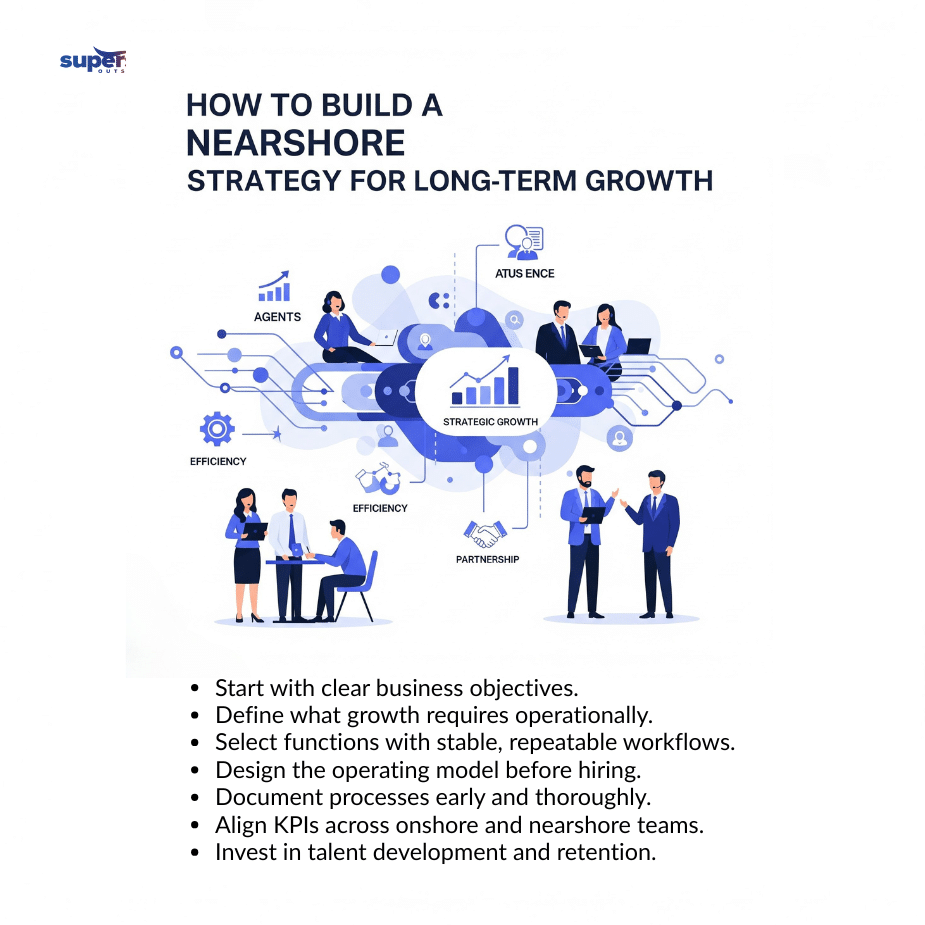
A mature nearshore strategy defines roles, responsibilities, and success metrics before onboarding begins. Leaders document processes. They clarify decision rights. They establish escalation paths.
This upfront design work reduces friction later. Teams understand how they fit into the broader organization from day one.
Integrate Nearshore Teams Into Daily Operations
Separation creates risk. Isolation leads to misalignment. A nearshore BPO provider performs best when their teams are embedded into how work actually gets done each day.
Integration starts with visibility. Nearshore teams need access to the same information as onshore teams. Roadmaps. Performance dashboards. Process updates. When teams see the full picture, they make better decisions in real time.
A strong nearshore strategy includes shared meetings that matter. Not status calls. Real working sessions. Daily huddles. Weekly planning. Monthly performance reviews. These touchpoints keep priorities aligned as conditions change.
Planning, Communication, and Performance
KPIs must also be consistent. Nearshore teams should be measured against the same standards as internal teams. Quality benchmarks. Response times. Customer outcomes. Alignment reinforces accountability and removes the perception of separate performance tiers.
Communication rhythms matter more than communication volume. Clear escalation paths. Defined owners. Agreed response windows. These structures reduce delays and prevent small issues from becoming operational bottlenecks.
Nearshore teams should also be included in planning discussions. Forecast reviews. Process changes. Policy updates. Participation builds context and reduces downstream confusion during execution.
Integration strengthens trust over time. Teams feel ownership, not detachment. Decision cycles shorten. Rework declines. The organization moves faster because fewer handoffs require explanation or correction.
When nearshore teams operate as part of the daily rhythm, the model becomes resilient. Scale feels controlled. Growth feels intentional. Operations stay aligned as complexity increases.
Build Knowledge Transfer Into the Timeline
Knowledge transfer is not a single event. It is a process that unfolds over time.
Strong nearshore strategy execution includes structured onboarding, shadowing periods, and documented playbooks. Knowledge is reinforced through repetition and feedback, not one-time training sessions.
This approach reduces dependency on individual contributors and protects operations against turnover or growth-related disruptions.
Establish Governance Without Overhead
Governance provides clarity when it is designed intentionally. It becomes a burden when it is reactive.
A sustainable nearshore strategy defines governance early. Reporting structures. Review cadences. Performance thresholds. These elements help leaders monitor outcomes without micromanaging.
Governance should support decision-making, not slow it down. When designed well, it creates confidence on both sides of the partnership.
Invest in Process Consistency
Process inconsistency limits scalability. Nearshoring exposes this quickly.
Companies with a strong nearshore strategy invest in process mapping and standard operating procedures. They define how work flows, where checks occur, and how exceptions are handled.
Consistency allows teams to maintain quality as volume increases. It also simplifies training and performance management as operations grow.
Align Talent Development With Growth Plans
Short-term hiring decisions can undermine long-term performance. Nearshore teams need growth paths, not just task lists.
A forward-looking nearshore strategy includes role progression, skill development, and cross-training. These investments improve retention and create internal capacity for future needs.
Stable teams preserve institutional knowledge. That stability becomes a competitive advantage over time.
Use Time Zone Alignment as an Operating Advantage
Time zone alignment is crucial to remote team communication strategies because it enables faster collaboration when used intentionally. It does not create value on its own.
A practical nearshore strategy schedules overlapping hours for real-time problem-solving, coaching, and quality reviews. Leaders use this overlap to shorten feedback loops and improve responsiveness.
This alignment reduces delays and improves coordination without extending workdays or creating burnout.
Measure Performance Beyond Volume
Volume metrics tell only part of the story. Sustainable growth requires deeper insight.
An effective nearshore strategy tracks quality, consistency, and operational impact alongside output. Leaders review accuracy rates, resolution times, and customer satisfaction trends.
Balanced measurement supports continuous improvement. It also ensures that growth does not come at the expense of service quality.
Expand Capacity in Controlled Phases
Rapid expansion creates instability. Phased growth preserves control.
A disciplined nearshore strategy scales in stages. Each phase includes evaluation checkpoints and operational adjustments. Teams stabilize before additional capacity is added.
This measured approach reduces risk and allows leaders to course-correct early.
Strengthen the Partnership Over Time
Nearshoring works best as a partnership, not a transaction. Long-term value depends on collaboration and transparency.
A resilient nearshore strategy includes regular reviews, shared planning, and open communication. Challenges are addressed early. Opportunities are explored jointly.
Strong partnerships adapt as the business evolves, supporting growth through changing conditions.
Build Flexibility Into the Model
Markets change. Demand shifts. Regulations evolve. Nearshore operations must be able to adjust without disruption.
A future-ready nearshore strategy includes flexible staffing models, adaptable processes, and continuous training. Teams are prepared for variation, not just steady workloads.
Flexibility ensures that growth remains sustainable even as external conditions change.
Executing a Nearshore Strategy for Long-Term Growth
Long-term growth demands more than added capacity. It requires an operating model designed for consistency, resilience, and control. A well-executed nearshore strategy provides that foundation when it is aligned with business goals and supported by disciplined execution.
SuperStaff works with SMEs and midmarket companies to design nearshore operations that integrate seamlessly with U.S.-based teams. Our approach emphasizes process clarity, talent stability, and scalable performance.
If you need guidance with executing a nearshore outsourcing plan for sustainable business growth, get in touch with our team and explore how we can help you create operations built to last.