
Healthcare leaders across the United States are under pressure to maintain service quality while managing rising administrative demands. Staffing gaps, compliance requirements, and patient access challenges are now daily operational concerns.
As a result, many organizations are reassessing how and where support work gets done. For many, the decision to outsource healthcare solutions is no longer tactical. It is structural.
Colombian BPO teams have emerged as a reliable option for healthcare organizations that need operational continuity without sacrificing control or quality. The value extends beyond cost considerations. It reflects how healthcare delivery itself is evolving.
Below are five strategic reasons U.S. providers are making this shift.
Colombia Aligns Naturally With U.S. Healthcare Operations
Time zone compatibility matters more than many organizations expect. Colombian teams operate within one to two hours of U.S. business hours. This alignment supports real-time collaboration across scheduling, patient coordination, and claims processing workflows.
That proximity enables faster handoffs. It also reduces communication friction between onshore teams and offshore staff. When providers outsource healthcare solutions to Colombia, operational decisions can still happen during the U.S. workday.
As a result, healthcare leaders retain visibility. They also preserve responsiveness across patient-facing and administrative functions.
Clinical Administration Requires Precision, Not Volume
Healthcare work is detail-intensive. Small errors in documentation or scheduling can have cascading effects across patient experience and revenue cycles. Colombian BPO teams are well suited for these environments because they emphasize structured processes and accuracy-driven execution.
Many providers rely on Colombian teams for intake coordination, eligibility checks, appointment confirmations, and post-visit follow-ups. These tasks demand consistency, not improvisation. They also require familiarity with U.S. healthcare workflows.
This is where healthcare support solutions delivered from Colombia perform well. Teams are trained to operate within defined protocols while adapting to client-specific systems.

Bilingual Capability Improves Patient Access and Experience
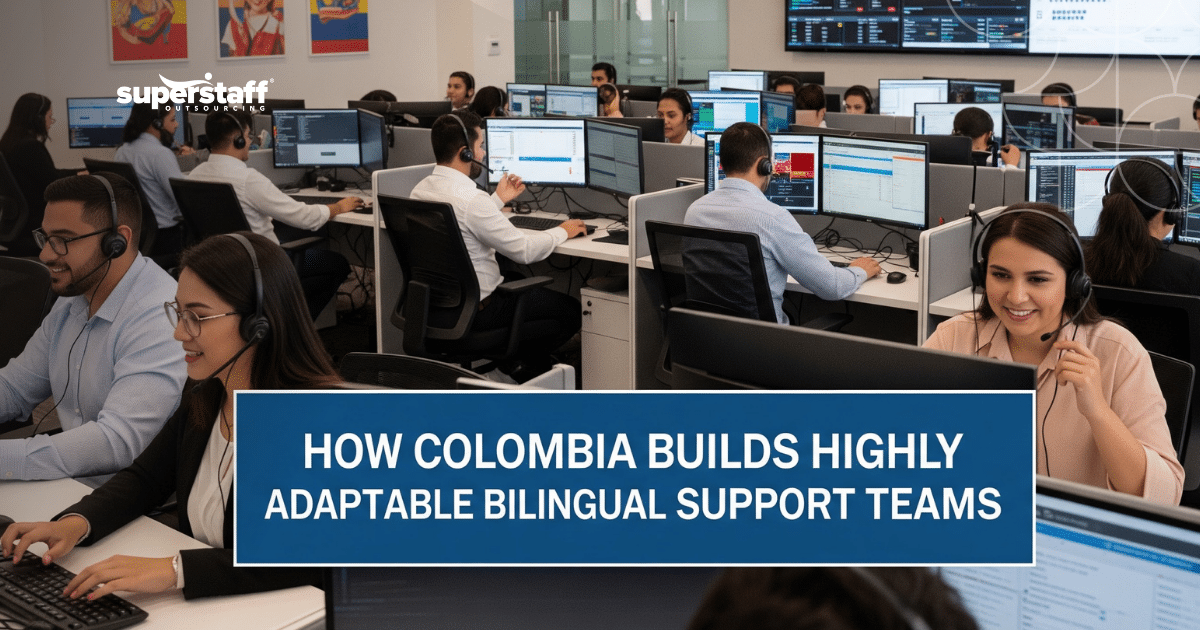
Language access continues to influence patient outcomes. Spanish-speaking populations represent a significant portion of the U.S. healthcare system. Colombian BPO teams offer native-level Spanish alongside professional English fluency.
That capability supports multilingual scheduling lines, patient reminders, and benefits explanations. It also reduces reliance on automated tools that may frustrate patients during sensitive interactions.
When organizations outsource healthcare solutions with bilingual capacity in mind, they create smoother patient journeys. They also reduce escalations that burden clinical staff.
This advantage is especially relevant for providers expanding their use of virtual healthcare services across diverse populations.
Healthcare Scalability Without Hiring Risk
Healthcare demand fluctuates. Seasonal surges, public health events, and payer changes can quickly overwhelm in-house teams. Expanding headcount domestically is slow and often irreversible.
Colombian BPO teams provide elasticity. Providers can scale support up or down without restructuring internal departments. That flexibility is critical for functions like appointment scheduling, referral management, and back-office processing.
As organizations outsource healthcare solutions to nearshore teams, they gain operating leverage. Capacity adjusts to demand without disrupting internal staffing models.
This approach also protects internal teams from burnout. It keeps clinical resources focused on patient care rather than administrative overload.
Compliance Awareness Is Built Into the Delivery Model
Healthcare outsourcing only works when compliance is respected. Colombian healthcare BPO teams are accustomed to working within HIPAA-aligned environments and U.S. privacy expectations.
Processes are designed with audit readiness in mind. Access controls, documentation standards, and escalation protocols are clearly defined. While compliance oversight remains with the U.S. provider, execution risk is reduced.
This structure supports providers that want to expand virtual healthcare services while maintaining governance standards. It also reassures leadership teams that outsourcing does not introduce uncontrolled exposure.
For many executives, this operational maturity explains why U.S. providers choose Colombian healthcare outsourcing over more distant offshore markets.
Strategic Integration Beats Transactional Outsourcing
The most effective healthcare outsourcing relationships are not task-based. They are integrated into operating models. Colombian BPO teams increasingly function as extensions of internal departments rather than isolated service providers.
They attend recurring operational reviews and align with KPIs tied to patient access and revenue cycle performance. Over time, they develop institutional knowledge that improves execution quality.
When organizations outsource healthcare solutions in this way, the value compounds. Productivity increases. Errors decline. Internal leaders regain time for strategic priorities.
This integration mindset separates effective outsourcing from short-term labor substitution.
Healthcare Support Evolves Alongside Technology
Healthcare technology adoption continues to accelerate. EHR updates, telehealth platforms, and digital intake tools change how work flows across organizations. Colombian teams adapt quickly to these shifts because their roles are process-driven rather than role-fixed.
Teams are trained to support platform transitions without service interruption. They also help stabilize workflows during technology rollouts.
That adaptability strengthens healthcare support solutions across both traditional and virtual care environments. It ensures operational continuity even as systems evolve.
Nearshore Teams Strengthen Control Without Micromanagement
Executives often worry about losing control when outsourcing. In practice, Colombian BPO teams often increase control by introducing structure and reporting discipline.
Clear performance metrics. Regular feedback loops. Defined escalation paths.
These elements help healthcare leaders monitor outcomes without managing daily execution. Oversight becomes strategic rather than tactical.
As more organizations outsource healthcare solutions through nearshore partnerships, governance improves rather than weakens.
Why This Model Continues to Gain Momentum
Healthcare operations are becoming more complex, not less. Administrative work continues to grow alongside clinical demand. Providers that rely solely on internal staffing struggle to keep pace.
Colombian BPO teams offer a practical alternative. They deliver healthcare support solutions that balance quality, access, and scalability. They also integrate well with virtual healthcare services that define modern patient engagement.
This combination explains why U.S. providers choose Colombian healthcare outsourcing as a long-term operating strategy rather than a temporary fix.
Outsource Healthcare Solutions to the Professional BPO Team at SuperStaff
As healthcare organizations continue to reevaluate how work gets done, the decision to outsource healthcare solutions becomes a question of design rather than cost. The goal is to build resilient operations that support growth without compromising care.
SuperStaff helps U.S. healthcare providers do exactly that. Through carefully built Colombian teams, SuperStaff delivers structured support that aligns with U.S. workflows, compliance expectations, and patient experience goals.
If your organization is ready to strengthen healthcare operations without expanding internal headcount, now is the time to explore how SuperStaff can help. Let us show you how nearshore healthcare outsourcing can support your next stage of growth.