
Midmarket leaders face constant pressure to scale operations without inflating overhead. Customer expectations continue to rise, yet internal budgets and talent pipelines remain tight. As a result, many executives are evaluating outsourced managed services as a strategic alternative to expanding in-house teams.
The decision is rarely simple. It affects cost structures, risk exposure, talent access, and long term competitiveness. Understanding the operational tradeoffs allows leaders to choose a model that aligns with growth goals rather than reacting to short term staffing gaps.
The True Cost Structure Behind In House Teams
Building an internal call center team involves more than salary lines. Recruitment cycles, onboarding, training, benefits, office space, technology licenses, and management oversight all add up quickly. Those costs remain fixed regardless of seasonal fluctuations in demand.
Midmarket firms often underestimate the management bandwidth required. Supervisors must coach agents, track performance metrics, handle attrition, and maintain compliance standards. Leadership time becomes absorbed in operational details instead of strategic priorities.
Budget predictability can also become difficult. Sudden demand spikes require overtime or rapid hiring, which strains both morale and cash flow. These realities prompt many executives to reconsider whether in house growth is always the most efficient path.
How Outsourced Managed Services Reshape Cost Control
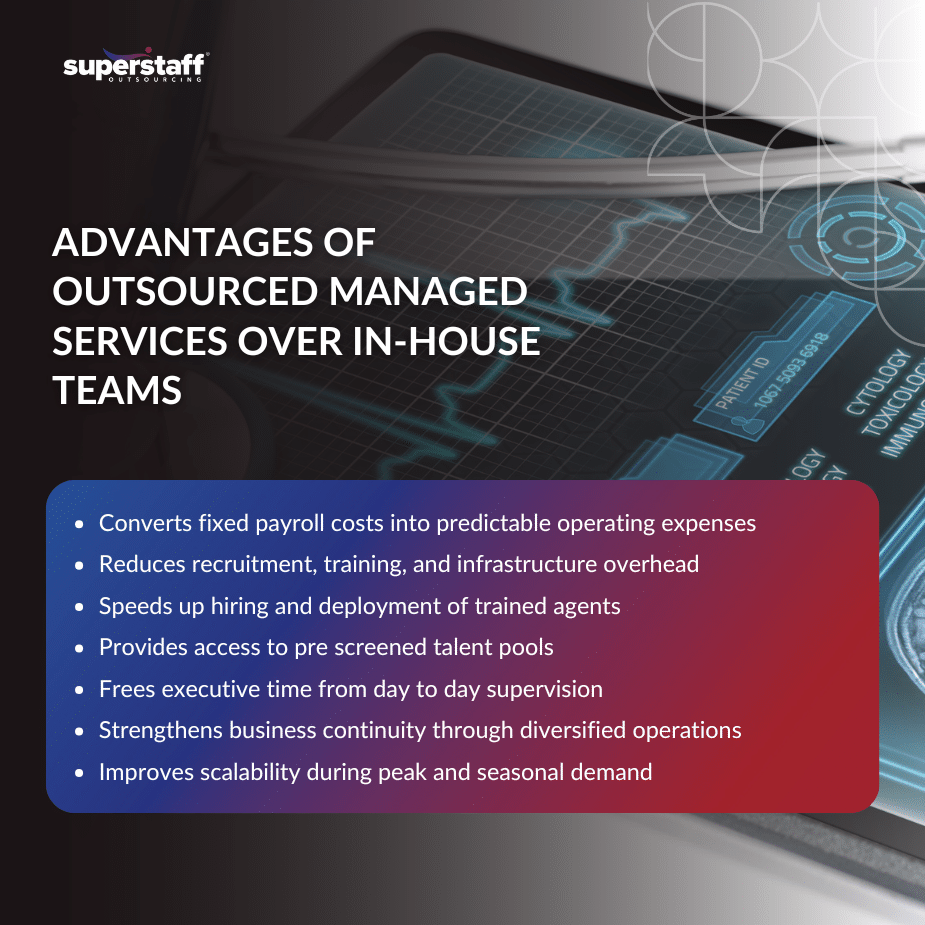
Outsourced managed services convert many fixed costs into predictable operating expenses. Instead of building infrastructure internally, companies leverage an established workforce, systems, and supervisory structure.
This model typically includes:
- Dedicated agents trained on your processes
- Workforce management and scheduling
- Quality assurance and performance reporting
- Technology infrastructure and data security protocols
Financial planning becomes more stable because costs align directly with service levels. Leadership teams gain clearer visibility into return on investment and can scale capacity up or down without restructuring internal departments.
Talent Access and Speed to Scale
Recruiting qualified customer service professionals in the United States can take months. Competition for experienced agents remains high, especially in specialized industries such as healthcare, finance, and logistics.
Outsourced managed services offer immediate access to pre screened talent pools. Philippine BPO providers maintain recruitment pipelines designed specifically for voice and omnichannel support roles. This structure shortens ramp up time significantly.
Speed matters when launching new products or entering new markets. Instead of delaying growth due to hiring constraints, companies can deploy trained teams within weeks. That agility supports revenue expansion without overwhelming existing staff.
Operational Focus for Executive Teams
When internal leaders oversee call center operations directly, they often juggle staffing, technology upgrades, and compliance reviews alongside strategic initiatives. Over time, operational complexity can dilute executive focus.
Outsourced managed services shift day to day supervision to an experienced delivery team. Account managers monitor KPIs, conduct coaching sessions, and maintain service level agreements. Internal stakeholders receive performance dashboards and strategic recommendations instead of handling daily escalations.
This structure allows C suite leaders to concentrate on product innovation, market expansion, and capital allocation. Operational oversight remains strong, yet it no longer consumes leadership bandwidth.
Risk Management and Business Continuity
Business continuity planning has become a board level priority. Natural disasters, labor shortages, and regulatory changes can disrupt centralized in-house teams.
Outsourced managed services providers in the Philippines operate within diversified facilities and remote capable infrastructures. Established BPO firms invest in redundant connectivity, backup power systems, and secure cloud environments.
Risk distribution becomes more balanced. Instead of concentrating operations in a single domestic office, companies leverage geographically diversified support teams. That model reduces single point of failure exposure and strengthens resilience.
Quality Assurance and Performance Governance
Some executives worry that external teams may lack accountability. However, mature outsourced managed services frameworks rely on structured governance models.
These typically include:
- Documented workflows and process mapping
- Defined service level agreements
- Weekly and monthly performance reviews
- Continuous training and calibration sessions
Clear metrics create transparency. Customer satisfaction scores, response times, and resolution rates remain visible to both parties. Structured oversight often results in more disciplined performance management than loosely supervised internal teams.
Cultural Alignment and Brand Representation
Customer experience reflects brand reputation. Leaders understandably want assurance that external teams will communicate in alignment with company values.
Philippine BPO professionals are known for strong English proficiency and service orientation. Providers invest heavily in accent neutralization, cultural training, and brand immersion programs. Agents learn not only scripts but also tone, compliance requirements, and escalation protocols.
Outsourced managed services arrangements typically include collaborative onboarding sessions with client stakeholders. That partnership ensures alignment on messaging, customer journey expectations, and performance benchmarks from day one.
Flexibility During Growth and Contraction
Midmarket companies often experience uneven demand cycles. Product launches, promotional campaigns, and seasonal peaks can stretch in-house teams beyond capacity.
Outsourced managed services allow leadership to scale staffing levels without permanent hiring commitments. When demand softens, service levels can be adjusted accordingly.
This flexibility protects margins. Instead of carrying excess payroll during slow periods, companies maintain an optimized cost base. At the same time, they avoid compromising customer experience during peak volume surges.
Technology Integration and Data Security
Modern call center performance depends on integrated CRM systems, analytics dashboards, and secure data handling protocols. Building and maintaining that infrastructure internally requires ongoing capital investment.
Outsourced managed services providers typically operate on enterprise grade platforms. Integration with client systems occurs through secure channels with defined access controls.
Security standards are not optional. Reputable Philippine BPO firms implement rigorous compliance frameworks, including documented information security policies and controlled access environments. That discipline often exceeds what smaller in-house teams can sustain independently.
When In-House Teams Still Make Sense
Certain scenarios favor internal control. Highly sensitive operations with complex regulatory oversight may benefit from direct internal management. Organizations with stable, predictable demand and strong internal HR capabilities may also prefer to retain full control.
However, even in these cases, hybrid models frequently emerge. Core strategic functions remain in house while high volume support shifts to outsourced managed services partners.
Balanced decision making requires honest evaluation of internal strengths, cost tolerance, and growth ambitions. Emotional attachment to legacy structures should not override data driven assessment.
Making the Strategic Choice
Executives should evaluate several questions:
- Does our current structure support scalable growth?
- Are we allocating leadership time to the highest value activities?
- Can we access specialized talent quickly enough to meet expansion plans?
- Are our cost structures flexible enough to withstand volatility?
Outsourced managed services offer a disciplined framework for answering these questions. They transform customer support from a fixed overhead burden into a managed, performance driven function aligned with strategic goals.
Midmarket companies that treat customer experience as a strategic lever rather than an administrative necessity often find this model particularly effective.
Outsourced Managed Services: A Strategic Shift for Sustainable Growth
Choosing between internal expansion and outsourced managed services requires careful financial and operational analysis. The most resilient midmarket organizations prioritize flexibility, disciplined governance, and scalable cost structures.
Outsourced managed services provide a practical path to achieve those objectives while preserving leadership focus on growth initiatives. When implemented with the right partner, they enhance customer experience without sacrificing control or brand integrity.
SuperStaff supports U.S. SMEs and midmarket leaders with dedicated Philippine based teams designed for performance, compliance, and scalability. If you are reassessing your call center strategy, contact us and see how we can help you build a model that supports long term growth and operational stability.