U.S. companies are under pressure to move goods faster, communicate clearer, and keep customers informed at every stage of an order. But as supply chains become more global and more unpredictable, the operational load on logistics teams has grown heavier than ever. This is why outsourcing in supply chain management has become a strategic advantage rather than a cost-cutting tactic.
Filipino logistics professionals have emerged as a dependable extension of U.S. operations, offering 24/7 service, strong communication skills, deep process expertise, and the discipline to maintain consistency in fast-moving environments.
From track and trace to POD verification and dispatch coordination, Philippine teams now play a critical role in maintaining shipment visibility, supporting driver communication, and ensuring smooth last-mile execution. For many U.S. logistics companies, the Philippines is no longer an optional resource — it is now the operational backbone that keeps shipments moving and customers updated.
Why Outsourcing in Supply Chain Management Is Growing
Companies today operate in an era of constant volatility. Port delays, driver shortages, fluctuating demand, and rising transportation costs create a level of unpredictability that logistics teams struggle to manage internally. As the operational burden increases, so does the need for specialized support.
This is where outsourcing in supply chain management becomes essential. Rather than spreading in-house teams too thin, companies build hybrid structures where strategic decisions stay internal, while repeatable, process-heavy tasks are offloaded to trained offshore teams. This model not only improves efficiency but also creates a resilient operational structure capable of managing disruptions.
Filipino logistics professionals bring structure to daily operations, enabling U.S. companies to control costs and maintain visibility without the overhead of constant hiring and training. By shifting track and trace, monitoring, POD collection, and dispatch coordination offshore, leaders gain operational stability even in the most unpredictable market conditions.
The Philippine Advantage in Supply Chain Support
The rise of supply chain outsourcing to the Philippines is not simply a trend — it is the result of years of industry specialization. Over the past decade, the Philippines has developed one of the most mature logistics BPO ecosystems in the world. This means U.S. companies don’t have to train teams from scratch; instead, they tap into a talent pool already familiar with carrier portals, TMS systems, ELD data monitoring, email dispatching, and broker–driver communication.
Filipino logistics talent excels not only because of technical capabilities but also because of their communication skills and cultural compatibility with U.S. partners. Logistics is a fast-paced environment where tone, clarity, and professionalism matter. The Philippines consistently delivers these qualities, making trust and collaboration easy even in high-pressure scenarios.
Another major factor is availability. Philippine operations run 24/7, enabling continuous shipment monitoring across U.S. time zones. When in-house teams end their day, Filipino teams take over. This creates uninterrupted visibility — a standard modern shippers and consignees expect.
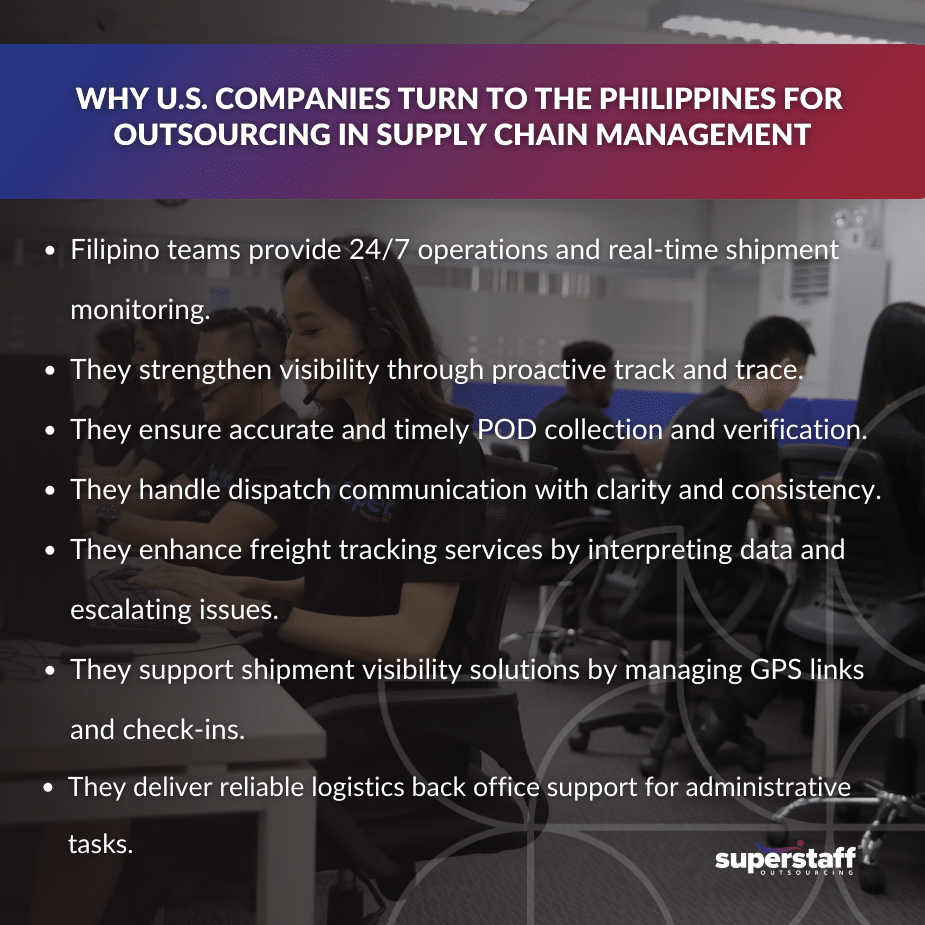
Track and Trace as a Core Function of Outsourcing in Supply Chain Management
Track and trace is the heart of logistics visibility. Without real-time updates, carriers can’t plan ahead, shippers can’t coordinate capacity, and end customers lose trust. Filipino teams play a central role in maintaining this visibility.
When U.S. companies adopt outsourcing in supply chain management, they gain immediate access to dedicated staff who monitor load status through ELD data, carrier portals, driver calls, and third-party platforms. Track and trace agents log updates into the TMS, communicate exceptions promptly, and escalate delays before they impact delivery schedules. The outcome is faster decision-making and higher reliability across all shipping lanes.
Filipino logistics teams also excel at making proactive calls — a key differentiator. While many competitors wait for drivers to check in, Philippine teams initiate communication, reducing guesswork and preventing missed updates. This proactive mindset is essential for companies looking to strengthen accountability across their carrier networks.
POD Collection and Verification Strengthens Accountability
As the freight industry shifts toward stricter audit and compliance standards, Proof of Delivery has become more than a closing formality. It is a critical document that protects revenue, enables accurate billing, and prevents disputes. Filipino POD specialists streamline this process by ensuring every delivery has verified documentation on file.
Through outsourcing in supply chain management, companies assign dedicated POD teams who consistently chase carriers, verify signatures, upload files into TMS systems, and notify billing teams once documentation is complete. This prevents delays in invoicing and keeps cash flow predictable — something U.S. logistics firms cannot afford to compromise.
A well-structured offshore POD team reduces write-offs, eliminates missing paperwork, and ensures accurate billing cycles. It also creates a reliable chain of documentation that protects companies during audits or customer disputes.
Dispatch Coordination and Driver Communication
Dispatch functions determine whether a shipment moves efficiently or gets stuck in avoidable bottlenecks. Filipino dispatch teams support U.S. operations by handling driver communication, updating schedules, confirming appointments, and coordinating with warehouses and brokers.
As organizations increase outsourcing in supply chain management, dispatch is one of the most valuable roles to offload. Offshore teams manage load assignments, schedule confirmations, and communication tasks that often overwhelm U.S. dispatchers during peak hours.
Filipino dispatchers are trained to maintain calm and clarity even when situations become urgent. They manage inbound driver calls, relay instructions precisely, and ensure updates are logged immediately. This structured, methodical approach creates operational continuity and reduces miscommunication — a common cause of delays in domestic transportation.
How Filipino Teams Improve Freight Tracking Services
U.S. companies use freight tracking services to maintain visibility across lanes, but the technology alone is not enough. Someone must interpret the data, anticipate exceptions, and escalate at the right time. Filipino teams serve as the human layer behind the software, turning data into action.
They monitor ELD signals, mileage progression, and route deviations, ensuring every load stays aligned with delivery expectations. When exceptions arise — weather delays, mechanical issues, detention risks — offshore teams notify stakeholders immediately. This rapid response gives U.S. companies more control and reduces the risk of surprise delays.
Their familiarity with multiple tracking systems gives them flexibility across clients who use different TMS platforms. With the right training, Filipino teams become experts in connecting system data with real-time driver updates, enabling smoother operations from pickup to delivery.
Enhancing Visibility Through Shipment Visibility Solutions
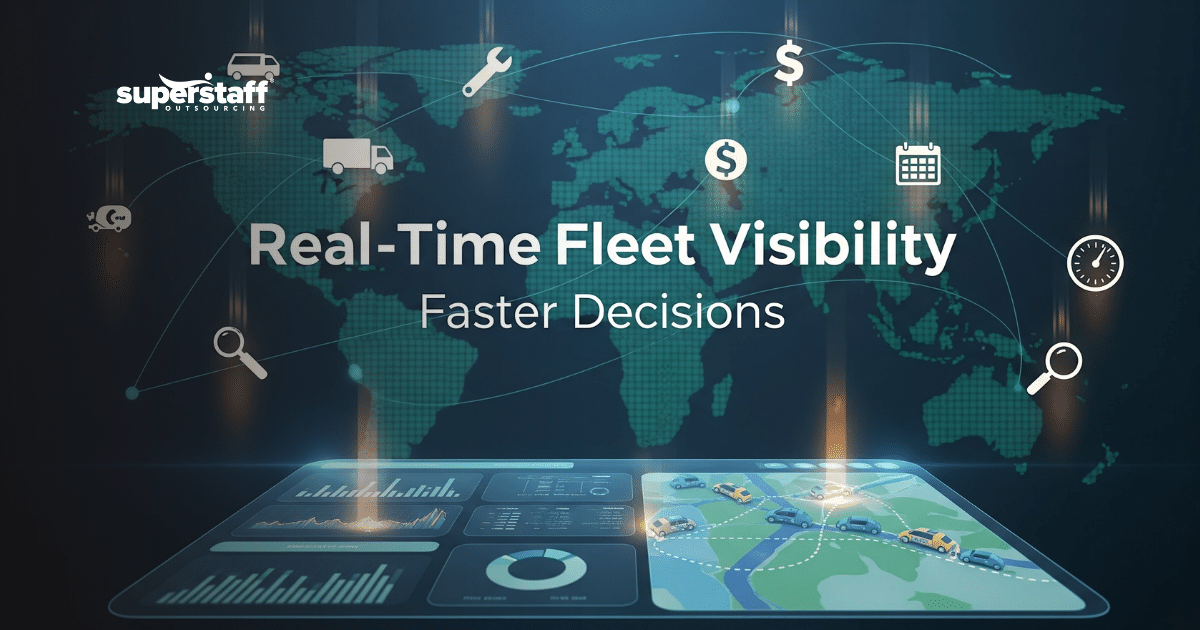
Visibility is now one of the most valuable competitive advantages in logistics. Shippers expect constant insight into their freight status, and carriers must match customer expectations with accurate updates. Filipino logistics teams support this need by operating as the human engine behind shipment visibility solutions.
These solutions improve visibility only when actively managed. Offshore agents ensure tracking links are sent, GPS connections remain active, drivers respond to check-ins, and delays are escalated quickly. They also verify automated system updates, ensuring the TMS reflects accurate information rather than outdated timestamps.
Through outsourcing in supply chain management, U.S. companies gain teams who safeguard visibility throughout every load’s journey. This reduces blind spots, ensures accountability, and improves the customer experience by providing timely, consistent updates across all shipments.
Logistics Back Office Support Creates Operational Stability
Behind every smooth shipment is a series of back-office tasks that must be completed consistently. Filipino teams manage these processes with precision and discipline, offering comprehensive logistics back office support that strengthens internal operations.
Logistics back office support services typically include:
- Rate quoting assistance
- Data entry for shipments and invoices
- Updating TMS records
- Scheduling appointments
- Resolving accessorial discrepancies
- Coordinating with warehouses
- Managing exception workflows
When U.S. companies embrace outsourcing in supply chain management, they gain the structure needed to maintain accuracy across thousands of shipments monthly. Offshore teams ensure data integrity, reduce administrative load on U.S. staff, and improve internal coordination across departments.
The outcome is a centralized, well-maintained back office that supports growth without requiring large in-house hiring sprees.
The Strategic Value of Supply Chain Outsourcing for U.S. Companies
The logistics industry is now shaped by demands for faster turnaround, real-time updates, and operational resilience. As a result, more companies are embracing supply chain outsourcing as a long-term strategy to stay agile.
Outsourcing to the Philippines enables U.S. companies to:
- Build scalable teams
- Reduce operational costs
- Extend service hours to 24/7
- Improve customer satisfaction
- Maintain consistency across lanes
- Strengthen visibility from pickup to delivery
Unlike temporary staffing solutions, Philippine supply chain teams become long-term partners. They integrate with internal systems, learn the business processes, and adapt to U.S. operational standards. This stability is essential for companies working through high volumes, tight schedules, and fluctuating market conditions.
Through structured offshoring models, companies gain both operational depth and flexibility — something increasingly difficult to achieve through in-house teams alone.
Turn to SuperStaff for Outsourcing in Supply Chain Management
The logistics industry has reached a point where operational excellence depends on visibility, communication, and consistency. Filipino logistics teams now support these core functions, becoming indispensable extensions of U.S. supply chain operations. Through outsourcing in supply chain management, companies gain the expertise needed to maintain accurate tracking, timely updates, reliable POD verification, and strong dispatch coordination.
As the industry continues to evolve, U.S. companies will rely even more on offshore teams who bring discipline, service orientation, and a deep understanding of logistics workflows. The Philippines is uniquely equipped to meet these demands, offering the perfect balance of talent, culture, and scalability.
In a world where every shipment counts, the Filipino workforce is not just supporting U.S. supply chains — they are helping push them forward.