Global service delivery models are shifting. Cost efficiency still matters, but access to talent, time zone alignment, and operational resilience now carry equal weight. These shifts are shaping today’s outsourcing trends and influencing how U.S. companies build global teams.
Colombia has emerged as a serious contender in this environment. For SMEs and midmarket firms evaluating their next move, the country represents more than a nearshore option. It reflects how outsourcing itself is evolving toward smarter, more strategic partnerships.
Below is a closer look at how Colombia fits into the next phase of outsourcing strategy and what that means for growth-focused organizations.
Nearshore Alignment With U.S. Business Hours
Time zone proximity has moved from convenience to necessity. Executive teams want real-time collaboration, faster escalations, and tighter feedback loops.
Colombia delivers on that expectation. Its alignment with U.S. time zones supports seamless integration with headquarters teams.
- Leaders can conduct daily standups without late-night scheduling.
- Sales and support teams can operate during overlapping business hours.
- Escalations move faster because decision-makers are available.
These factors reflect broader outsourcing trends focused on operational agility. Nearshore models now compete directly with offshore options when collaboration speed is critical.
A Bilingual Workforce That Supports Revenue Growth
Language capability is no longer optional. U.S. businesses serve increasingly diverse customer bases.
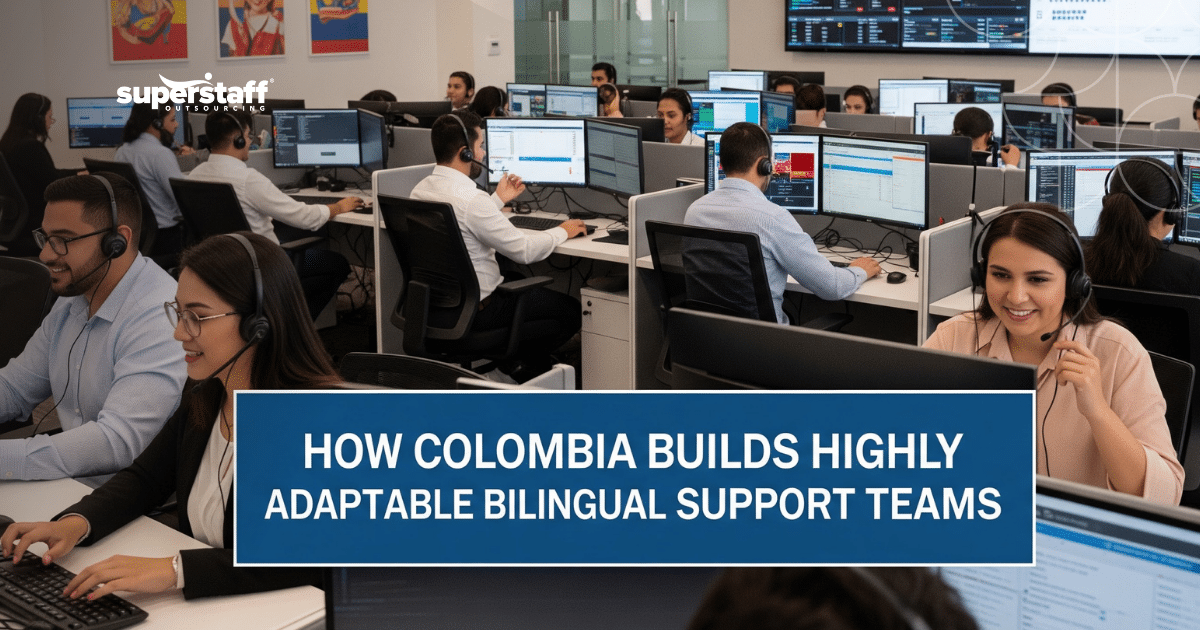
Colombia offers a strong pool of bilingual professionals, particularly in English and Spanish. That capability supports revenue expansion and enhances customer experience.
- Contact centers can serve North American markets with cultural fluency.
- Support teams can assist both U.S. and Latin American customers.
- Sales pipelines benefit from multilingual engagement.
As outsourcing trends evolve, businesses look for talent that contributes to revenue generation, not just cost reduction. Bilingual capacity directly supports that objective.
Risk Diversification in a Multi-Country Strategy
Supply chain disruptions and geopolitical uncertainties have changed how executives think about concentration risk. Many organizations now pursue multi-location outsourcing frameworks.
Colombia plays a strategic role in this diversification model. Companies often pair Southeast Asia operations with Latin American hubs to balance risk exposure.
This approach reflects outsourcing pipeline growth strategies designed to maintain continuity during disruptions. When one region faces constraints, another can absorb demand.
Consequently, Colombia strengthens the resilience of global service delivery structures.
Digital Infrastructure and Skilled Talent Pools
Technology readiness influences site selection decisions. Organizations want access to digital infrastructure and skilled professionals capable of supporting modern systems.
Colombia has invested heavily in technology education and urban development. Major cities provide reliable connectivity and a growing base of IT and business process talent.
This environment supports a wide range of business outsourcing solutions, including:
- Customer experience operations
- Back-office support
- Finance and accounting services
- IT and technical support
Such capabilities align with outsourcing trends centered on scalability and specialized expertise.
Cultural Compatibility With U.S. Clients
Communication style matters in service delivery. Cultural alignment reduces friction and improves collaboration.
Colombian professionals often demonstrate strong interpersonal communication skills and familiarity with U.S. business norms. That compatibility enhances customer satisfaction and internal coordination.
From onboarding to performance management, shared expectations simplify oversight. These characteristics strengthen Colombia’s position within outsourcing trends that prioritize partnership quality over transactional arrangements.
Talent Scalability for Growing Companies
SMEs and midmarket firms frequently face hiring constraints at home. Labor shortages and wage pressures limit domestic expansion.
Colombia offers scalable talent pipelines. Companies can ramp teams up or down without the overhead of traditional in-house hiring.
For example, a U.S. ecommerce company expanding into Latin America might require:
- Spanish-speaking support agents
- Order management specialists
- After-sales service representatives
A nearshore Colombia team can support that expansion without significant infrastructure investment.
Such flexibility supports outsourcing pipeline growth strategies focused on entering new markets efficiently.
Cost Efficiency Without Compromising Quality
Cost remains part of the equation. However, leadership teams increasingly evaluate total value rather than hourly rates.
Colombia provides competitive labor costs relative to the United States. At the same time, service quality remains high due to education levels and professional training.
Executives examining outsourcing trends recognize that sustainable savings come from operational design, not wage arbitrage alone. Nearshore structures in Colombia offer balanced economics.
This combination allows companies to reinvest savings into innovation, marketing, or product development.
Supporting Customer Experience Expansion
Customer expectations continue to rise. Omnichannel support, rapid response times, and personalized interactions are standard requirements.
Colombia supports these expectations through trained agents capable of handling voice, chat, and email channels. Its workforce can operate extended hours aligned with U.S. business needs.
Businesses seeking business outsourcing solutions often start with customer service. Over time, many expand into back-office and revenue-support roles.
That progression mirrors broader outsourcing trends where partnerships deepen as trust grows.
Strategic Position in Latin America
Colombia’s geographic location strengthens its regional relevance. It connects North America with broader Latin American markets.
For U.S. companies expanding southward, this positioning offers logistical and cultural advantages. Teams in Colombia understand regional nuances and regulatory environments.
The discussion around outsourcing trends impacting Latin America and Colombia highlights this growing integration. Rather than serving solely as a cost center, Colombia functions as a regional growth platform.
That strategic orientation differentiates it from purely transactional outsourcing destinations.
Integration With Offshore Models
Colombia does not replace established offshore hubs. Instead, it complements them.
Many companies design blended delivery structures. For example:
- Philippine teams manage overnight U.S. coverage.
- Colombia teams handle daytime operations.
- Shared management systems unify reporting and quality control.
This integrated framework reflects modern outsourcing trends focused on global continuity. Businesses achieve 24-hour coverage while maintaining collaboration across time zones.
SuperStaff supports this hybrid model by combining Philippine offshore expertise with nearshore options in Colombia. The result is flexibility aligned with executive priorities.
Executive-Level Considerations for U.S. Decision-Makers
C-suite leaders evaluating Colombia must consider several strategic factors.
First, assess how nearshore delivery aligns with long-term growth plans. Expansion into Spanish-speaking markets strengthens the case.
Second, evaluate internal management capacity. Nearshore teams often integrate closely with headquarters functions, requiring clear governance structures.
Third, examine scalability. Colombia supports phased growth models where teams expand based on demand forecasts.
These considerations reflect the sophistication of today’s outsourcing trends. Outsourcing now influences revenue growth, customer loyalty, and operational resilience.
Why Colombia Matters in the Next Phase
The outsourcing conversation has matured. Executives no longer ask whether to outsource. Instead, they ask where and how to structure global partnerships.
Colombia addresses multiple executive concerns at once:
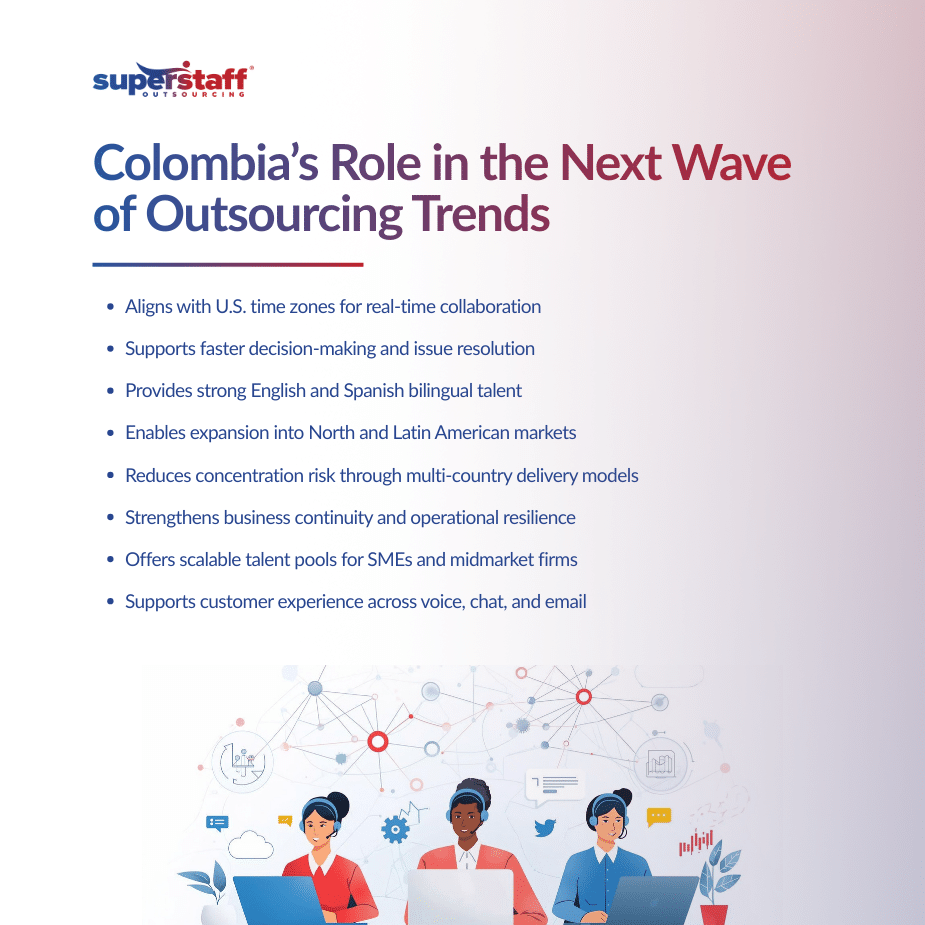
- Real-time collaboration
- Bilingual customer engagement
- Regional market expansion
- Diversified risk management
- Competitive cost structure
These factors position the country within the next generation of outsourcing pipeline growth strategies.
For SMEs and midmarket firms, this environment creates access to capabilities previously reserved for large enterprises.
Nearshore Outsourcing Trends: Building a Strategic Path Forward
Outsourcing decisions should support long-term competitiveness. Leadership teams must align service delivery models with business strategy.
Colombia represents one component of a broader, flexible framework. When integrated with experienced offshore partners, it enhances responsiveness and resilience.
SuperStaff helps U.S. companies design that framework. Our presence in the Philippines, combined with nearshore capabilities in Colombia, enables clients to build structured, scalable support systems.
As outsourcing trends continue to evolve, decision-makers must evaluate partners that offer more than labor capacity. They need providers that understand positioning, growth planning, and operational design.
Colombia’s role in the next wave of outsourcing trends reflects this shift toward strategic, growth-oriented collaboration. If your organization is exploring how nearshore and offshore models can strengthen your service operations, now is the time to act.
Connect with SuperStaff to explore tailored solutions that align with your expansion goals and customer experience strategy.