Every company—regardless of size, industry, or digital maturity—runs on data. Customer information. Order details. Claims. Invoices. Compliance records. Inventory logs. Operational metrics. Data flows through every department, and when it stops flowing, the business stops moving.
This is where data entry outsourcing services become a true operational advantage. What used to be viewed as a simple “cost-cutting tactic” has now become a foundational strategy for scaling, streamlining, and de-bottlenecking business workflows. For midmarket companies and fast-growing SMEs, outsourcing data entry isn’t just cheaper. It’s smarter. It’s faster. It’s more predictable. And it’s the key to keeping internal teams focused on the work that drives revenue—not administrative drag.
This blog breaks down the real ROI of partnering with reliable data entry teams, from reduced costs to increased speed, higher accuracy, and workflow resilience. Most importantly, you’ll see why competitive companies now treat data entry outsourcing services as an engine for growth—not an afterthought.
Data Is Scaling. Internal Teams Aren’t.
In 2025, data volume is exploding at a rate most internal back-office teams can’t keep up with.
- E-commerce brands process more orders than ever.
- Healthcare providers handle increasing documentation requirements.
- Logistics firms need real-time updates for shipments, loads, and carrier transactions.
- Fintech companies rely on fast data cleanup and verification to stay compliant.
- Professional services—from law firms to insurance brokers—must manage mountains of documents and records.
Yet most internal teams are already stretched thin. Hiring more full-time staff is expensive, slow, and increasingly competitive. Even automation, while powerful, still needs human oversight for accuracy, exception handling, and data validation.
This widening gap makes data entry outsourcing services a strategic move—not a stopgap.
Why Outsourcing Data Entry Became a Growth Strategy (Not a Cost Strategy)
Companies once outsourced data entry to reduce labor costs. Today, they outsource to:
- Improve operational resilience
- Scale workloads without hiring
- Increase accuracy and turnaround time
- Free internal teams to focus on core revenue functions
- Build predictable cost structures
- Prevent backlogs from snowballing into operational delays
The ROI comes from the combination of speed, efficiency, risk reduction, and strategic reallocation of talent.
Predictable Costs: No Surprises, No Overhead
One of the strongest financial advantages of data entry outsourcing services is cost predictability. Internal data entry teams come with fluctuating expenses—recruitment, onboarding, training, salaries, benefits, office space, IT equipment, and turnover.
Outsourcing eliminates these variables. You gain:
Fixed, Transparent Pricing
You pay for output, hours, or volume—nothing more.
Zero Overhead
No office space. No HR burden. No training costs.
Scalability Without Cost Spikes
Need 10 agents this month and 30 the next? Outsourcing makes it possible without internal restructuring.
Better Budgeting for High-Volume Businesses
Retailers, logistics firms, healthcare providers, and insurance companies often experience seasonal spikes. Outsourcing lets them plan ahead without expanding headcount.
This is the reason offshore regions—particularly the Philippines and Colombia—remain strong hubs for offshore data entry services. Predictable cost structures create predictable operational performance.
Faster Output: More Data Processed in Less Time
Speed is everything in modern operations. When the flow of data slows, workflows break. Orders get delayed. Claims get stuck. Compliance timelines tighten. Customers complain.
Data entry outsourcing services deliver faster output through:
Dedicated Teams Working Full-Time
You’re not sharing internal teams who split their time across tasks.
24/7 Operations
Nearshore and offshore teams ensure your business runs even while you’re offline.
Process Specialization
Experienced outsourcing providers bring optimized workflows built from years of handling high-volume data tasks.
Better Turnaround SLAs
From 4-hour, same-day, or next-day commitments—outsourced teams hit faster output targets consistently.
This is how outsourced back office services eliminate lag across departments.
Zero Bottlenecks: Consistent Workflow Flow, Even During Chaos
Seasonal peaks, staff absences, and unexpected surges can cripple internal operations. But with data entry outsourcing services, bottlenecks become manageable—or disappear entirely.
Here’s why:
Flexible Workforce Allocation
If volume spikes, more agents can be added immediately.
24/7 Monitoring
No more piles of unprocessed forms, orders, invoices, or documents.
Redundant Staffing
Your operations don’t stop just because an internal team member is sick, resigned, or on leave.
Faster Exception Handling
Outsourced teams specialize in identifying errors early—before they become bigger problems.
When paired with automation tools, how outsourced data entry teams speed up business processes becomes even more evident. Machines handle repetitive actions. Humans validate edge cases. Together, they eliminate delays that slow business growth.
Higher Accuracy: Better Data, Better Decisions
Data entry isn’t just typing. It’s the foundation of every critical decision your business makes. Inaccurate data leads to:
- Wrong orders
- Duplicate records
- Faulty analysis
- Poor customer service
- Bad financial reporting
- Compliance risks
Outsourced teams deliver higher accuracy because they’re:
Highly trained for specific data tasks
From financial encoding to healthcare forms to legal documentation.
Experienced with industry-specific workflows
E-commerce orders are different from insurance claims. Logistics data is different from medical records. Outsourcing providers specialize in these differences.
Supported by quality control layers
Double-entry verification. Random audits. Automated validation tools.
This multi-layer quality approach is difficult and expensive to build internally.
Operational Resilience: Outsourcing Keeps You Running
Disruptions happen. Market shifts. Leadership changes. Internal restructuring.
But your data needs to move—every day.
Data entry outsourcing services create operational resilience through:
- Business continuity planning
- Workforce redundancy
- Technology and security layers
- Geographical diversification
- Scalable capacity
While your core business focuses on innovation, your outsourced team ensures the foundational work never stops.
Stronger Focus on Core Work: Your Team Does What Matters
Internal teams should spend their time on:
- Strategy
- Client service
- Product development
- Process improvement
- Revenue growth
- High-level analysis
Not repetitive data entry tasks.
By shifting administrative workload to experts offering offshore data entry services, companies regain time, bandwidth, and energy to move forward.
This is especially transformative for:
- Startups scaling fast
- Midmarket companies modernizing operations
- Retailers navigating peak season
- Healthcare and insurance firms dealing with strict compliance
- Logistics and transportation companies managing real-time data
Outsourcing clears the clutter so teams can perform at their highest value.
Compliance and Security Built Into the Partnership
Modern data operations require:
- HIPAA alignment
- SOC 2 considerations
- ISO 27001 data security controls
- GDPR sensitivity
- Encrypted systems
- Access controls
- Audit trails
Outsourcing providers invest heavily in compliance because it’s core to their business. That means your company benefits from enterprise-grade security without the cost of building it in-house.
For industries with sensitive information—healthcare, finance, insurance, logistics—this is one of the biggest ROI drivers of all.
The ROI Formula: Tangible and Intangible Gains
When businesses calculate the ROI of data entry outsourcing services, they typically include:
Tangible Gains
- Labor cost reduction
- Lower overhead
- Faster processing times
- Reduced error correction costs
- Lower hiring and training expenses
Intangible Gains
- Better customer experience
- More accurate reporting
- Faster decision-making
- Improved employee satisfaction
- Agility during peak seasons
- Reduced operational stress
Together, these make outsourcing not just a back-office decision, but a long-term business strategy.
Why Smart Companies Choose Data Entry Outsourcing Services
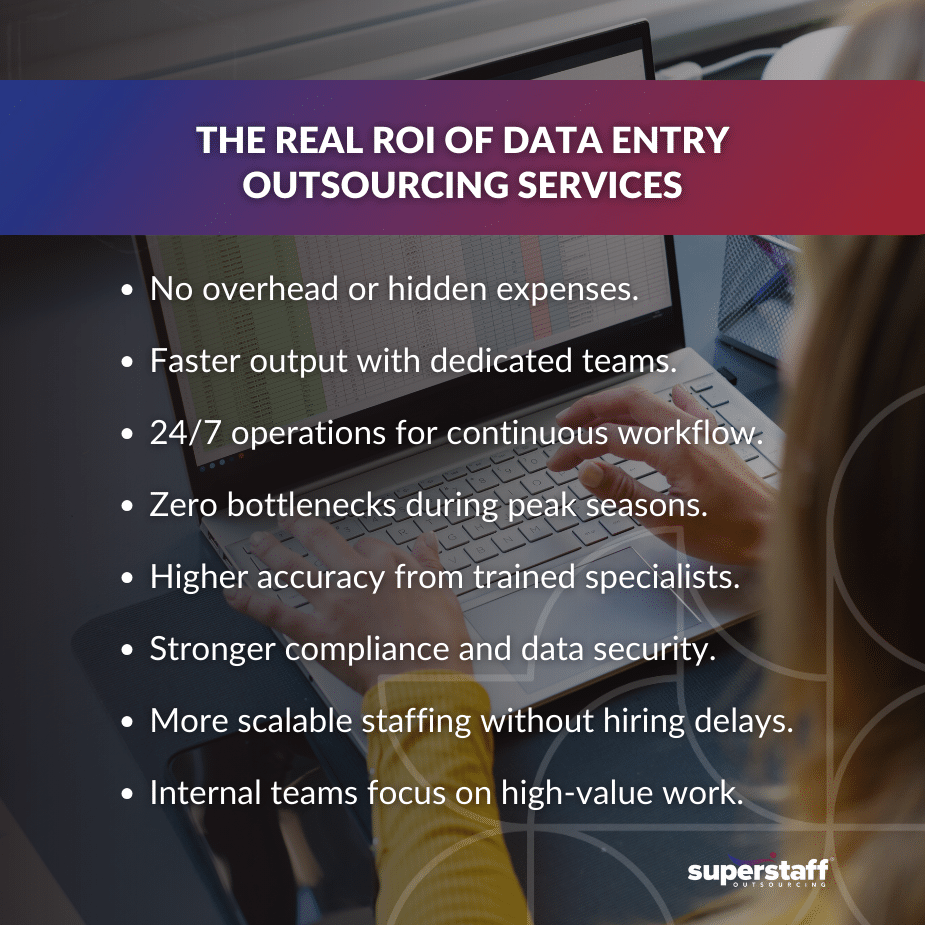
Companies that rely heavily on accurate, timely data—from retailers to healthcare providers to logistics firms—can’t afford bottlenecks, delays, or inaccuracies. This is why more decision-makers now treat data entry outsourcing services as a core operational engine.
It delivers:
- Predictable costs
- Faster processing
- Zero backlog pressure
- Higher accuracy
- Stronger compliance
- Better focus for internal teams
- Scalable workforce capacity
- Resilience during high-volume surges
When combined with automation and modern workflow tools, how outsourced data entry teams speed up business processes becomes undeniable.
The future of back-office operations is hybrid, scaled, and streamlined—and SuperStaff’s outsourcing services sit at the center of that transformation.
Connect with us, and see how our data entry outsourcing services can empower your business!