

The developer shortage isn’t a future problem. It’s today’s daily struggle for tech leaders everywhere. With demand far outpacing supply, teams are stretched thin, product timelines keep slipping, and burnout has quietly become the norm rather than the exception.
For many SaaS companies, scaling has turned into a slow, painful climb—not because of lack of vision, but because there simply aren’t enough hands to build the future.
This is where SaaS outsourcing steps in. It doesn’t just plug talent gaps. It transforms bottlenecks into breakthroughs. It creates space for innovation, helps teams breathe again, and gives companies the ability to move with the speed that the market demands.
In a global economy defined by rapid iteration and fierce competition, SaaS outsourcing has become one of the most strategic moves companies can make—not as a cost-cutting tactic but as a sustainable growth engine.
The Real Developer Shortage: Why Companies Are Under Pressure
Across the United States and major tech markets, developer roles stay unfilled for months. Salaries keep rising. Hiring cycles drag endlessly. Teams are asked to stretch, then stretch again.
This developer shortage has a ripple effect:
- Product releases slow down.
- Technical debt piles up.
- Engineers switch between roles they’re not supposed to do.
- Training, onboarding, and backfilling drain managers’ time.
- Burnout pushes even more developers out of the industry.
The result? Companies fall behind.
The crush of deadlines, expectations, and unrelenting workloads is exactly what pushes leaders to look for SaaS outsourcing solutions to overcome developer shortage—not as a band-aid, but as a long-term resilience strategy.
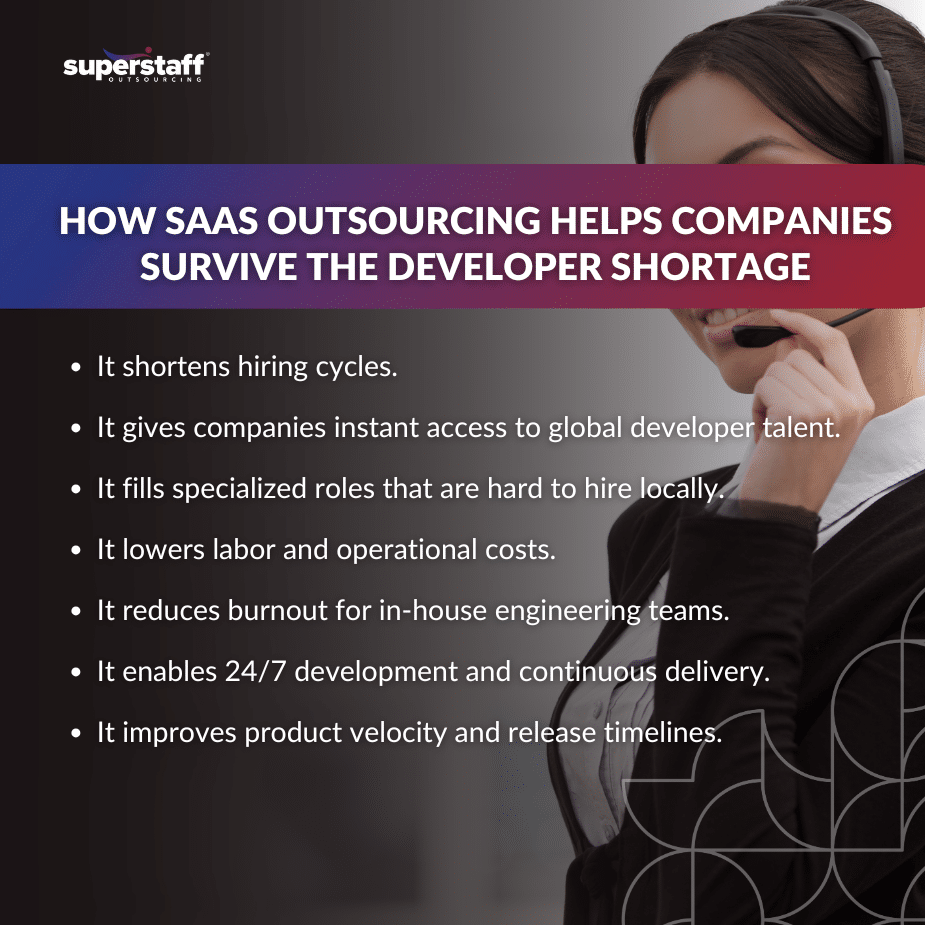
Why SaaS Outsourcing Is Becoming the Default Path Forward
Outsourcing used to be a reactive decision. Today, it’s strategic. Proactive. And in many SaaS companies, it’s simply the smart way to scale fast. Here’s why SaaS outsourcing is now at the center of high-growth tech operations.
1. Faster Hiring Cycles When Every Day Matters
Recruiting a senior developer locally can take over a month—sometimes more. During that time, roadmaps stall. Meanwhile, competitors move.
With SaaS outsourcing, companies instantly tap into global talent pools. Instead of waiting months, they acquire skilled developers in weeks, sometimes days.
This matters for startups, scale-ups, and established SaaS brands alike. Speed is everything. Product-led growth demands momentum. And outsourcing software developers gives teams the velocity they need.
2. Access to Specialized Roles That Are Almost Impossible to Hire Locally
Try hiring these roles in the U.S. today:
- DevOps engineers
- AI/ML developers
- API integration specialists
- Cloud-native architects
- Senior full-stack developers
- Mobile SaaS engineers
The competition is intense—and expensive.
SaaS development outsourcing provides access to these specialized roles through experienced, trained, and often certified teams across the Philippines, Latin America, and other major talent hubs. You get the expertise without the hiring headache.
3. Lower Cost, Higher Capability
Outsourcing isn’t just about saving money. It’s about reinvesting it in innovation. For every outsourced developer, companies save on:
- Salary
- Benefits
- Recruiting
- Infrastructure
- Training
- Equipment
These cost efficiencies allow SaaS companies to redirect budget toward building features that matter, expanding product capabilities, and accelerating go-to-market.
This is how SaaS outsourcing helps companies scale fast—not just by adding people but by expanding what your budget can accomplish.
4. No More Burnout: Teams Finally Get Breathing Room
Burnout doesn’t just affect morale—it affects product quality, customer experience, and long-term retention.
SaaS outsourcing gives exhausted teams something they desperately need: relief.
By distributing work across time zones and global teams, companies:
- Reduce after-hours pressure
- Minimize weekend emergencies
- Eliminate unrealistic workloads
- Protect core developers from context switching
This leads to fewer errors, better code quality, and a healthier, more stable engineering culture.
5. 24/7 Development Is No Longer Just for Big Tech
Round-the-clock development used to be expensive and reserved for tech giants. Not anymore.
With SaaS outsourcing, companies can run:
- 24/7 code deployment
- Continuous QA
- Real-time bug patching
- Around-the-clock product support
This shortens release cycles and significantly accelerates innovation. Small and mid-market SaaS firms finally get enterprise-level capability.
6. Scale Up—Without Disrupting Your Core Team
One of the hidden advantages of outsourcing software developers is team stability. Instead of overhiring during peak demand and laying off during slow quarters, outsourcing allows flexible scaling.
Need five new developers for a three-month sprint? Add them. Need to reduce the team after deployment? Scale down seamlessly. Your core team remains focused, stable, and protected from constant restructuring.
7. Outsourced Teams Are Now Built for Modern SaaS Workflows
Today’s SaaS products demand agile, cross-functional collaboration. Modern outsourcing teams are structured with this expectation in mind.
They can jump into systems like:
- GitHub, GitLab, Bitbucket
- Agile software management tools
- CI/CD pipelines
- Cloud environments (AWS, Azure, GCP)
- Microservices architectures
- AI-assisted development tools
This removes friction and lets outsourced developers integrate seamlessly with your in-house team.
Where SaaS Outsourcing Delivers the Biggest Breakthroughs
Not all outsourced developers do the same work. In SaaS environments, the biggest wins happen in areas where technical specialization meets time-sensitive delivery.
Here are the functions where companies see the fastest ROI:
Product Engineering
- New features
- API enhancements
- SaaS integrations
- Mobile app versions
- UI/UX improvements
Technical Debt Reduction
- Refactoring legacy architecture
- Improving performance
- Enhancing scalability
- Strengthening security
Cloud Engineering & Automation
- Cloud migration
- Infrastructure-as-code
- DevOps
- Automation pipelines
Quality Assurance
- Functional testing
- Regression testing
- Automated testing
- User acceptance testing
Data Engineering & AI Support
- Data pipelines
- Analytics setups
- ML workflows
- AI-powered insights
The Future: SaaS Outsourcing as a Competitive Advantage
The companies that will dominate the next decade are not the ones with the biggest internal teams. They’re the ones with the most adaptive teams.
SaaS outsourcing is no longer a backup plan during talent shortages. It has evolved into a long-term competitive strategy for companies that want to scale without limits.
This shift is driven by simple economics and simple truths:
- Developer shortages will continue.
- Salaries will keep rising.
- Product requirements will get more complex.
- Time-to-market will matter more than ever.
Companies that build hybrid global development teams will outpace those that rely solely on local hiring.
Final Thoughts: From Burnout to Breakthrough
Burnout isn’t inevitable. Product delays aren’t inevitable. Growth plateaus aren’t inevitable.
Not if companies embrace a smarter, more sustainable path.
SaaS outsourcing is how companies survive the developer shortage. It’s how they scale faster, innovate more boldly, and bring balance back to their engineering teams.
In a world where demand grows faster than talent supply, outsourcing doesn’t just fill the gaps. It unlocks possibilities.
Your next breakthrough may not come from hiring one more developer—it may come from building a global team that works with you, not against your workload.
Looking for a reliable SaaS outsourcing partner? Find out what SuperStaff can do for you!