
The real cost of empty seats isn’t just lost productivity. It’s the pressure placed on the people who are left behind.
The role has been open for three months. Recruiters have posted it across multiple job boards, hiring managers have reviewed resumes and conducted interviews, and candidates have moved through the process. Yet the position remains vacant. Meanwhile, the work continues. Team members absorb additional responsibilities, managers step in to cover operational gaps, and projects move more slowly than planned.
What begins as a hiring challenge can quickly become an operational problem that affects productivity, morale, and business performance.
For many business leaders, this situation is all too familiar. Across industries such as technology, healthcare, logistics, finance, and professional services, finding qualified talent has become increasingly difficult. In many cases, the challenge is not a lack of budget. The challenge is finding the right people before prolonged vacancies begin affecting the rest of the organization.
For years, companies that struggled to hire locally often looked overseas primarily to reduce labor costs. Today, that conversation is changing. The most effective COOs are not expanding their talent search because they want the cheapest option available. They are doing it because local hiring alone is no longer solving the problem.
The discussion is no longer centered on offshoring. It is centered on solving a hiring crisis.
The Cost-Reduction Trap
When business leaders hear the word “offshore,” cost savings are often the first thing that comes to mind. For decades, global hiring strategies were frequently associated with reducing expenses and lowering operational costs. While financial considerations still matter, focusing exclusively on cost can create challenges that outweigh the initial savings.
Organizations that choose hiring solutions based solely on price often face higher costs over time. High turnover can quickly outweigh any initial savings. Studies show that replacing an employee can cost up to 2.5 times their annual salary, while recruitment and training can add another 50% to 60%. In some cases, talent replacement costs account for up to 25% of a company’s annual expenses. Beyond the financial impact, turnover disrupts operations and reduces productivity.
The companies achieving the strongest results tend to ask different questions. Rather than focusing solely on rates, they focus on outcomes. Can qualified talent be found quickly? Can critical positions be filled before operational pressure builds? Can service quality remain consistent? Can stable teams be developed for long-term success? These questions have a greater impact on business growth than hourly costs alone. Organizations that prioritize quality, speed, and long-term partnership often position themselves for stronger performance than those focused only on reducing expenses.
“When leaders stop viewing offshoring as a cost-cutting strategy and start viewing it as a solution to a hiring problem, the conversation changes completely.”

The Hidden Cost of Empty Seats
Many organizations underestimate the true impact of an unfilled position. While recruiting costs and lost productivity are often discussed, the broader effects are not always visible until they begin affecting daily operations.
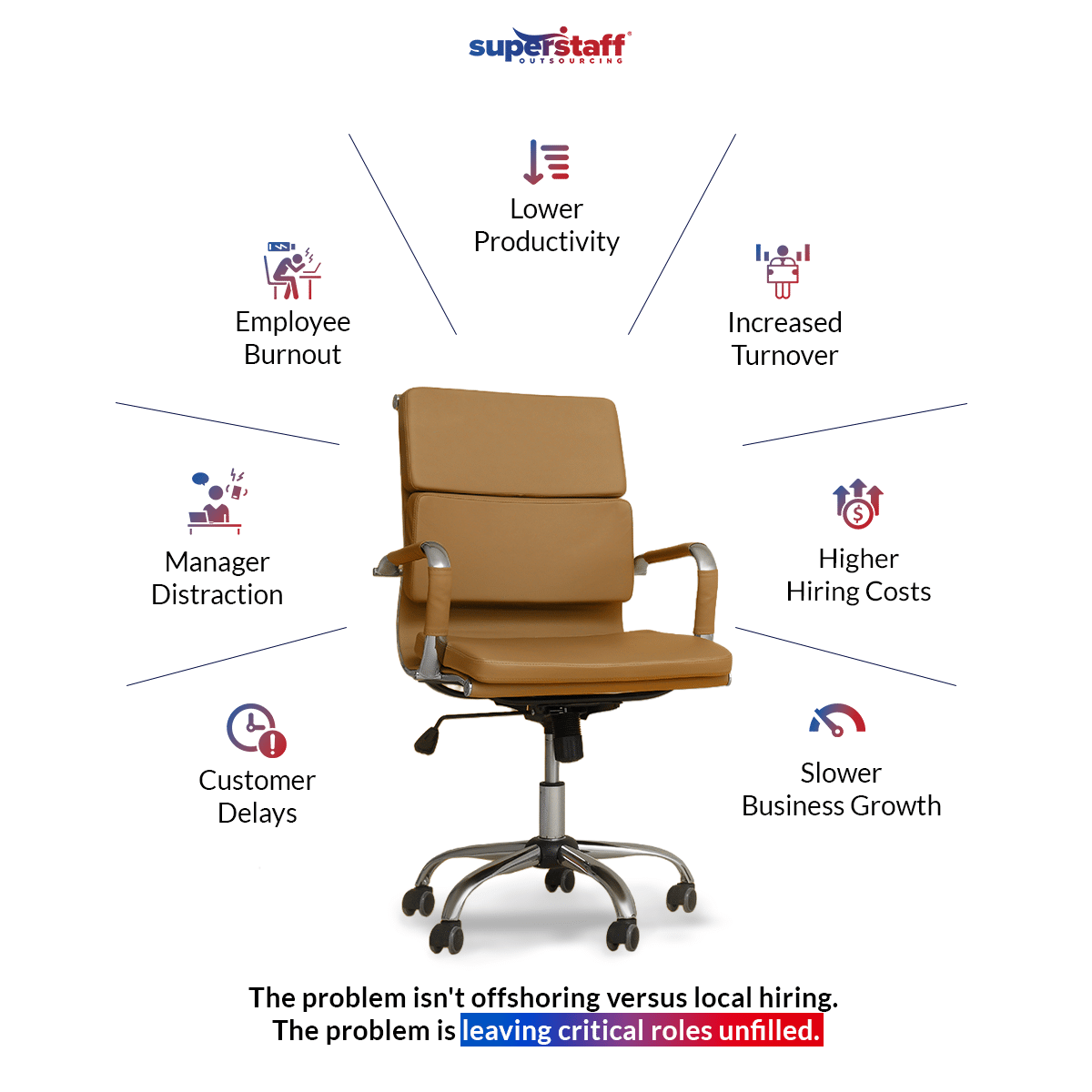
An open role creates pressure throughout the organization. Existing employees may take on additional responsibilities to keep work moving forward. Managers spend valuable time covering gaps instead of focusing on strategic priorities. Customer service levels may decline, projects may experience delays, and business initiatives may lose momentum.
When a critical position remains vacant, organizations often experience several challenges:
- Customer response times increase
- Managers spend more time covering operational gaps, and projects move more slowly
- Existing employees take on additional workload
- Team morale declines, and burnout risks become more significant
Consider a support team operating without a key engineer for several months. Or imagine an accounting department approaching a busy reporting cycle while a senior finance role remains vacant. The work does not disappear simply because the position remains unfilled. Instead, the burden shifts to the people who are already carrying full workloads.
Over time, this additional pressure can lead to frustration, decreased engagement, and even further turnover. This is one reason hiring speed has become a top priority for many COOs. Every week that a critical role remains vacant creates additional strain on employees, managers, and business operations.
Why More Companies Are Looking Beyond Local Markets
In many regions, organizations are competing for the same limited pool of skilled professionals. Demand continues to grow while the supply of qualified candidates struggles to keep pace. According to recent global workforce research, 74% of employers report difficulty finding the talent they need, marking one of the highest talent shortage levels recorded in recent years. As a result, hiring timelines have lengthened, and businesses often find themselves competing for talent with multiple employers simultaneously.
Business leaders are finding that local hiring alone cannot address every workforce challenge. To complicate matters, the pressing issue isn’t always a shortage of talent. In many markets, qualified professionals are available, but hiring them is becoming increasingly expensive due to fierce competition, rising salary expectations, and an ongoing demand for specialized skills. As a result, filling critical roles locally can place significant pressure on hiring budgets.
In addition, expanding the search beyond local markets provides access to a broader talent pool. Instead of waiting months for the ideal candidate to appear, organizations can connect with qualified professionals across multiple regions and accelerate the hiring process.
The goal is not to replace local hiring. The goal is to supplement it with additional talent sources that provide cheaper labor cost, greater flexibility and faster access to specialized skills.

Access to Specialized Talent
Many COOs are looking beyond local markets to gain access to qualified talent that may be difficult to find, attract, or retain within their immediate hiring region.
Countries such as the Philippines and Colombia have developed strong talent pools across a range of business functions, giving organizations access to qualified professionals with specialized expertise. This is particularly valuable for roles that are often difficult to fill locally, such as accounting, finance, support engineering, and technical support.
By looking beyond local markets, businesses can connect with qualified professionals faster, reduce hiring delays, and maintain operational continuity while supporting long-term growth.
Building Stability Instead of Filling Seats
The strongest hiring strategies are not focused solely on filling vacancies as quickly as possible. They are focused on building stable, high-performing teams that can support long-term business objectives.
Today’s COOs are increasingly looking for hiring solutions that improve retention, reduce turnover, and create consistency across operations. They recognize that hiring success is measured not only by how quickly a role is filled, but also by how effectively employees contribute over time.
As a result, many organizations seek partners that can:
Deliver qualified candidates efficiently
- Reduce hiring timelines
- Support employee retention
- Maintain operational continuity and scale alongside business growth
Building a workforce requires more than simply filling open positions. It requires creating a sustainable talent strategy that supports organizational goals while minimizing disruption.
A Different Way to Think About Global Hiring
The term “offshoring” often brings to mind outdated assumptions about labor costs and budget reductions. While cost considerations remain important, they no longer represent the primary reason many organizations are expanding their talent search internationally.
The real challenge facing business leaders today is finding qualified people when local hiring efforts fall short. It is maintaining productivity while critical positions remain vacant. It supports growth without placing additional pressure on employees already carrying demanding workloads.
The most successful COOs have adjusted their perspective. They are not asking where they can find the cheapest labor. They are asking where they can find the right talent, at the right time, with the skills needed to support business objectives.
When critical positions remain open for months, the impact extends far beyond payroll costs. It affects teams, customers, operations, service quality, and growth opportunities. Solving that challenge requires a broader approach to talent acquisition, one that prioritizes access, stability, and long-term success.
That is why the conversation is changing. It is no longer about offshoring. It is about finding the people who can help the business move forward.
About Us
SuperStaff is a premier global BPO and managed services powerhouse that helps businesses worldwide scale seamlessly while slashing operational costs by up to 50%. As a trusted provider of offshore staffing and outsourcing solutions, SuperStaff connects companies with elite, highly trained professionals across a diverse range of roles, including multilingual customer support, sales, back-office processing, and tech support.
Whether deploying agile remote teams or robust on-site operations, SuperStaff eliminates hiring friction and delivers consistently high-quality work. We don’t just hire agents; we strategically source top-tier talent tailored to your growth objectives. That’s not just business process outsourcing; that’s our Superpower!
Discover how we help businesses improve efficiency at www.superstaff.com or follow our journey on social media at @superstaffoutsourcing.