
High inflation has reshaped the retail landscape. Prices shift faster. Margins tighten. Customers expect more, yet tolerance for delays is at an all-time low. To stay competitive, modern retailers are turning to one proven strategy: they outsource order processing to flexible, efficient, nearshore and offshore teams that can adapt faster than in-house operations.
Today, the ability to outsource order processing is no longer just cost-saving—it’s a survival advantage. From hypergrowth DTC brands to traditional retail chains, businesses are rethinking fulfillment, accuracy, turnaround times, and labor spend. And in an economic climate where every minute and every dollar counts, the move toward retail order processing outsourcing continues to accelerate.
Below, we break down why modern retail brands choose to outsource order processing, how it helps them overcome inflation-related pressures, and what the future of retail fulfillment looks like.
Inflation Has Changed Retail—and Order Processing Must Keep Up
Inflation hits retailers from all directions: inventory costs rise, freight prices fluctuate, labor becomes more expensive, and operational inefficiencies get painfully exposed. While customers expect fast, accurate shipping at the lowest possible cost, retailers work behind the scenes to maintain profitability and service quality.
This is where order fulfillment outsourcing for retailers becomes essential.
Instead of expanding internal teams, taking on new fixed costs, or investing in expensive technology, brands partner with specialized outsourcing providers to absorb volume spikes, provide accurate processing, and handle fulfillment workflows at scale—without draining operational budgets.
Retailers now outsource order processing not only to reduce costs, but also to protect margins, stabilize workflows, and create predictable revenue streams in an unpredictable market.
Reason #1: Outsourcing Order Processing Controls Costs in an Inflationary Market
Labor shortages and rising wages have made in-house order processing more expensive than ever. Inflation magnifies these expenses—especially during peak seasons like Q4, when demand skyrockets.
When retailers outsource order processing, they instantly reduce:
- Staffing overhead
- Training and onboarding costs
- Overtime spending
- Technology and software investment
- Error-related losses
Instead of dealing with workforce turnover or rising payroll, brands shift their order processing to trained teams in cost-efficient regions such as the Philippines and Colombia. This gives businesses the stability they need when inflation threatens profit margins.
For many brands, the benefits of outsourcing order processing for retail businesses start with one simple truth: converting fixed costs into variable costs protects profitability.
Reason #2: Retailers Gain Access to Trained Specialists Without Rebuilding Their Workforce
Order processing is highly detail-oriented. Even minor errors—incorrect SKUs, wrong quantities, missed orders—can lead to costly returns, negative reviews, and lost lifetime value.
Outsourcing eliminates these gaps. BPO providers train specialized teams to handle:
- Order verification
- Data entry
- Inventory coordination
- Shipment arrangement
- Returns logistics
- Billing and invoicing
- Customer updates
- Marketplace order management
These are roles that require precision, consistency, and speed. When retailers outsource order processing, they tap into a talent pool that already has expertise in fulfillment workflows, e-commerce platforms, ERP tools, and customer communication.
Better skills = fewer errors = higher customer satisfaction.
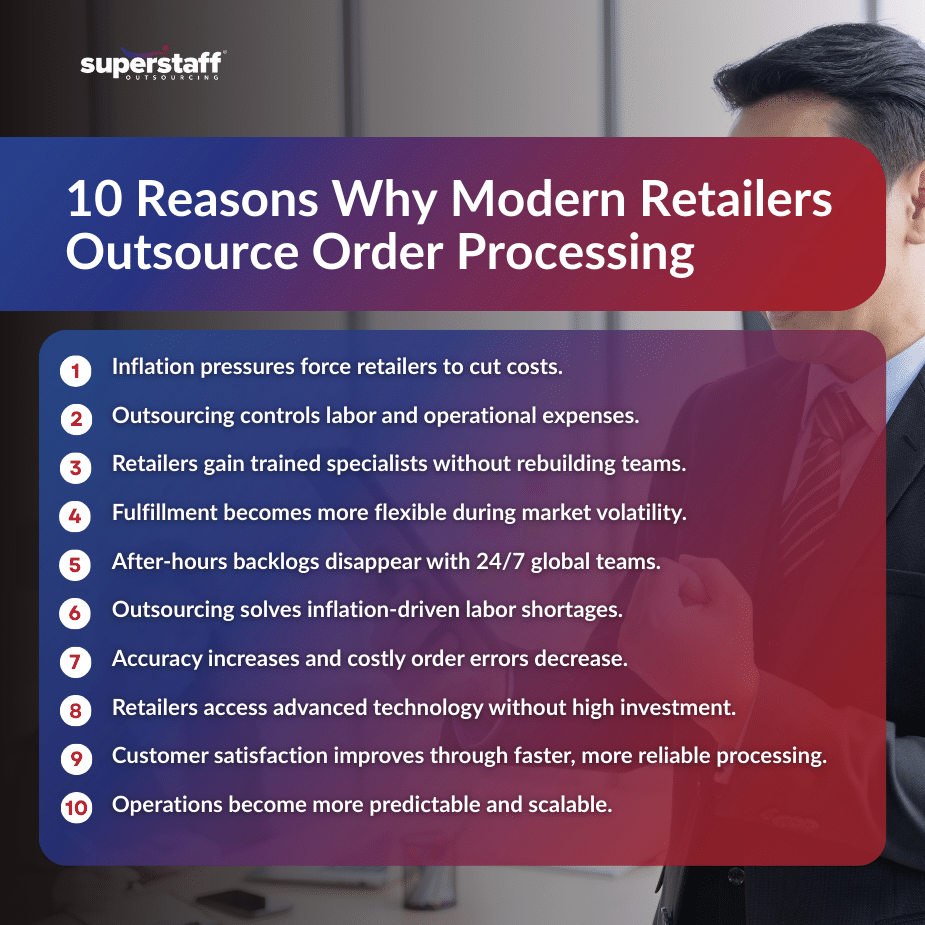
Reason #3: Outsourcing Creates Fulfillment Agility During Market Volatility
Inflation is unpredictable. Demand fluctuates. Shipping delays happen. Customer expectations don’t slow down.
This makes flexibility the new competitive edge.
When demand surges without warning—seasonal spikes, viral products, opportunistic campaigns—outsourcing allows retailers to scale teams up or down with minimal effort. Instead of hiring temporary workers or forcing existing teams into overtime, they rely on dedicated offshore and nearshore teams that adapt instantly.
This flexibility is a strategic advantage and one of the strongest arguments for how retailers outsource order processing during inflation.
If peak season brings triple the order volume, the outsourced team expands.
If demand drops, retailers avoid paying for idle labor.
This protects both margins and customer experience.
Reason #4: Global Teams Eliminate After-Hours Bottlenecks
Inflation has compressed delivery expectations. Same-day confirmations and next-day shipments are no longer optional—they’re required.
In-house teams struggle with:
- After-hours order clutter
- Weekend backlogs
- Overnight processing delays
But when retailers outsource order processing, they gain true 24/7 operations. Offshore teams work while U.S. teams sleep, clearing orders before business resumes. This eliminates fulfillment delays and ensures packages ship faster.
For online shoppers, speed equals trust—and trust drives repeat purchases.
Reason #5: Outsourcing Protects Retailers From Inflation-Driven Labor Shortages
Inflation doesn’t just increase wages—it makes hiring harder. Skilled operational roles like order processors, data entry specialists, and fulfillment coordinators are in short supply in major U.S. cities.
Retailers outsource order processing to avoid:
- Costly recruitment cycles
- High employee turnover
- Long training ramps
- Short-term seasonal hires
Instead of competing for limited local workers, brands tap into global markets with abundant talent and strong customer-centric culture.
Offshore teams bring discipline, accuracy, and reliability—crucial qualities for order processing roles that run on precision and consistency.
Reason #6: Order Processing Outsourcing Enhances Operational Accuracy
Retailers lose millions every year to:
- Order errors
- Incorrect packaging
- Wrong items
- Inventory mismatch
- Fulfillment delays
- Miscommunication between departments
Even small errors create large financial losses in high-inflation periods.
Outsourcing providers use:
- Dedicated quality assurance teams
- Proven workflows
- Automated platforms
- Multistep accuracy checks
- Cross-trained order processors
This leads to fewer mistakes and faster resolution of issues. For retailers, it directly translates to higher margin protection and fewer returns.
Reason #7: Outsourcing Provides Access to Advanced Technology Without the Cost
Modern fulfillment requires:
- Order management systems
- Warehouse management systems
- Data extraction tools
- Inventory synchronization tools
- API integrations
- Marketplace automation
- CRM systems
These tools are expensive to build and maintain internally.
When retailers outsource order processing, the provider already brings state-of-the-art platforms, trained staff, and multi-channel capability.
This means:
- No upfront investment
- No software licensing fees
- No maintenance expenses
- No internal IT overhead
Retailers get enterprise-level infrastructure without enterprise-level costs.
Reason #8: Outsourcing Strengthens Customer Satisfaction and Brand Loyalty
In the age of hyper-competition, customers expect:
- Fast delivery
- Accurate orders
- Real-time updates
- Smooth returns
- Transparent tracking
One mistake can push customers to switch brands.
Outsourcing ensures:
- Faster turnaround times
- Fewer order errors
- Immediate status updates
- Round-the-clock customer support
- Integrated communication with warehouse partners
For retailers battling inflation, customer loyalty is their strongest defense. Accurate, seamless order processing isn’t just operational—it’s a branding advantage.
Reason #9: Retailers Use Outsourcing to Expand Into New Markets Without High Costs
Global expansion requires multi-channel order management, international shipping coordination, and cross-border fulfillment support.
Instead of building costly local teams, retailers outsource order processing to multilingual and multicultural teams who can:
- Process international orders
- Coordinate cross-border shipments
- Manage multi-currency transactions
- Provide localized customer support
This lowers entry barriers and makes global expansion less risky in an inflationary climate.
Reason #10: Outsourcing Makes Retail Operations More Predictable
Inflation creates variability. Outsourcing creates stability.
Retailers gain:
- Predictable monthly costs
- Scalable fulfillment capacity
- Reliable processing times
- Consistent quality controls
- Dedicated staff without the HR burden
Predictability is invaluable when every percentage of margin matters.
Outsource Order Processing to the BPO Professionals at SuperStaff
In a high-inflation market, retailers cannot afford slow operations, rising labor costs, fulfillment errors, or delayed shipments. They need accuracy, flexibility, and speed—without destroying margins.
This is why more brands than ever choose to outsource order processing.
The combination of lower labor costs, high operational quality, instant scalability, 24/7 coverage, and advanced fulfillment technology gives retailers the resilience they need to outperform competitors—even as inflation reshapes the industry.
For any modern retail brand facing growth pressure, labor shortages, or tight margins, the path forward is clear: Outsourcing isn’t just helpful. It’s essential.
Ready to get started on your outsourcing journey? Get in touch with SuperStaff today!