Artificial intelligence is no longer a futuristic ambition reserved for tech giants. In 2025, it has become an operational backbone for businesses of every size and industry. Retailers use AI to predict demand with near-perfect accuracy. Healthcare providers rely on machine learning to streamline diagnoses and reduce administrative errors. Financial institutions deploy sophisticated models to flag fraud in real time. Even small businesses now integrate AI into customer service, logistics, and marketing.
But behind every high-performing AI system is the hidden engine that determines whether a model will succeed or fail: high-quality, human-labeled data. This invisible foundation is why companies across the globe will increasingly outsource data annotation services in 2025 and far beyond. The demand for annotated datasets is exploding, internal teams are reaching their limits, and global competition forces organizations to accelerate their AI roadmaps without sacrificing accuracy or compliance.
The future of AI operations will be shaped by how effectively companies can build, scale, and maintain reliable datasets. And outsourcing has become not just a practical solution but a strategic advantage.
Why AI Models Need More Data Than Ever
A few years ago, AI systems could perform impressively with relatively small datasets. Today, the landscape is entirely different. Modern models, especially multimodal and enterprise-specific ones, require exponentially larger datasets. Businesses are not just training general-purpose language models. They are fine-tuning AI on proprietary product catalogs, customer conversations, medical records, insurance claims, legal documents, or logistics workflows.
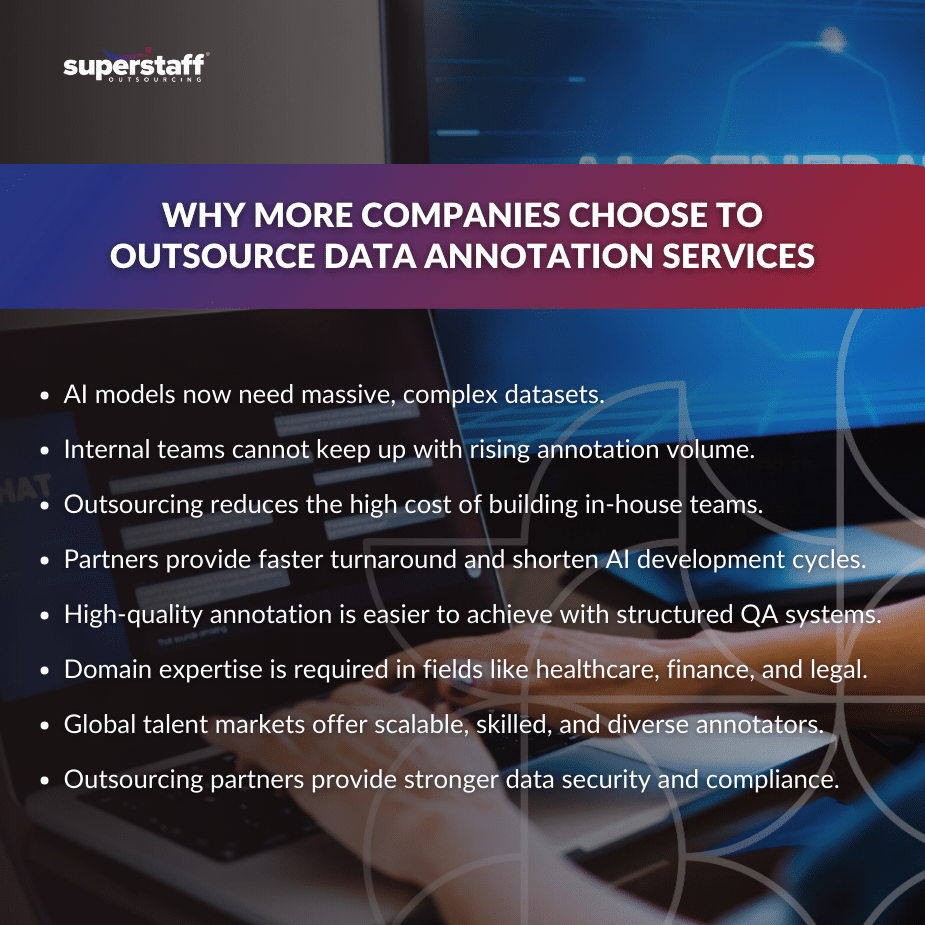
This shift fuels the skyrocketing demand for annotated data and intensifies the need for large, specialized annotation teams. Internal employees simply cannot keep pace with the growing volume of labeling requirements. Companies that once managed annotation in-house now encounter daily bottlenecks that slow down model development.
As AI becomes embedded in everyday operations, the need for fresh, accurate training data expands. The more a company relies on AI, the more critical annotation becomes. This is one of the primary reasons organizations are choosing to outsource data annotation services to meet these enormous and constantly evolving demands.
How to Scale AI Operations With Outsourced Data Annotation
AI development is one of the most resource-intensive undertakings a company can pursue. Building an internal annotation team may look straightforward at first glance, but the real costs add up quickly. Recruitment cycles are long. Training new annotators requires specialized instruction. Attrition disrupts consistency. Teams need supervisors, quality assurance specialists, and workflow managers. Infrastructure, tools, and software licenses add another layer of expenses.
Most companies do not have the workforce utilization needed to justify a fully scaled internal annotation unit year-round. Workload often spikes dramatically during key phases of model development and tapers off after deployment. Maintaining a large in-house team during slow periods becomes financially inefficient.
Offshore data annotation providers, on the other hand, enable companies to adjust capacity dynamically. They can scale up or down depending on project volume while maintaining predictable costs. This cost-efficiency is transformative, particularly for midmarket companies seeking to grow their AI capabilities without overextending their budgets.
As a result, more organizations will outsource data annotation services to align their costs with actual usage rather than absorbing the fixed costs of a full-time internal department.
Accelerating Time-to-Market Through Outsourcing
Speed is now a competitive differentiator in AI adoption. Business leaders do not have the luxury of multi-year development cycles. Markets shift quickly, consumer expectations evolve, and competitors release new AI features at a relentless pace. To keep up, companies must accelerate model development timelines.
AI systems need constant data refreshes to stay relevant. The lifecycle of a model is no longer linear. It requires ongoing annotation, evaluation, and fine-tuning. But internal teams often become the bottleneck when workloads surge.
AI data labeling outsourcing eliminates this constraint completely. External partners have the ability to ramp talent quickly, move in parallel workflows, and supply consistent annotation volume. They operate at a scale and rhythm most internal teams cannot sustain.
When companies outsource data annotation services, they gain access to a continuous data pipeline. This speeds up training, validation, and deployment cycles, giving them the agility needed to compete in a rapidly shifting digital landscape.
Quality Becomes Mission-Critical in AI Systems
As AI grows more powerful, the risks associated with poor training data become more pronounced. A mislabeled image can disrupt a medical model’s output. Biased text labeling can skew hiring or lending algorithms. Ambiguous categories can make customer service bots respond inaccurately. The consequences of poor annotation are not trivial. They impact safety, fairness, and regulatory compliance.
Enterprises are discovering the importance of precise, consistent, and well-documented annotation processes. Quality assurance in annotation requires structured workflows, multi-layer review systems, and specialized tools. It demands a level of discipline and expertise that generalist internal teams often lack.
Outsourcing partners, by contrast, build their entire operational models around accuracy. They implement standardized QA frameworks, review cycles, and auditing processes. When companies outsource data annotation services, they gain access to mature, well-tested quality systems that significantly reduce the risk of model inaccuracies. High-quality annotation is no longer a luxury. It is a non-negotiable requirement for responsible AI development.
The Rise of Domain-Specific Annotation Needs
Industries across the world are moving away from generic AI models and toward solutions tailored to their specific contexts. Healthcare AI cannot rely on the same categories as retail AI. A model trained for logistics workflows cannot share datasets with one built for legal document analysis.
Domain knowledge has become essential.
Medical AI requires annotators who understand anatomy, diagnostics, treatment codes, and clinical workflows. Financial AI depends on specialists who understand transactions, risk patterns, and compliance requirements. Legal AI needs annotators familiar with evidence categorization, case types, and legal terminology.
This is no longer work that any employee or generalist annotator can perform. Companies must outsource data annotation services to gain access to teams trained in these specialized fields. Outsourcing partners recruit domain experts, create customized training regimens, and maintain pools of annotators with industry-specific backgrounds. This expertise gives enterprises a significant advantage in building more accurate, reliable, and context-aware models.
Global Talent Markets Become Essential to AI Operations
AI operations demand large, talented, and diverse data annotation teams. This is where global talent markets, especially in the Philippines and Colombia, have become invaluable. These countries offer unique strengths: large English-speaking populations, strong cultural alignment with Western markets, high educational attainment, and established BPO ecosystems.
Their workforces excel in tasks requiring precision, empathy, and contextual understanding. This makes them ideal for complex annotation projects that involve customer conversations, sentiment analysis, product categorization, or content moderation.
Moreover, global teams reduce bias in model training. Diverse annotators provide a variety of perspectives, which leads to more inclusive AI outcomes. Companies that outsource data annotation services to global partners not only scale faster but also build models that perform more accurately across multiple demographics.
This access to multilingual, multicultural, and highly trainable talent will continue to be a major competitive edge for companies investing in AI development.
The Growing Importance of Data Security and Compliance
As AI systems process more personal, sensitive, and regulated information, the stakes for data protection increase. Companies cannot afford to expose themselves to breaches, leaks, or mismanaged data workflows. Trust is essential, and compliance requirements continue to expand across industries.
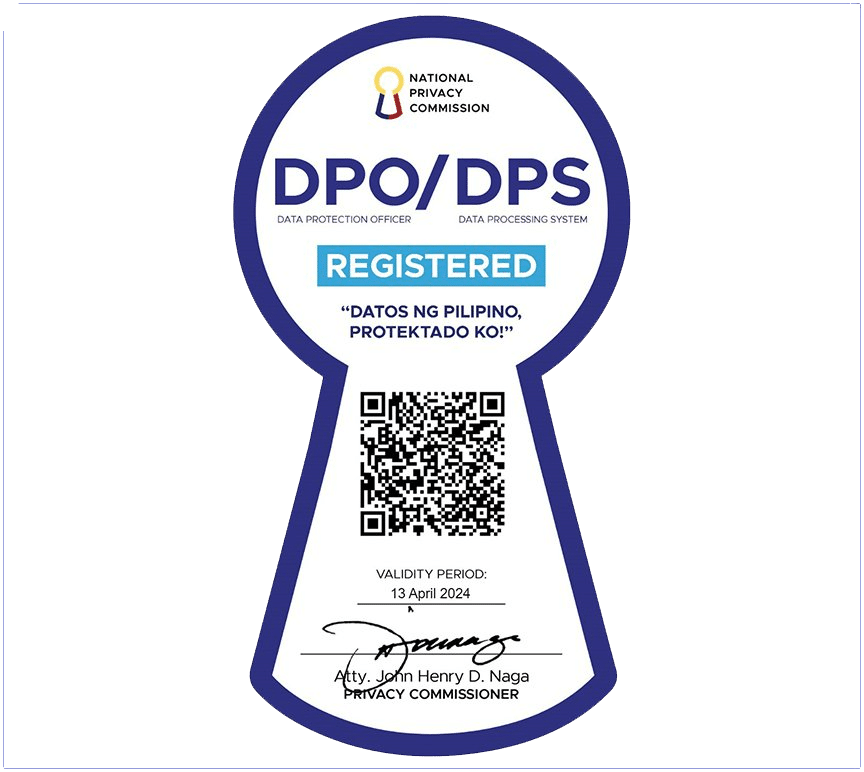
Outsourcing partners have significantly advanced their data protection standards. Many hold globally recognized certifications for security, quality management, and process control. They invest in secure facilities, encrypted systems, structured access controls, and redaction workflows that exceed what most internal teams can build on their own.
When businesses outsource data annotation services, they often gain stronger, more disciplined security practices than they would achieve internally. This shift in capability is why regulated industries such as healthcare, fintech, biotech, and insurance increasingly turn to outsourcing to support their AI workflows responsibly.
Outsourcing Evolves From Task Execution to Strategic AI Enablement
The nature of outsourcing has changed. It is no longer about performing basic tasks at lower cost. The best outsourcing partners now participate directly in AI design, workflow creation, data strategy, and model evaluation. They collaborate with enterprises to build end-to-end AI pipelines that support development, monitoring, refinement, and governance.
This strategic shift means companies no longer treat annotation as a transactional line item. Instead, it becomes a core component of their AI operations. Partners work hand-in-hand with internal teams to improve labeling consistency, design datasets, build documentation, reduce bias, and accelerate iterative model improvement.
Companies that outsource data annotation services gain access not only to labor but also to expertise, operational structure, and AI-adjacent capabilities. This expands their ability to innovate faster while ensuring their AI systems remain reliable and compliant.
Trends From 2025 to 2030 Point to Sustained Growth in Annotation Demand
The next five years will bring dramatic shifts in how businesses use AI. Multimodal models will become standard. Reinforcement learning from human feedback will be required for most enterprise applications. Continuous learning systems will demand constant data updates. Generative AI will move deeper into regulated industries and mission-critical workflows.
Every one of these trends requires more human annotation, not less.
As AI grows more sophisticated, the need for diverse, high-quality, and frequently refreshed datasets becomes more urgent. Companies will not be able to support these needs internally. The scale, specialization, and operational intensity required will push more industries to outsource data annotation services as a foundational strategy for AI success.
Enterprises that embrace outsourcing will be able to move quickly and confidently. Those that resist will be left behind in both speed and quality.
Outsource Data Annotation Services to the BPO Professionals at SuperStaff
Data annotation has moved from a behind-the-scenes task to a strategic pillar of AI success. As AI becomes a mission-critical function for organizations worldwide, the infrastructure that supports it must evolve. Outsourcing meets the core demands of modern AI development: cost efficiency, scale, speed, accuracy, domain expertise, and data security.
Companies that outsource data annotation services position themselves to innovate faster, minimize risk, and build AI systems that remain competitive as technology evolves. The future of AI operations depends on reliable, continuous access to high-quality training data. Outsourcing to SuperStaff ensures that companies can meet this requirement without overburdening internal teams or compromising standards.
In 2025 and beyond, the organizations that thrive will be those that build strong global partnerships and view annotation not as a manual task but as an essential component of responsible, scalable AI operations.
Are you searching for the best companies to outsource data annotation in 2025? Contact us today to find out what our innovative BPO team can do for you.