

Customer experience has come a long way from the days of long hold times, scripted replies, and one-size-fits-all service. Today’s most successful brands share a secret: They understand the science behind what makes buyers feel valued, heard, and emotionally connected. The best-performing companies with great customer service are not just efficient. They are deeply aware of buyer psychology, and they build their entire service playbook around it.
In an era where competitors are only a click away, this mastery of behavioral insight has become a crucial competitive advantage. Understanding how people think, decide, and react allows brands to shape experiences that reduce friction, inspire trust, and strengthen loyalty.
Here is a closer look at what the top companies with great customer service know about the mind of the modern buyer and how any business can use these principles to elevate support operations.
Psychology in Customer Service: Understanding How to Give the Best Possible Buyer Experience
The most trusted companies with great customer service treat customer interactions as emotional events, not transactional moments. They understand that behind every inquiry is a psychological trigger that, if handled well, leads to positive memory formation.
Below are the psychological principles most high-performing customer-centric companies rely on:
1. The Need for Cognitive Ease
People prefer interactions that feel simple, fast, and intuitive. When a problem is easy to solve, the brain rewards the experience with a sense of satisfaction.
Companies with great customer service excel here. They reduce complexity at every customer touchpoint. Short wait times, clear communication, frictionless processes, and proactive updates deliver the cognitive ease buyers crave.
This is why self-service portals, real-time chat, and knowledgeable agents make such an impact. When the brain experiences ease, customers interpret the brand as trustworthy.
2. The Power of Emotional Contagion
Customer emotions influence agent behavior, and agent behavior influences customer emotions. Top brands understand this two-way exchange and train teams to maintain a steady, positive emotional tone.
This is not accidental. Neuroscience shows that mirror neurons cause people to subconsciously mimic the emotions of the person they are speaking with. Calm and empathetic agents can transform frustration into cooperation.
Companies with great customer service consistently invest in empathy training for this reason. They know that tone matters just as much as the solution itself.
3. The Peak-End Rule
Behavioral scientists say people remember an experience based on two key moments: the emotional peak and the final impression. This means that even if the entire interaction is not perfect, the ending can dramatically influence how customers recall the event.
High-performing service organizations design interactions with this in mind. They ensure customers leave the conversation feeling supported, reassured, and confident that the issue is fully resolved.
4. The Human Need for Recognition
Every buyer wants to be seen, heard, and acknowledged. Companies with great customer service know that personalization is not optional. It is psychological currency.
Using a customer’s name, referencing their history, and tailoring recommendations tap into the deep emotional need for recognition. People feel valued when their uniqueness is acknowledged, and that emotional connection often becomes a loyalty anchor.
5. Loss Aversion and the Urgency to Resolve Issues
Customers are more sensitive to losses than gains. A delayed shipment feels worse than a discount feels good. An unanswered message can trigger anxiety far more quickly than a positive update produces joy.
Because of this, companies with great customer service take proactive measures. Real-time notifications, rapid escalation systems, and diligent follow-through prevent small concerns from turning into perceived losses.
They also understand that speed is part of psychology. Quick response times reassure the customer’s brain that “everything is under control,” reducing emotional friction.
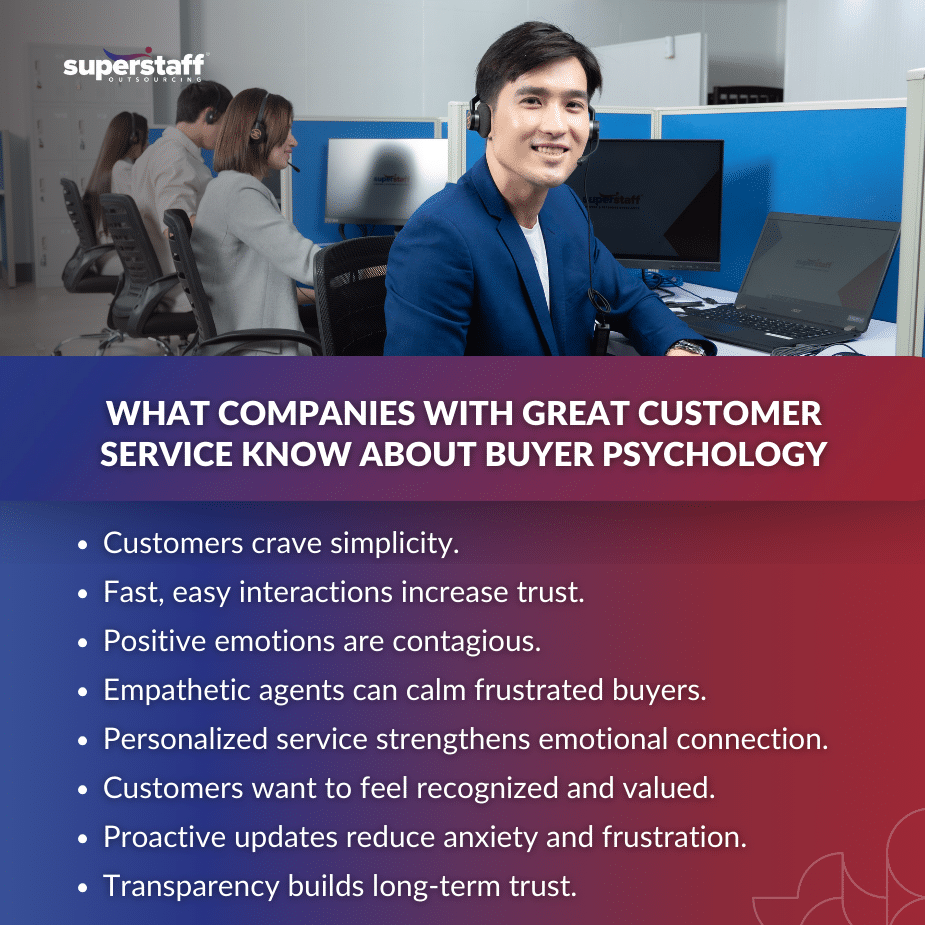
Customer Service Best Practices: How Top Brands Apply Buyer Psychology in Everyday Interactions
Understanding psychological principles is one thing. Operationalizing them is another. The most respected companies with great customer service translate behavioral insights into practical CX strategies.
Below are the ways they apply psychology to deliver high-impact support.
They Reduce Effort at Every Step
The Effort Reduction Model is a cornerstone of behavioral science. Buyers reward brands that save them time and energy.
Leading brands:
- Design clear, intuitive support pathways.
- Use automation for simple tasks.
- Guide customers with easy, step-by-step instructions.
- Eliminate redundant verification steps.
- Provide multiple convenient channels: chat, email, phone, and social.
Every second saved strengthens trust.
They Build Trust Through Transparency
Trust is emotional. Customers want honesty, clarity, and follow-through. Companies with great customer service are transparent about wait times, fees, delays, policies, and expectations.
They follow a simple formula:
- Tell the customer what will happen.
- Tell them when it will happen.
- Follow through exactly as promised.
- Communicate proactively if anything changes.
This satisfies the brain’s need for predictability.
They Train Agents to Become Emotional Anchors
Instead of focusing only on technical knowledge, top brands train for emotional intelligence. Agents learn to:
- Validate feelings.
- Match tone appropriately.
- Apologize sincerely.
- De-escalate tension.
- Guide conversations without sounding robotic.
Psychologically, this anchors the interaction in safety and assurance. The customer feels supported rather than judged.
They Personalize the Experience
The modern buyer expects brands to know them. Personalized service taps into recognition psychology.
Companies with great customer service use customer data not for surveillance but for connection. They tailor replies, recommendations, and solutions based on history, preferences, and previous interactions.
This creates emotional consistency that the brain interprets as “relationship.”
They Celebrate the “Moment of Delight”
Top CX organizations engineer small moments of surprise that activate the brain’s dopamine system.
Examples include:
- Sending thoughtful follow-up messages.
- Offering unexpected upgrades.
- Resolving issues faster than promised.
- Including handwritten notes with products.
- Turning a mistake into a positive experience.
These memorable peaks strengthen long-term loyalty.
Why Companies With Great Customer Service Win More Buyers
Businesses that understand buyer psychology do more than resolve problems. They shape behavior. They create emotional memory structures that influence:
- repeat purchases,
- advocacy,
- trust,
- satisfaction, and
- brand attachment.
Companies with great customer service win more buyers because they understand that behavior is shaped by emotion more than logic.
Here is why they consistently outperform competitors:
1. They Reduce Churn
Customers who feel reassured and respected do not leave easily. Emotional satisfaction is a powerful retention tool.
2. They Turn Service Into Differentiation
Many products are interchangeable. Service is not. Psychological insight gives top companies a unique competitive edge.
3. They Generate Higher Lifetime Value
Satisfied customers buy more often, try more products, and stay longer.
4. They Turn Customers Into Advocates
Word of mouth is one of the strongest forms of social proof. Positive emotions create powerful storytelling.
5. They Create Consistent Experiences
Reliability reduces cognitive stress. Consistency builds trust.
How to Apply These Principles in Your Own Support Strategy
Any business, regardless of size, can adopt the strategies used by companies with great customer service. You can start by:
- Training teams on empathy and emotional awareness.
- Keeping processes simple and removing friction.
- Using customer history for personalization.
- Reducing the perceived effort required to reach solutions.
- Delivering clear, proactive communication.
- Creating positive “peak moments.”
- Ending every interaction on a strong, reassuring note.
The goal is not just to fix issues. It is to make customers feel psychologically safe, valued, and supported.
Want to Be Like the Top Companies With Great Customer Service? Partner With SuperStaff!
Buyer psychology is not an abstract concept. It is the foundation of customer experience. Companies with great customer service understand the emotional architecture of human decision-making and design their operations around it.
They know that satisfaction is a science. And once you apply that science correctly, customer loyalty is no longer a mystery. It becomes a predictable outcome.
Are you ready to elevate your customer experience strategy? The CX professionals at SuperStaff are here to help you get started.
Did you enjoy reading our best practices for delivering exceptional customer service? Take the next step. Connect with our BPO team, and find out how our comprehensive outsourcing solutions can benefit your brand!