Global supply chains will remain under pressure in 2025. Volatile trade policies, ocean freight disruptions, inflation-driven cost spikes, and workforce shortages continue to challenge even the most established companies. As CEOs re-evaluate their long-term operational models, one shift is becoming clear: leaders are building their supply chain outsourcing strategy around the Philippines.
The Philippines has become a preferred destination for supply chain operations not because of cost advantages alone, but because of its unique combination of skilled talent, operational resilience, global time zone alignment, and proven excellence in logistics, customer support, and back-office coordination. For CEOs navigating unpredictable markets, the country provides something increasingly rare: stability, scalability, and speed.
This blog breaks down why more global executives are anchoring their 2025 decisions on the Philippines—and why a supply chain outsourcing strategy centered on Filipino talent is becoming the new competitive formula.
Why Supply Chain Transformation Is No Longer Optional in 2025
The supply chain landscape has fundamentally changed. Even companies with historically strong logistics networks are facing:
- Delayed shipments and unpredictable transit times
- Expensive workforce shortages in freight, dispatch, and operations
- Customer frustration over slow responses and poor visibility
- Pressure to implement automation without increasing headcount
- Rising overhead costs and margin compression
These challenges have led CEOs to prioritize resilience over ambition. A future-ready supply chain outsourcing strategy must be built on systems that adapt quickly—not just function efficiently.
The urgency is driven by three realities:
1. Digital-first customers expect real-time updates.
Buyers want instant notifications, proactive communication, and accurate ETAs. Traditional in-house teams often cannot keep up, especially during peak surges. Outsourced teams in the Philippines fill this gap with 24/7 availability and specialized logistics tools.
2. Supply chain costs are rising faster than revenue.
Labor, technology, and freight costs have all increased. Outsourcing operational support allows companies to reallocate budgets toward innovation instead of maintenance.
3. CEOs want flexibility, not fixed cost structures.
A scalable supply chain outsourcing strategy allows organizations to expand or contract support based on fluctuating demand.
With the Philippines ready to meet these challenges, the shift toward offshore logistics support has become a strategic—not tactical—decision.
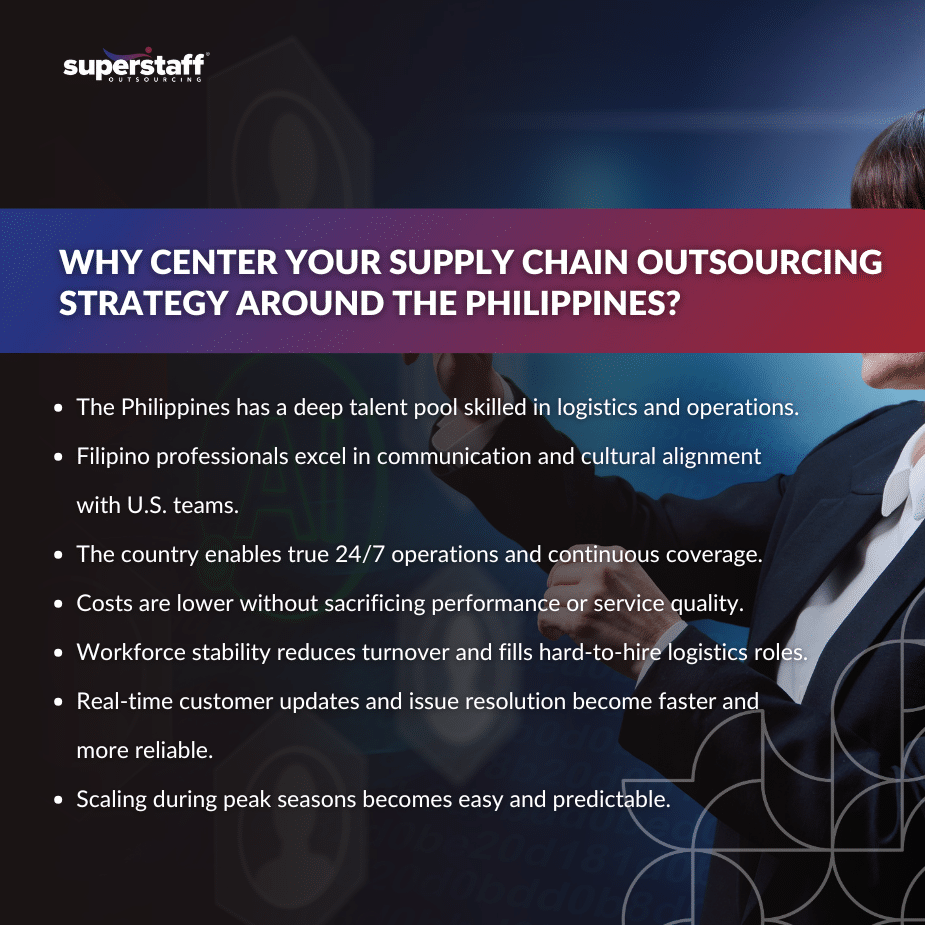
Outsourcing Philippines Benefits: Why the Philippines Is Becoming the Epicenter of Supply Chain Support
1. A Deep Talent Pool Skilled in Logistics, Operations, and Customer Coordination
The Philippines is one of the few countries where supply chain processes, dispatching support, freight coordination, back-office operations, customer service, and tech-enabled logistics tasks are already widely outsourced.
Filipino professionals excel in roles such as:
- Track and Trace Specialists
- Dispatch Support Coordinators
- Freight Documentation Analysts
- Inventory and Purchasing Assistants
- Order Management Specialists
- Carrier and Vendor Support Agents
- Logistics Customer Service Representatives
This maturity gives CEOs confidence that their supply chain outsourcing strategy will run on experienced talent from day one.
2. Cultural Alignment With U.S. Operations
Clear communication is the backbone of smooth logistics management. Filipino professionals offer excellent English proficiency, cross-cultural fluency, and high empathy—making them ideal for:
- Carrier negotiations
- Shipper communication
- Customer escalation support
- Vendor management
- Collaborative workflows with U.S. teams
This alignment reduces errors, speeds up issue resolution, and elevates the customer experience.
3. A 24/7 Follow-the-Sun Model That Eliminates Operational Blind Spots
Freight delays and customer inquiries don’t stop when your local office closes. A Philippines-based supply chain outsourcing strategy enables:
- Overnight status updates
- Real-time exception handling
- Continuous monitoring of high-risk shipments
- Faster customer responses
- Zero downtime during peak seasons
When a U.S. team signs off, the Philippine team signs on. By morning, issues are already resolved.
4. Lower Total Cost Without Lowering Performance
Cost efficiency is a benefit—but not the primary reason CEOs are shifting. The bigger value lies in:
- Reducing the cost of turnover
- Improving fill rates for hard-to-hire roles
- Avoiding expensive overtime or weekend labor
- Lowering technology and training expenses
- Enhancing accuracy and reducing costly supply chain errors
A smart supply chain outsourcing strategy improves both operational and financial performance.
5. Access to Specialized Technology and Process Expertise
Beyond the cost and operational benefits of Philippine supply chain outsourcing, leading offshore providers also support multiple logistics clients across industries. This gives companies access to:
- Deep knowledge of TMS and WMS platforms
- Expertise in automation and process optimization
- Experience with cross-border compliance workflows
- Proven SOPs for track and trace, POD verification, exception management, and order fulfillment
Instead of building in-house systems from scratch, CEOs benefit from ready-made operational infrastructure.
What CEOs Want Their 2025 Supply Chain Outsourcing Strategy to Achieve
Based on industry trends, CEOs are now focused on four strategic priorities:
1. Faster Visibility and Stronger Customer Communication
Real-time freight tracking, POD confirmation, milestone monitoring, and proactive notifications are no longer optional. The Philippines delivers trained teams who can manage these functions with high accuracy and customer empathy.
2. Workforce Stability and Access to Specialized Roles
Supply chain labor shortages in North America continue to disrupt operations. The Philippines fills these critical gaps with reliable, highly-trained professionals who specialize in logistics workflows.
3. Flexible Scaling During Peak Seasons
Peak season surges—holiday demand, promo periods, seasonal fluctuations—often overwhelm local teams. A Philippines-based supply chain outsourcing strategy allows companies to scale staffing in weeks, not months.
4. Transformation Without Internal Disruption
Most U.S. logistics departments are already stretched thin. Outsourcing enables “transformation without turbulence,” allowing companies to improve processes without overwhelming internal teams.
What a Supply Chain Outsourcing Strategy Built on the Philippines Actually Looks Like
A future-ready model includes:
Frontline Logistics Support
- Track and trace
- Driver and carrier communication
- Route updates
- Exception management
- Delay mitigation
Customer-Facing Operations
- Shipment visibility support
- Delivery window coordination
- Issue resolution
- Billing inquiries
Back-Office and Compliance
- POD verification
- Documentation
- Billing preparation
- Inventory data updates
- Order processing
Analytics and Optimization
- Forecast support
- Demand planning assistance
- Process reporting
- Performance dashboards
A mature supply chain outsourcing strategy integrates all four—not as separate tasks but as one cohesive system.
Why CEOs Are Choosing the Philippines Over Other Outsourcing Markets
While India and Latin America also offer strong outsourcing capabilities, the Philippines stands out for supply chain functions because of:
- Exceptional communication skills
- Familiarity with U.S. logistics terminology
- High accuracy in documentation-heavy workflows
- Strong customer service culture
- Long-standing BPO infrastructure
- Operational resilience across weather, political shifts, and global disruptions
Executives increasingly describe the Philippines as “the most dependable global operations engine.”
How CEOs Use Outsourcing to Strengthen Internal Teams—Not Replace Them
A modern supply chain outsourcing strategy is not about offloading entire departments. CEOs use outsourcing to:
- Offload repetitive tasks
- Support understaffed teams
- Stabilize coverage
- Improve customer response times
- Build a hybrid operational model
The goal is not replacement—it’s rebalancing. In-house teams focus on strategy, vendor partnerships, and process improvement while offshore teams handle execution, coordination, and customer communication.
The result: a calm, predictable workflow instead of constant firefighting.
What Happens When a CEO Rebuilds Their Supply Chain Outsourcing Strategy Around the Philippines
While specifics vary, CEOs commonly experience:
- 40–70% faster exception resolution
- 24/7 visibility where none existed before
- Dramatically improved customer satisfaction
- Reduced overtime and burnout
- Clearer forecasting through cleaner data
- Faster onboarding for new supply chain roles
Most CEOs report that their only regret is not shifting sooner.
The 2025 CEO Mandate: Build Resilience Before the Next Disruption Hits
2025 will challenge supply chains—again. Businesses that rely solely on internal staffing will continue to face the same recurring problems: delays, backlogs, and customer dissatisfaction.
A Philippines-based supply chain outsourcing strategy is no longer a competitive advantage. It is becoming the baseline for operational success.
Companies that act early will outperform. Companies that delay will be playing catch-up for years.
Why the Philippines Is the Smartest Anchor for Your Supply Chain Outsourcing Strategy for 2025 and Beyond
The Philippines gives CEOs what they need most:
- A stable talent pipeline
- 24/7 operations
- Cost-efficient scalability
- High-quality logistics expertise
- Strong customer communication skills
- Proven resilience in unpredictable markets
In a world where disruptions are the norm, the Philippines offers something powerful: a dependable foundation for the modern supply chain.
Businesses that build their 2025 supply chain outsourcing strategy around the Philippines will not only survive uncertainty—they will operate with greater clarity, speed, and confidence.
Ready to get started? Partner with SuperStaff today!