
Telemedicine has shifted from a supplemental service to a primary care delivery channel for many providers. As virtual visits increase, operational demands rise alongside them. Patient expectations around responsiveness, clarity, and continuity are higher than ever. To meet those expectations, telemedicine software platforms must be supported by teams that can scale operations without slowing care delivery or overwhelming internal staff.
For SMEs and midmarket healthcare organizations in the United States, nearshore teams in Colombia have become a practical and strategic solution. They help translate digital capability into dependable patient experiences while preserving focus on clinical quality and long-term growth.
Growth in virtual care exposes operational gaps
Telemedicine expands access quickly. It also exposes gaps that were easier to manage in smaller volumes.
As patient traffic increases, scheduling requests pile up. Intake documentation becomes harder to track. Technical questions multiply across devices and platforms. These pressures often land on the same internal teams responsible for care coordination or product oversight.
Telemedicine software platforms may be technically sound, yet still struggle to deliver consistent service without operational reinforcement. Nearshore support addresses this challenge by absorbing repeatable, time-sensitive tasks that keep virtual care moving.
The role of nearshore teams in day-to-day operations
Nearshore telemedicine support teams in Colombia strengthen the workflows that surround every virtual visit. Their work is not clinical. It is operational, patient-facing, and tightly integrated with internal systems.
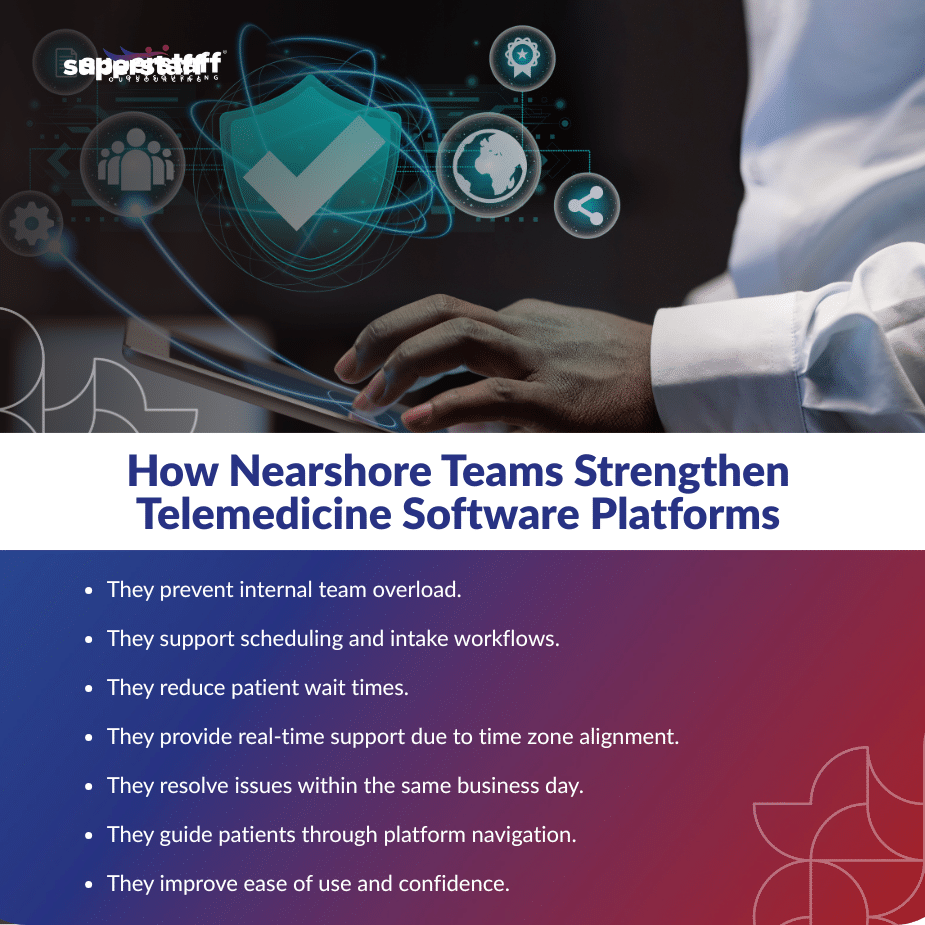
They handle appointment coordination, patient onboarding, follow-up communication, and non-clinical support tickets. These functions ensure telemedicine software platforms operate smoothly across every stage of the patient journey.
By externalizing these responsibilities, providers reduce friction while maintaining full visibility and control over care delivery standards.
Time zone proximity strengthens responsiveness
One of the most practical advantages of nearshore outsourcing is time zone alignment with the United States. Nearshore teams in Colombia operate during overlapping business hours, enabling faster resolution of issues and smoother collaboration.
Questions from patients can be addressed the same day. Workflow adjustments do not wait overnight. Escalations reach internal teams while decisions can still be made in real time.
For telemedicine software platforms supporting urgent care or scheduled visits, this responsiveness directly affects patient satisfaction and operational stability.
Supporting patient confidence in digital care
Virtual care depends heavily on patient confidence. When patients struggle to log in, upload information, or understand next steps, trust erodes quickly.
Nearshore teams help patients navigate digital interactions with clarity and patience. They reinforce instructions, confirm expectations, and provide consistent guidance across channels.
This human layer strengthens telemedicine software platforms by making them easier to use, even for patients who are less comfortable with technology.
Reducing clinician and staff overload
Clinicians are not meant to manage scheduling errors or technical questions. Administrative overload contributes to burnout and distracts from patient care.
Here’s another critical reason why healthcare companies outsource telemedicine software support to Colombia: Nearshore teams absorb operational volume so clinical staff can focus on outcomes rather than logistics. They triage non-clinical requests and resolve issues before they escalate.
This separation of responsibilities allows telemedicine software platforms to support care delivery without adding stress to already stretched teams.
Colombia’s workforce aligns with healthcare operations
Colombia has developed a strong base of professionals experienced in healthcare-adjacent services. Many are familiar with U.S. healthcare workflows, patient privacy expectations, and service quality standards.
This familiarity reduces onboarding time and improves execution consistency. Nearshore teams can be trained to work within specific telemedicine software platforms without constant oversight.
Their ability to follow structured processes makes them a reliable extension of internal operations rather than a disconnected support layer.
Process discipline supports compliance efforts
Compliance in telemedicine depends on consistency. While policy decisions remain internal, execution happens across daily interactions.
Nearshore teams reinforce compliance through disciplined adherence to workflows. They follow documentation standards, respect access controls, and escalate exceptions appropriately.
Telemedicine software platforms benefit from this structure because risk is reduced through predictable, repeatable execution rather than ad hoc fixes.
Improving platform adoption and user satisfaction
Adoption is often underestimated in telemedicine rollouts. New features, updates, or integrations require user support to succeed.
Nearshore teams assist patients and providers during transitions. They answer common questions, provide step-by-step guidance, and flag recurring issues for internal review.
This feedback loop helps telemedicine software platforms improve usability while minimizing disruption during change.
Scaling without compromising service quality
Growth often forces trade-offs. Many organizations struggle to scale without sacrificing response times or service consistency.
Nearshore teams enable flexible capacity planning. Support levels can increase during peak periods without restructuring internal teams. Coverage remains stable even as demand fluctuates.
Telemedicine software platforms supported by this model are better positioned to handle growth without eroding patient experience.
Cost efficiency tied to operational stability
Cost savings alone do not justify outsourcing in healthcare. Predictability and reliability matter more.
Nearshore teams in Colombia offer cost efficiency alongside operational maturity. Providers avoid constant hiring cycles and reduce overtime pressure on internal staff.
Telemedicine software platforms benefit from steady support structures that grow with demand rather than reacting to it.
Building long-term resilience into virtual care
Healthcare delivery is rarely linear. Demand shifts due to seasons, policy changes, or unexpected events.
Nearshore support adds resilience by providing a buffer against volatility. Teams can adapt to volume changes without compromising service levels.
This flexibility strengthens telemedicine software platforms by ensuring continuity even under pressure.
Strategic focus enabled by operational clarity
Leadership teams need space to think strategically. When daily operations consume attention, innovation slows.
Nearshore teams handle execution so leadership can focus on platform development, care models, and patient outcomes. Telemedicine software platforms perform better when strategy is not crowded out by operational noise.
This division of labor supports sustainable growth rather than short-term fixes.
Why partnership quality matters
Healthcare operations demand accountability and alignment. Nearshoring works best when teams feel integrated, not outsourced.
SuperStaff builds dedicated nearshore teams in Colombia that align with client workflows, performance expectations, and service standards. These teams operate as an extension of internal operations, supporting telemedicine software platforms with consistency and care.
The focus is long-term partnership, not transactional support.
Scale Up Telemedicine Software Platforms With the Right Nearshore Partner
Telemedicine will continue to expand across specialties and patient populations. Technology alone will not determine success. Execution will.
Nearshore teams in Colombia provide the operational foundation that helps telemedicine software platforms remain reliable, responsive, and patient-focused as they grow.
If your organization is looking to scale virtual care without overburdening internal teams, SuperStaff can help.
Explore how our nearshore healthcare support teams can strengthen your telemedicine operations and support sustainable growth.