
Customer expectations have changed, but many service operations have not kept pace. Today’s buyers want fast answers, clear communication, and consistent outcomes across every interaction. They expect the same level of service whether they call once a year or every week. For leadership teams, this raises a practical challenge. How do you deliver dependable service at scale without driving up costs or exhausting internal teams?
This is where executives begin to rethink service delivery models. The conversation shifts from staffing to structure, from coverage to consistency. What is great customer service becomes less about individual interactions and more about building a system that performs reliably under pressure. For many top brands, offshoring has become a strategic part of that system when it is designed with discipline, clarity, and accountability from day one.
What Great Customer Service Really Means Today
Great service starts with reliability. Customers want accurate answers, fast resolution, and respectful interactions every time they reach out. Consistency matters more than charm.
From an executive lens, what is great customer service comes down to outcomes. Issues are resolved on the first contact. Customers do not repeat themselves. Promises made by marketing match the experience delivered by support.
This definition shifts service from a soft function to a measurable business capability.
Why Consistency Is the Hardest Part
Many companies understand service standards. Fewer can deliver them at scale. Growth introduces volume spikes, new channels, and longer operating hours.
This is where leaders revisit what is great customer service in operational terms. It requires staffing depth, stable processes, and quality control that works across time zones. Internal teams alone often struggle to meet these demands without burnout or rising costs.
Consistency is not about hero agents. It is about systems that work even on the busiest days.
Offshoring Customer Service Best Practices: How Filipino Teams Support Service Discipline
Offshoring succeeds when it is designed around service quality. The strongest brands use offshore teams to reinforce structure and coverage.
They revisit what is great customer service and translate it into workflows. Scripts support clarity, not rigidity. Knowledge bases are updated continuously. Escalation paths are clear and fast.
Offshore teams are not treated as overflow. They are integrated into the core service operation.
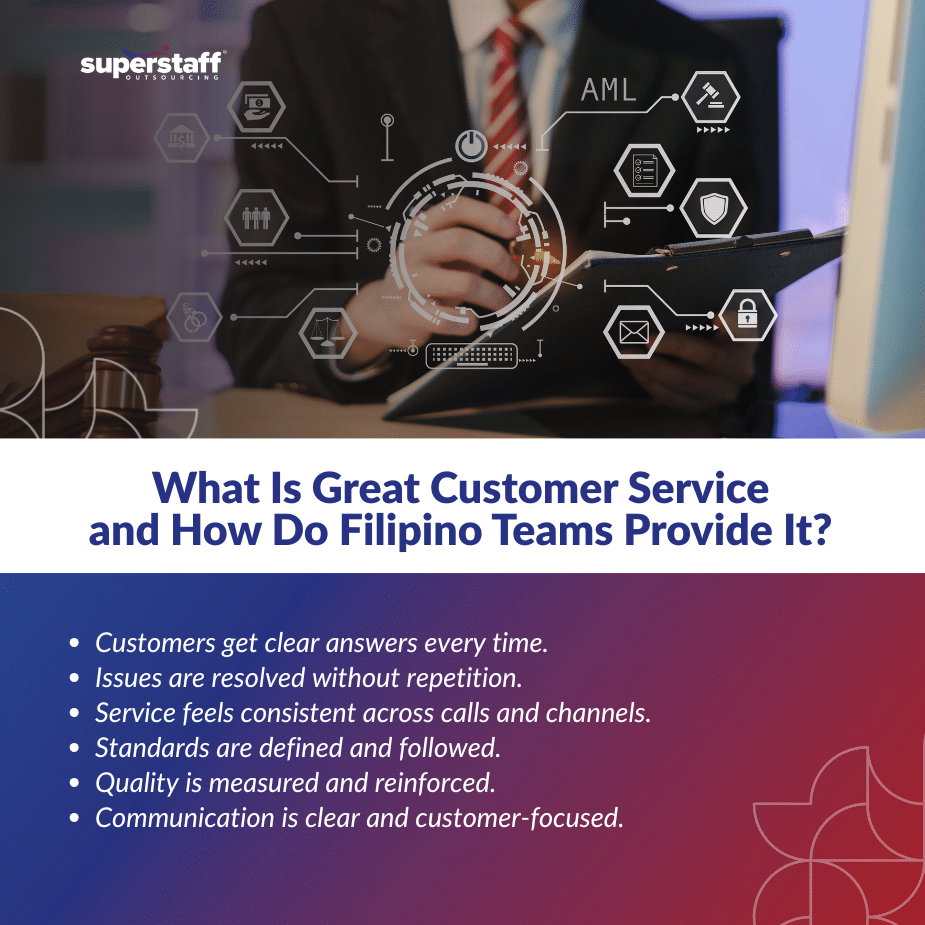
The Philippines Advantage for Customer Service
The Philippines remains a leading destination for customer support for clear reasons. Talent depth, service orientation, and cultural alignment with U.S. customers are well established. English proficiency is strong, and communication tends to be clear, neutral, and customer-focused.
Companies that define what is great customer service operationally find that Philippine teams adapt quickly. Agents absorb brand guidelines fast. They apply tone standards consistently. They understand when to follow scripts and when to use judgment.
What Is Great Customer Service for Filipino Teams?
Here are a few examples of excellent customer service traits exhibited by Filipino teams: Work ethic plays a role in delivering excellent customer experiences. Philippine customer service professionals are accustomed to performance-based environments. They respond well to coaching, quality reviews, and structured feedback. This creates steady improvement rather than uneven results.
Process discipline is another advantage. Agents follow workflows closely. They respect escalation paths. They document interactions thoroughly, which supports continuity across teams and time zones.
Accountability extends beyond activity metrics. Teams take ownership of resolution quality, not just volume. Supervisors focus on consistency across shifts, not isolated wins.
All of this makes dependable service achievable across channels and operating hours. For U.S. companies that need scale without losing control, the Philippines offers a customer service model built for reliability.
Training That Reinforces Brand Standards
Top brands invest heavily in onboarding and continuous training. Offshoring does not reduce this need. It increases its importance.
Clear training frameworks help answer what is great customer service for each brand. Tone guidelines are specific. Product knowledge is reinforced weekly. Coaching focuses on decision quality, not call time alone.
Well-trained offshore teams deliver service that feels aligned, not outsourced.
Process Ownership Drives Better Outcomes
Consistency improves when ownership is clear. Leading companies assign offshore teams responsibility for defined service segments.
This approach reframes what is great customer service as an operational contract. Teams own resolution rates, customer feedback trends, and compliance metrics. They are accountable for improvement, not just execution.
Ownership builds confidence on both sides of the partnership.
Technology as an Enabler, Not a Crutch
Strong service operations rely on the same tools across locations. CRM platforms, QA systems, and reporting dashboards must be shared.
When leaders define what is great customer service, they align technology to support it. Agents see full customer history. Supervisors track patterns, not just tickets. Insights flow back into training and process updates.
Technology supports consistency when paired with discipline.
Scaling Without Losing Control
Growth often exposes service gaps. New markets and channels increase complexity fast.
Brands that revisit what is great customer service during scaling decisions use offshoring to stay ahead. They add capacity without compromising standards. They extend hours without exhausting core teams.
This balance protects both customer experience and internal morale.
Measuring What Matters
Metrics shape behavior. High-performing organizations choose metrics that reflect customer outcomes.
Their definition of what is great customer service includes resolution quality, adherence to process, and customer trust signals. Volume metrics still matter, but they do not dominate.
This measurement discipline keeps offshore teams aligned with brand priorities.
Why Execution Matters More Than Location
Offshoring fails when treated as a cost tactic. It succeeds when treated as an operating strategy.
Companies that are clear on what is great customer service build offshore models that reinforce it daily. They invest in leadership, communication, and continuous improvement. Location becomes an advantage, not a risk.
The result is service that feels consistent, dependable, and professional.
Wondering About What Is Great Customer Service? Find a Practical Path Forward With SuperStaff
Are you wondering how top brands deliver great customer service through offshoring? Excellent service does not happen by accident. It is designed, trained, measured, and reinforced.
At SuperStaff, we help U.S. SMEs and midmarket companies operationalize what is great customer service through dedicated offshore teams in the Philippines. Our model focuses on integration, accountability, and long-term performance.
If you are ready to deliver consistent customer service at scale without losing control, explore how SuperStaff can support your growth. Let’s build a service operation your customers can rely on.