
Healthcare compliance is no longer a back-office concern. It sits at the center of operational risk, patient trust, and long-term growth. As regulations expand and enforcement tightens, many organizations are reassessing how their compliance functions are staffed and supported.
For healthcare compliance companies, the pressure is constant. Documentation must be accurate. Processes must be repeatable. Teams must follow strict protocols without slowing the business. This is where offshore support in the Philippines has become a practical solution rather than a tactical shortcut.
The Philippines offers a compliance-ready workforce built for structure, consistency, and accountability. When managed correctly, offshore teams strengthen compliance operations instead of introducing risk.
Why Compliance Work Is Moving Offshore
Compliance workloads have grown steadily. Regulatory updates arrive faster. Audits require more documentation. Reporting cycles shorten. Internal teams often struggle to keep pace without adding headcount.
Healthcare compliance companies are responding by outsourcing defined compliance functions to offshore teams that operate under strict governance. The goal is stability. The outcome is scalability without losing control.
HIPAA compliance Philippines outsourcing teams excel in this environment because they are trained to follow processes. They work well within documented frameworks. They value accuracy and consistency. These traits align directly with compliance demands.
The Philippines as a Compliance Operations Hub
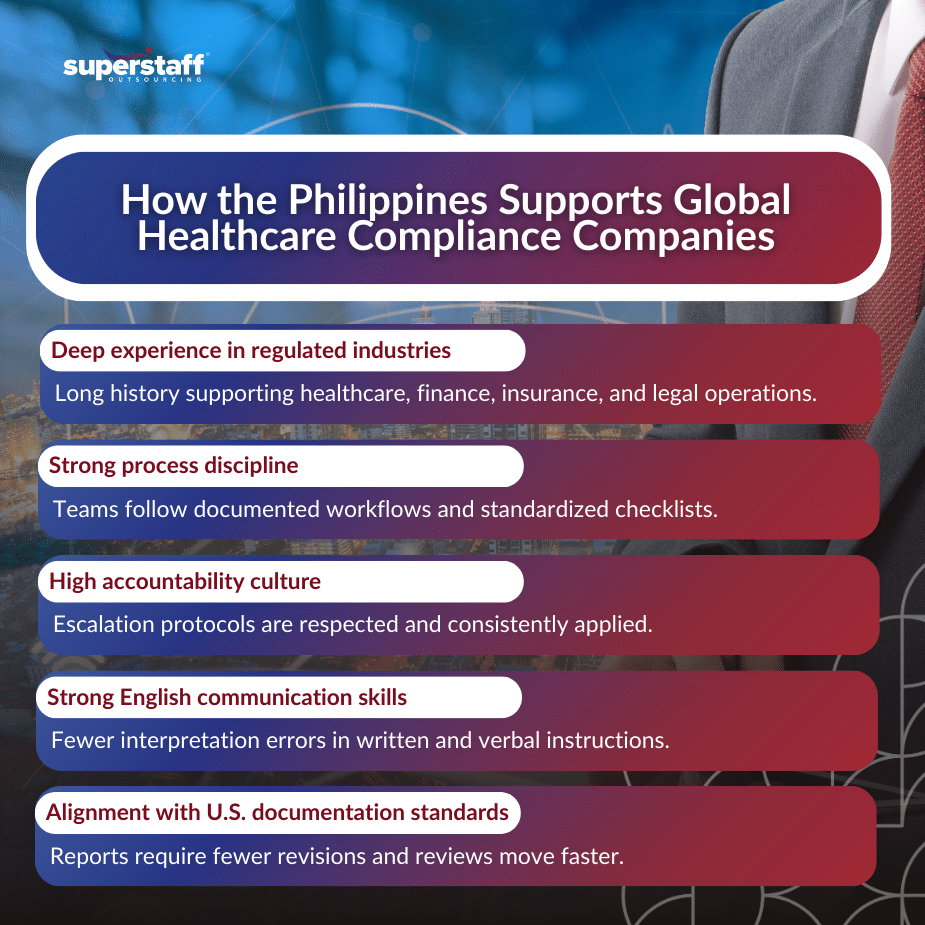
The Philippines has supported regulated industries for decades. Healthcare, insurance, finance, and legal services have long relied on Filipino teams to manage sensitive, rules-based work where accuracy and consistency are nonnegotiable. This foundation gives offshore compliance teams a level of operational maturity that newer markets often lack.
Healthcare compliance companies benefit from a workforce trained to operate within defined frameworks. Offshore professionals are accustomed to working from written policies, version-controlled documents, and step-by-step procedures. Structured documentation, standardized checklists, and escalation protocols are embedded into daily workflows. These practices are reinforced through quality reviews and supervisory oversight, not left to individual judgment.
This operational discipline reduces variance. Tasks are performed the same way every time. Deviations are identified early and escalated appropriately. For healthcare compliance companies, this predictability supports audit readiness and lowers operational risk.
The Linguistic and Cultural Edge
English fluency also plays a critical role. The Philippines consistently produces professionals with strong written and verbal English skills, shaped by an education system and work environment aligned with U.S. communication standards. Clear communication reduces interpretation errors. Instructions are followed as written. Clarifications happen quickly when questions arise.
When providing healthcare back office support services, Philippine teams ensure written reports align closely with U.S. expectations in tone, structure, and terminology. Documentation reviews move faster because fewer revisions are required. Compliance leaders spend less time correcting language and more time validating substance.
Time zone overlap further strengthens this hub model. Philippine teams can support U.S. compliance operations during extended business hours. Questions are resolved within the same workday. Issues do not sit overnight waiting for follow-up. This responsiveness improves coordination without disrupting internal teams.
Taken together, these factors position the Philippines as more than a delivery location. It functions as a reliable compliance operations hub where healthcare compliance companies can scale structured work with confidence, consistency, and control.
Alignment With U.S. Healthcare Standards
Healthcare compliance companies supporting U.S. clients require teams that understand American healthcare operations. Philippine offshore teams are trained around U.S. healthcare workflows, terminology, and documentation practices.
This alignment reduces onboarding friction. Teams understand how provider networks operate. They recognize payer-provider relationships. They work within HIPAA-aware environments when properly supported by their BPO partner.
Offshore does not mean disconnected. With the right governance, Philippine teams operate as an extension of U.S.-based compliance departments.
Roles Commonly Outsourced in Compliance Operations
Offshore compliance support works best when responsibilities are clearly defined. Many healthcare compliance companies start with operational roles that require consistency and attention to detail.
Commonly outsourced functions include:
- Compliance documentation review and formatting
- Policy and procedure maintenance support
- Audit preparation assistance
- Incident tracking and reporting
- Regulatory correspondence coordination
- Credentialing and verification support
These roles support compliance leaders without replacing decision-making authority. Oversight remains with U.S. stakeholders.
Process Discipline Over Speed
Compliance success depends on discipline. Speed matters only when accuracy is protected. Philippine offshore teams are known for process adherence. This mindset reduces risk.
Healthcare compliance companies benefit from teams that follow checklists precisely. Deviations are flagged early. Escalation protocols are respected. This approach creates predictable outcomes.
Process discipline also simplifies audits. Documentation is organized. Version control is maintained. Records are easy to retrieve when regulators ask.
Managing Risk Through Structure
Offshore compliance requires governance. The Philippines succeeds when supported by strong frameworks. Clear role definitions. Documented workflows. Access controls. Regular reviews.
Healthcare compliance companies that invest in structure experience fewer offshore risks. Teams understand boundaries. Tasks remain within defined scopes. Compliance leaders retain visibility through reporting and dashboards.
Risk decreases when offshore operations are designed intentionally rather than improvised.
Cultural Fit Matters in Compliance Work
Compliance work demands professionalism and accountability. Philippine work culture aligns well with these expectations. Teams respect hierarchy. They follow authority. They value quality control.
Healthcare compliance companies often note lower attrition in compliance-focused roles. Stability matters when institutional knowledge is critical. Philippine teams tend to stay longer in structured roles with clear expectations.
This continuity improves accuracy over time. Fewer errors occur as teams gain familiarity with internal policies.
Data Protection and Access Management
Healthcare compliance companies must protect sensitive information. Offshore support requires strict access controls. The Philippines supports this through mature BPO infrastructure.
Secure facilities. Role-based system access. Monitored environments. These are standard when working with experienced providers like SuperStaff.
Compliance leaders control what data is shared. Offshore teams access only what is necessary to complete assigned tasks. This limits exposure while maintaining productivity.
Scaling Compliance Without Overloading Leaders
As healthcare organizations grow, compliance workloads expand unevenly. New regulations appear. Mergers introduce complexity. Audit cycles overlap.
Healthcare compliance companies use offshore teams to absorb operational load without distracting senior leaders. Compliance officers stay focused on interpretation and strategy. Offshore teams manage execution.
This balance improves performance without adding unnecessary internal pressure.
Why the Philippines Delivers Long-Term Value
Here’s how the Philippines supports global healthcare compliance companies: Offshore compliance is not only about short-term savings. It is about building resilient operations. The Southeast Asian country offers consistency, talent depth, and operational maturity.
Healthcare compliance companies that partner with the right BPO gain a long-term advantage. Processes stabilize. Documentation improves. Audit readiness becomes routine.
This reliability matters more than cost alone.
Choosing the Right Offshore Partner
Not all offshore models are equal. Compliance work requires specialization. Healthcare compliance companies should choose partners with healthcare experience, governance frameworks, and compliance training.
SuperStaff focuses on building dedicated teams aligned with client standards. Roles are customized. Training reflects client-specific requirements. Oversight remains transparent.
This approach ensures offshore compliance support strengthens operations rather than introducing uncertainty.
Strengthening Healthcare Compliance Companies With Strategic Offshore Support
Healthcare compliance companies operate under constant scrutiny. Every process must withstand review. Offshore support in the Philippines delivers structure, accountability, and operational discipline when done correctly.
With the right partner, healthcare compliance companies can scale compliance operations without sacrificing control or credibility. SuperStaff helps organizations build offshore teams that meet U.S. healthcare standards and support long-term compliance goals.
If your compliance operation is stretched and growth is increasing complexity, explore how SuperStaff can support your compliance strategy with dedicated offshore teams built for accuracy and trust.