
U.S. logistics firms are operating in an environment defined by constant pressure. Customers expect faster delivery. Inventory cycles are tighter. Service failures are visible immediately and often irreversible.
Warehouses sit at the center of this pressure. When warehouse execution breaks down, transportation schedules slip, inventory accuracy erodes, and customer confidence weakens. This reality is forcing leaders to rethink how warehouse operations are staffed, managed, and scaled.
As a result, outsourcing warehouse operations to Colombia is becoming a strategic response rather than a tactical experiment. The move reflects a desire for speed, cost predictability, and operational control in a single operating model.
Why Warehousing Has Become a Strategic Decision
Warehouse operations used to be treated as fixed infrastructure. Today, they are a variable that directly affects competitiveness.
Labor availability in the U.S. remains uneven. Hiring cycles stretch longer than demand planning cycles. Training investments are repeatedly lost to turnover. These conditions make consistent execution difficult.
Executives are responding by reexamining location strategy. Outsourcing warehouse operations allows firms to regain stability in an area where instability has become the norm.
Colombia’s Evolution as a Logistics Support Market
Colombia did not emerge overnight as a logistics destination. Its growth has been gradual and operationally grounded.
The country has invested in industrial zones, port connectivity, and logistics education. Many professionals now have experience supporting North American supply chains across retail, manufacturing, and third-party logistics.
For U.S. firms outsourcing warehouse management, Colombia offers operational maturity without the distance challenges associated with far-off offshore locations. Colombia
Time Zone Alignment Reduces Execution Friction
Logistics depends on coordination. Small delays compound quickly when teams operate asynchronously.
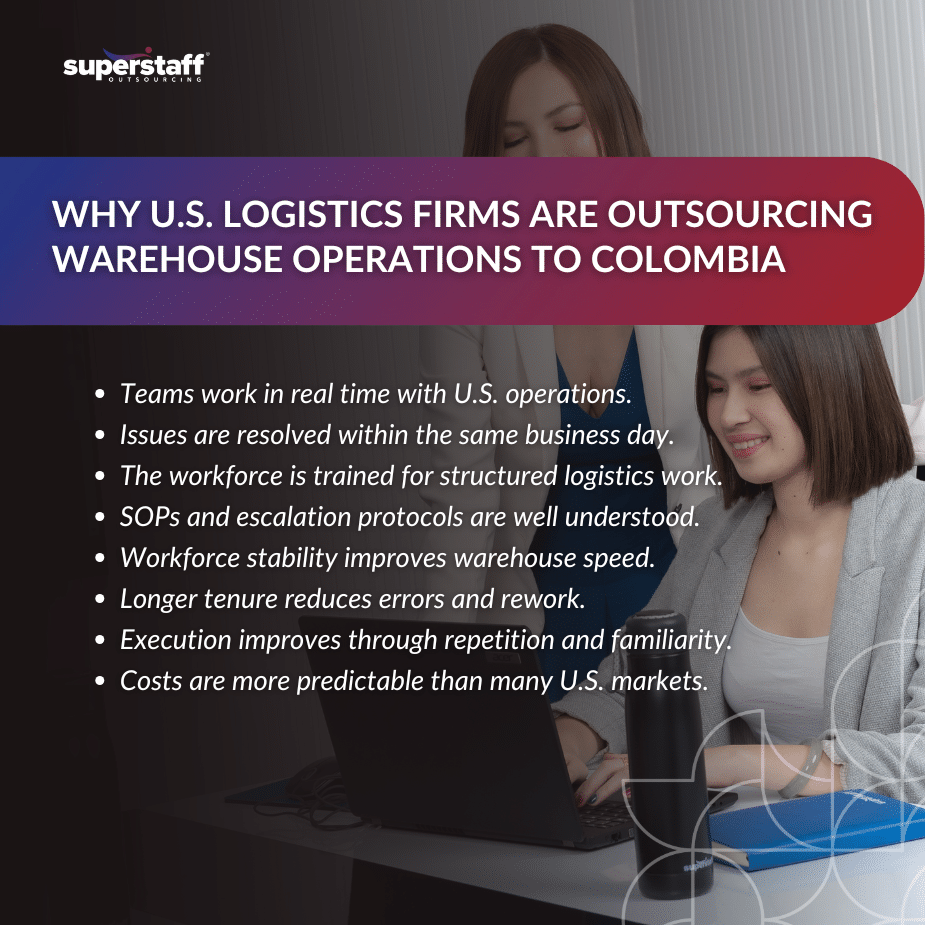
Colombian warehouse teams work on U.S. business hours. Planning discussions happen live. Issues are resolved the same day rather than being deferred across time zones.
Companies outsourcing warehouse operations benefit from this immediacy. It reduces miscommunication and allows U.S.-based leaders to stay actively engaged in daily execution.
Workforce Stability Drives Performance Gains
Warehouse performance improves with familiarity. Teams providing outsourced fulfillment services understand layouts, systems, and workflows, making fewer mistakes and moving faster.
Colombia offers a more stable logistics workforce than many U.S. markets. Employees often remain in roles longer, allowing training investments to compound.
For organizations outsourcing warehouse operations, this stability translates into measurable operational benefits. Picking accuracy improves. Exception handling becomes more consistent. Ramp-up periods shorten over time.
Process Discipline as an Operating Norm
Warehouse success depends on adherence to process. Shortcuts create downstream failures.
Colombian logistics teams are accustomed to structured operating environments. As such, SOPs, checklists, and performance reviews are standard expectations rather than compliance burdens.
When firms pursue outsourcing warehouse operations, they gain teams that respect documentation, escalation paths, and audit requirements. This discipline supports control even as operations scale.
Cost Control That Supports Long-Term Planning
Cost pressures are unavoidable in logistics. The challenge is managing them without degrading service.
Colombia offers a cost structure that is more predictable than many U.S. warehouse markets. Labor costs are competitive, wage volatility is lower, and workforce availability supports planned growth.
For companies outsourcing warehouse operations, cost savings are often reinvested into technology integration, quality management, and training rather than absorbed by constant rehiring.
Speed Comes From Repeatability
Fast warehouses are not chaotic. They are repeatable.
Stable teams executing consistent processes move faster over time. As such, errors decline, rework drops, and throughput improves.
Colombian warehouse teams benefit from longer tenure and structured onboarding. Firms outsourcing warehouse operations often see speed gains driven by execution quality rather than staffing intensity.
Control Through Performance Governance
Executives often equate control with proximity. In practice, control comes from governance.
Modern outsourcing warehouse operations rely on defined KPIs, regular reporting, and clear accountability. Colombian providers are experienced in operating under these models.
Leaders maintain visibility into inventory accuracy, order cycle times, and exception trends. Control is exercised through data and decision frameworks rather than physical presence.
Scalability Without Structural Risk
Logistics demand fluctuates. Warehouses must absorb peaks without becoming liabilities during slow periods.
Colombia’s labor market allows for controlled scaling. As such, teams can expand during high-volume seasons and contract when demand normalizes.
For organizations outsourcing warehouse operations, this flexibility reduces financial risk. Capacity aligns more closely with actual demand rather than fixed assumptions.
Integration With Customer-Facing Functions
Warehouse execution directly affects customer experience. Delays and errors surface quickly through support channels.
Nearshore warehouse teams in Colombia collaborate easily with customer service and back-office teams supporting U.S. logistics firms. Communication flows smoothly, and root causes are identified faster.
This integration strengthens outcomes for companies outsourcing warehouse operations by reducing silos between physical execution and customer communication.
Risk Diversification Without Complexity
Supply chain resilience depends on diversification. Single-market strategies expose firms to labor disruptions and regulatory uncertainty.
Nearshoring warehouse operations to Colombia introduces geographic balance without excessive complexity. Teams remain close enough for oversight while reducing dependency on U.S. labor markets.
Additionally, firms adopting outsourcing warehouse operations as part of a broader risk strategy gain operational optionality. They can adjust faster to external pressures without destabilizing core workflows.
Preparing the Organization for Transition
Successful transitions begin internally.
Leaders must align on process documentation, data integration standards, and governance expectations before shifting operations. Pilot programs allow teams to test assumptions and refine workflows.
Organizations that approach outsourcing warehouse operations methodically experience smoother transitions and stronger long-term results.
Long-Term Value Beyond Immediate Relief
Outsourcing warehouse management for logistics companies is not about short-term fixes. It is about building an operating model that supports growth and resilience.
Colombia offers a balance of proximity, workforce readiness, and cost discipline that aligns well with U.S. logistics priorities.
Companies that commit to outsourcing warehouse operations as a strategic initiative rather than a reactive measure position themselves for sustained performance improvements.
Thinking of Outsourcing Warehouse Operations? Build a Durable Warehouse Strategy With SuperStaff
U.S. logistics leaders are redefining how warehouse operations support competitiveness, customer trust, and operational resilience.
Colombia provides a nearshore option that balances speed, cost control, and visibility. When designed with discipline, outsourcing warehouse operations strengthens execution without sacrificing oversight.
SuperStaff helps logistics firms design and manage nearshore operational models aligned with U.S. standards. Our focus is execution discipline, transparency, and long-term partnership.
If you are evaluating how nearshore warehouse support fits into your growth strategy, explore how SuperStaff can help you build a faster, more controlled logistics operation.