
U.S. companies expanding into Latin America often face a strategic decision before they hire their first agent. The question of staff augmentation vs outsourcing can determine how fast you scale, how well you manage risk, and how effectively you serve customers. For leaders considering nearshoring to Colombia, the right model depends on control, speed, compliance, and long term growth plans.
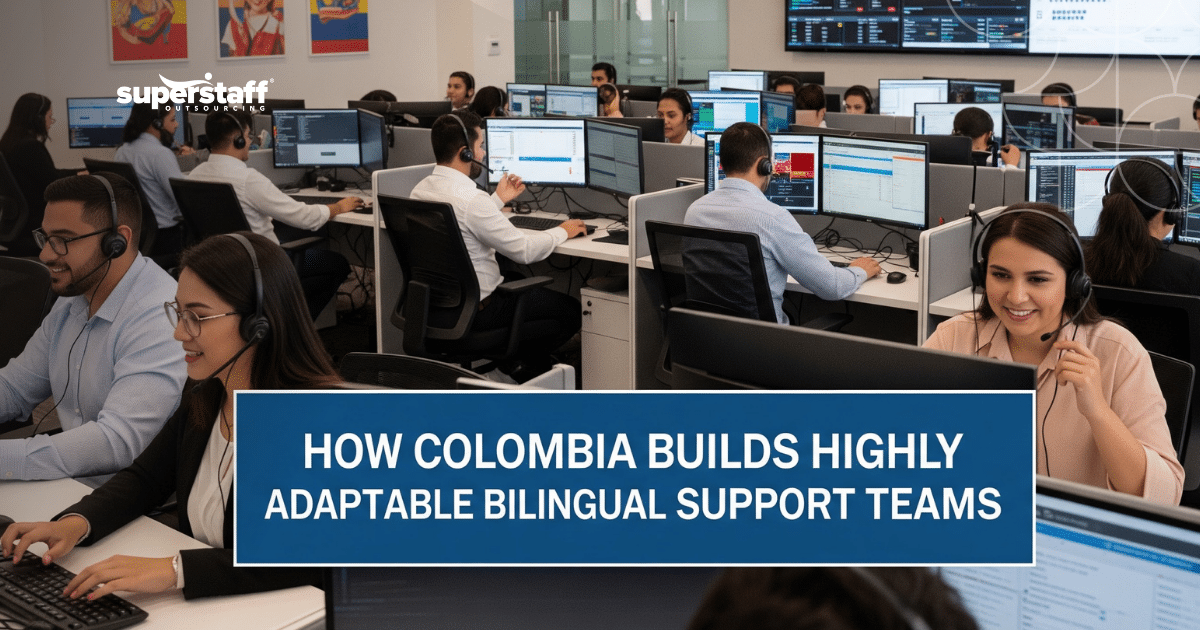
Colombia has emerged as a strong nearshore destination for customer support. Time zone alignment with North America makes collaboration easier. English proficiency continues to improve. Operating costs remain competitive compared to U.S. markets. However, choosing the right engagement structure matters just as much as choosing the right geography.
Understanding staff augmentation vs outsourcing in this context is essential before committing resources.
What Staff Augmentation Looks Like in Colombia
Staff augmentation allows you to extend your in-house team with external talent. Agents or support staff technically work through a local provider, but you manage them directly.
This model often appeals to companies that:
- Want tight operational control
- Already have established processes
- Need specialized roles for a defined period
- Prefer to manage daily KPIs internally
When evaluating staff augmentation vs outsourcing for nearshoring, augmentation can feel like a natural extension of your internal team. Your managers assign tasks, your supervisors monitor performance, and your systems remain central.
However, leadership must absorb additional management responsibility. Local compliance, HR administration, and workforce planning still require coordination with the provider. Operational maturity on the client side becomes critical.
If your internal team lacks bandwidth, staff augmentation can increase complexity rather than reduce it.
What Outsourcing Looks Like in Colombia
Outsourcing transfers responsibility for outcomes, not just headcount. The nearshore partner builds and manages the team. Service levels, reporting, and staffing are handled through a structured agreement.
In discussions about staff augmentation vs outsourcing, outsourcing offers a different value proposition. Instead of adding individual contributors, you delegate an entire function.
This model often suits companies that:
- Need faster ramp up
- Want predictable service levels
- Prefer a partner-led management structure
- Seek operational accountability
Operational oversight remains important, but your internal leaders focus on strategy rather than daily supervision. That distinction becomes significant when scaling support operations across multiple time zones.
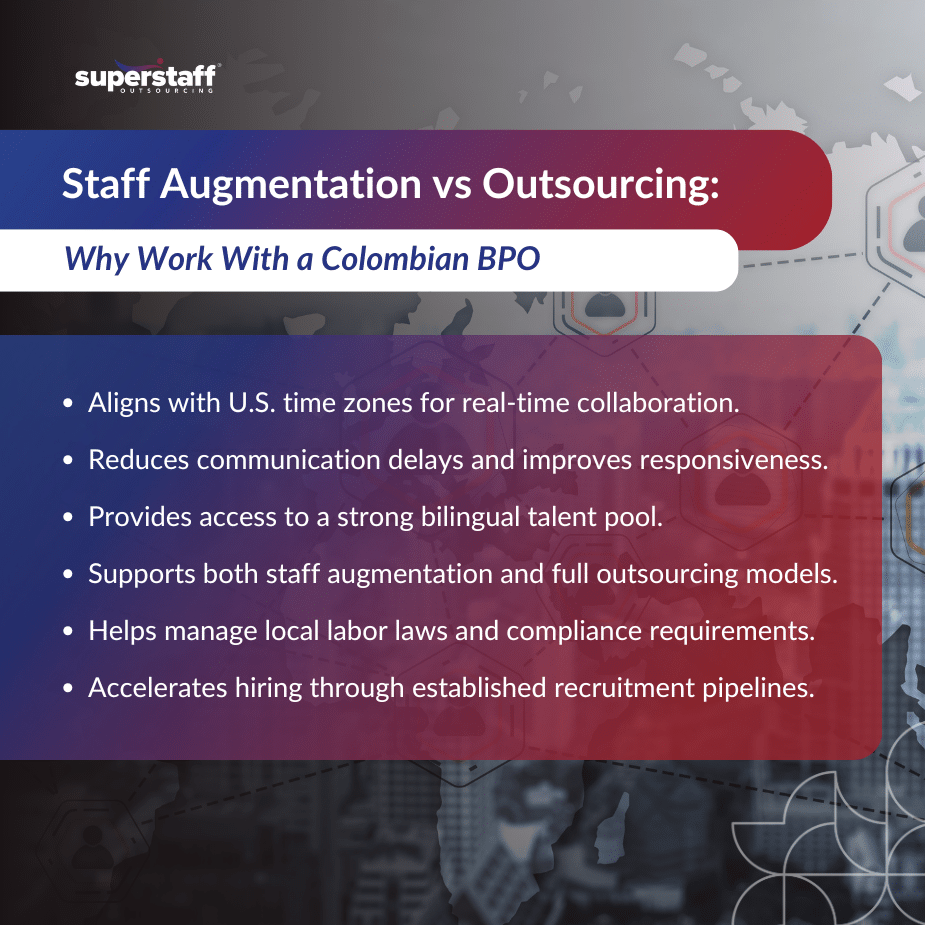
Control Versus Accountability
One of the clearest distinctions in staff augmentation vs outsourcing is the balance between control and accountability.
Staff augmentation maximizes direct control. Your managers lead the agents. Performance metrics are fully internal. Culture integration can feel seamless if managed well.
Outsourcing, on the other hand, formalizes accountability through service level agreements. The provider commits to measurable outcomes. Escalation protocols and performance management sit within the partner’s structure.
Executives nearshoring to Colombia must ask a direct question. Do we want to manage people or manage results?
When internal leadership capacity is limited, outsourcing often reduces strain. When internal oversight is strong and highly specialized, augmentation can work well.
Speed of Deployment
Speed matters for growth stage companies. Product launches, seasonal spikes, or regional expansion can require rapid hiring.
In the staff augmentation vs outsourcing debate, outsourcing typically accelerates deployment. Established providers already have recruitment pipelines, training frameworks, and onboarding processes in place. Teams can scale in structured waves.
Staff augmentation may take longer if your managers must design training, performance dashboards, and quality controls from scratch. While Colombia offers a strong talent pool, operational readiness on the client side still determines ramp up speed.
Nearshoring decisions should align with your timeline. If immediate performance consistency is required, outsourcing often delivers faster stabilization.
Cost Structure and Financial Visibility
Finance leaders analyze staff augmentation vs outsourcing differently than operations teams. Augmentation may appear leaner because you pay for individual roles. However, indirect costs can accumulate.
Consider internal management hours. Factor in training development. Account for technology integration and workforce planning. These expenses rarely show up in initial projections.
Outsourcing generally consolidates costs into a predictable monthly model. Workforce management, HR compliance, recruitment, and performance monitoring are embedded in the structure.
For midmarket companies entering Colombia for the first time, predictable cost models can support clearer forecasting. CFOs often value stability over variable management overhead.
Risk and Compliance Considerations
Colombia’s regulatory environment continues to evolve. Labor laws, benefits, and termination processes require local knowledge.
Within staff augmentation vs outsourcing frameworks, risk allocation differs significantly. Staff augmentation places more oversight responsibility on the client. Even with a local partner, you remain deeply involved in workforce decisions.
Outsourcing shifts more operational risk to the provider. Experienced partners manage labor compliance, local employment regulations, and HR administration as part of the service.
Nearshore expansion should reduce risk exposure, not increase it. Companies without Latin American HR expertise often find outsourcing provides a safer entry point.
Scalability Over Time
Growth rarely follows a straight line. Customer demand rises and falls. New markets open. Product lines expand.
When analyzing staff augmentation vs outsourcing, scalability becomes a decisive factor. Augmentation works well for targeted growth or highly specialized additions. It can feel flexible at small scale.
Outsourcing, however, supports structured scaling. Providers can add supervisors, QA analysts, and workforce managers as volume grows. Operational infrastructure evolves alongside headcount.
Colombia’s nearshore advantage strengthens when your partner can scale without disrupting service quality. For organizations planning multi year growth, outsourcing often supports smoother expansion.
Cultural Integration and Brand Alignment
Many U.S. executives worry about cultural alignment when nearshoring. Colombia’s cultural proximity to North America helps reduce friction.
Still, staff augmentation vs outsourcing affects how brand culture translates to the nearshore team. Augmentation enables deeper integration into your internal culture because agents operate almost as direct employees.
Outsourcing requires intentional brand immersion. Strong providers invest in training, tone guidelines, and ongoing calibration to reflect your voice and standards.
The key lies in partner selection. A nearshore provider that prioritizes communication alignment can maintain brand consistency while managing operational structure independently.
When Staff Augmentation Makes Sense
Staff augmentation vs outsourcing should never be framed as a universal answer. Specific business scenarios determine fit.
Staff augmentation often works best when:
- Your internal leadership team has excess management capacity
- You require niche technical or bilingual roles
- You need temporary capacity for defined projects
- You want complete authority over daily workflows
Organizations with mature operational playbooks often prefer this approach.
When Outsourcing Delivers Greater Impact
Outsourcing typically works best when:
- You want end to end customer support management
- You are entering Colombia for the first time
- You need rapid scale with defined service levels
- You aim to reduce internal operational strain
For midmarket U.S. companies focused on growth, outsourcing often aligns with strategic priorities. Leadership attention shifts to expansion rather than micromanagement.
The comparison of staff augmentation vs outsourcing ultimately centers on how you allocate executive time.
A Strategic View for Nearshoring to Colombia
Nearshoring is not only a cost decision. It is an operational strategy. Colombia offers time zone alignment, strong talent, and regional proximity. However, structure determines success.
Companies evaluating staff augmentation vs outsourcing should assess internal readiness first. Do you have experienced managers who can oversee offshore agents daily? Are compliance processes clearly defined? Is performance infrastructure already in place?
If the answer is yes, augmentation may complement your model. If the answer is uncertain, outsourcing can create structure from day one.
Both models can work. The difference lies in leadership bandwidth, risk tolerance, and long term vision.
Choosing Between Staff Augmentation vs Outsourcing? Learn the Benefits of BPO Solutions
The decision between staff augmentation vs outsourcing shapes how effectively you nearshore to Colombia. Each model offers advantages. Augmentation emphasizes control. Outsourcing emphasizes accountability and scalability.
For many U.S. SMEs and midmarket firms, outsourcing provides a more structured path to nearshore growth. It simplifies compliance, accelerates ramp up, and stabilizes performance.
SuperStaff supports both offshore and nearshore strategies, including operations in Colombia and the Philippines. Our teams help leaders design support models that align with business objectives and operational maturity.
If you are evaluating your next step, connect with us to explore how a nearshore customer support model can strengthen your growth strategy.