

Manufacturing leaders are under constant pressure to maintain efficiency while navigating supply chain disruptions, talent shortages, and rising operational costs.
Many organizations are revisiting how work gets done and who performs it. This shift has renewed attention to the outsourcing definition business manufacturing and how it applies in modern production environments.
Today, outsourcing is not limited to relocating factory operations. It increasingly includes remote expertise, administrative support, and operational services delivered by specialized global teams.
Understanding how outsourcing fits into manufacturing strategy helps decision makers unlock new ways to strengthen productivity and resilience.
Understanding Outsourcing in Manufacturing Today
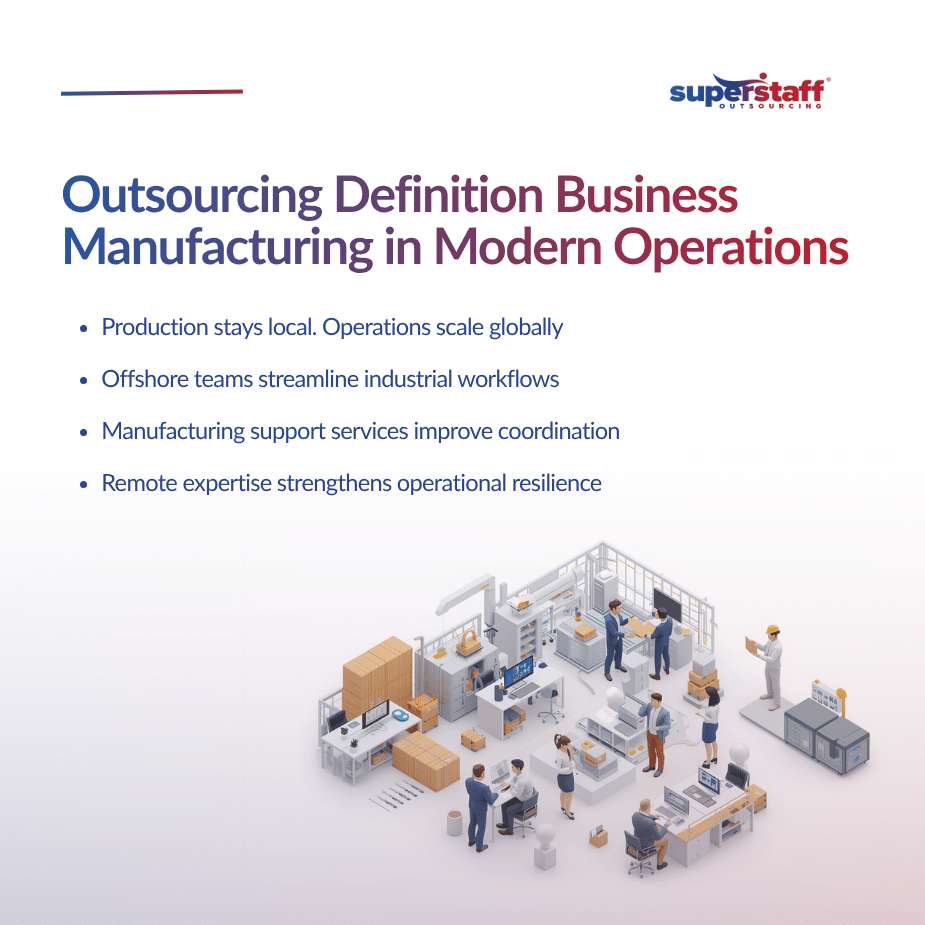
The outsourcing definition business manufacturing has evolved beyond relocating assembly lines or production facilities. Modern manufacturers now outsource a wide range of operational and support functions.
Manufacturing companies increasingly partner with external providers to manage processes that do not require direct factory presence. These include administrative coordination, data management, customer support, procurement tracking, and supply chain communication.
This broader interpretation of the outsourcing definition business manufacturing reflects how manufacturing companies operate today. Production may remain local, while operational support functions are handled by distributed teams across global locations.
Why Manufacturing Leaders Are Rethinking Operational Models
Manufacturing executives must balance efficiency with flexibility. Traditional staffing models often struggle to scale quickly when demand shifts or production cycles fluctuate.
Applying the outsourcing definition business manufacturing allows leaders to create more adaptable workforce structures. Offshore and remote teams can support operational functions while internal staff focus on production quality and strategic oversight.
This model also addresses workforce challenges that manufacturers increasingly face, including shortages of specialized administrative and operational support talent.
The Expanding Role of Manufacturing Support Services
Many companies are now outsourcing services that help factories operate smoothly without affecting production control.
Manufacturing support services typically include operational coordination, order management, supplier communication, documentation handling, and customer service.
When leaders revisit the outsourcing definition business manufacturing, they recognize that support functions often consume internal resources that could otherwise be focused on engineering, innovation, or process improvement.
Delegating these support tasks to specialized external teams can increase operational efficiency without disrupting factory operations.
Operational Areas That Benefit From Outsourcing
Modern manufacturing environments contain numerous workflows that are well suited for external support.
Common outsourced functions include:
- Customer service for product inquiries and order updates
• Inventory tracking and reporting support
• Procurement coordination and supplier communication
• Documentation management and compliance tracking
• Production scheduling support
• Technical help desk assistance for industrial products
These activities reflect the evolving outsourcing definition business manufacturing, where operational efficiency is achieved by distributing responsibilities across specialized teams.
Offshore Teams and Industrial Coordination
Manufacturing operations require constant communication between suppliers, logistics providers, distributors, and internal departments.
Remote teams for industrial and production processes can manage many of these coordination activities. Offshore teams help maintain workflow continuity by handling communication, reporting, and documentation tasks.
Manufacturers that embrace the outsourcing definition business manufacturing often build hybrid operational structures. Factory teams manage production, while offshore specialists support the broader operational ecosystem.
This model ensures that production leaders remain focused on quality control and operational improvement rather than administrative tasks.
How Outsourcing Improves Manufacturing Agility
Manufacturers must react quickly to shifts in demand, supply chain disruptions, and customer expectations.
The outsourcing definition business manufacturing enables organizations to scale operational capacity without expanding permanent staff.
For example, when demand rises, external support teams can increase coverage for order management, supply chain coordination, and customer communication. When demand slows, organizations avoid the burden of maintaining excess internal staff.
This flexibility makes outsourcing a valuable operational strategy rather than simply a cost decision.
Customer Experience in Industrial Manufacturing
Manufacturers increasingly compete on service quality as much as product performance. Customers expect timely updates, fast issue resolution, and clear communication throughout the purchasing process.
Customer service teams that specialize in manufacturing support services can manage inquiries related to product availability, shipping updates, warranty support, and technical assistance.
The outsourcing definition business manufacturing increasingly includes customer support operations that ensure industrial clients receive consistent communication and service.
Strong customer support can strengthen relationships with distributors, retailers, and enterprise buyers.
Data Management and Process Visibility
Manufacturing organizations generate large volumes of operational data. This includes order documentation, inventory updates, supplier records, compliance reports, and production logs.
External teams can assist with organizing, updating, and maintaining this information across multiple systems.
Applying the outsourcing definition business manufacturing allows companies to maintain accurate operational data while freeing internal teams from administrative workloads.
Reliable data management supports better decision making across procurement, production planning, and logistics coordination.
Workforce Strategy in the Manufacturing Sector
Manufacturing leaders are increasingly developing blended workforce strategies that combine factory staff, engineers, and remote operational teams.
This approach aligns with the evolving outsourcing definition business manufacturing, where companies view external teams as an extension of their operations rather than a temporary staffing solution.
Offshore support teams often provide consistent operational coverage across time zones. This helps manufacturers maintain communication with suppliers, distributors, and customers without overloading internal employees.
A distributed workforce also improves operational continuity during periods of rapid growth or supply chain disruption.
How Outsourcing Strengthens Supply Chain Coordination
Supply chains involve complex interactions between vendors, logistics partners, and manufacturing facilities.
The outsourcing definition business manufacturing now includes external teams that support procurement coordination, shipment tracking, and supplier communication.
These teams monitor updates, manage documentation, and relay information to production managers in real time.
When manufacturing companies maintain strong coordination across supply chain partners, production delays become easier to manage and customer expectations remain aligned with operational realities.
Choosing the Right Outsourcing Partner
Successful outsourcing requires careful partner selection and clear operational planning.
Manufacturers should evaluate outsourcing providers based on industry knowledge, operational transparency, communication practices, and workforce stability.
Organizations that understand the outsourcing definition business manufacturing treat outsourcing as a long term operational collaboration rather than a short term cost reduction strategy.
Strong outsourcing partners contribute to operational reliability, improved responsiveness, and better customer support across industrial markets.
A Strategic Approach to Modern Manufacturing Operations
Manufacturing companies are no longer defined solely by what happens on the factory floor. Operational success increasingly depends on the systems, communication channels, and support functions that surround production.
The outsourcing definition business manufacturing reflects this reality. Manufacturing leaders are building distributed operational models that combine factory expertise with specialized external support.
By integrating offshore operational teams into manufacturing workflows, companies can improve efficiency, strengthen communication across supply chains, and maintain focus on production quality.
For organizations looking to implement this model, experienced outsourcing partners play a critical role.
SuperStaff supports manufacturers with dedicated teams that handle customer service, operational coordination, documentation management, and other essential manufacturing support services. These teams integrate seamlessly with internal operations while maintaining high standards of reliability and communication.
If your organization is exploring new ways to scale operations while maintaining production focus, it may be time to evaluate how the outsourcing definition business manufacturing can strengthen your operational strategy.
Learn how SuperStaff can support your manufacturing operations and help your team focus on what it does best.