
Business leaders are facing a different operating environment in 2026. Cost pressures remain, but they are no longer the only driver. Companies now look at resilience, access to talent, and operational continuity when designing a global outsourcing strategy.
Decisions are becoming more deliberate. Leaders want flexibility without losing control, and efficiency without increasing exposure to risk.
A well-structured global outsourcing strategy allows organizations to scale with clarity, manage uncertainty, and stay competitive in a shifting global market.
Why outsourcing strategy is shifting in 2026

Outsourcing is no longer centered on cost reduction alone. It has become part of broader business planning.
Executives now treat outsourcing as a structural decision that impacts growth, customer experience, and risk posture.
- Focus has moved from single-location setups to multi-country models
- Leadership teams expect outsourcing partners to support long-term goals
- Operational stability is now a key performance measure
This shift sets the stage for diversification as a core strategy.
Diversification reduces operational risk
Relying on a single geography creates exposure. Disruptions in one location can impact the entire operation.
A diversified global outsourcing strategy spreads operations across regions to reduce that risk.
- Multi-country setups help maintain continuity
- Businesses avoid overdependence on one labor market
- Geographic spread supports faster recovery during disruptions
This approach leads to more resilient operations without increasing complexity when managed properly.
The role of the Philippines in global outsourcing strategy
The Philippines remains a strong choice for companies building a global outsourcing strategy.
It offers a combination of talent, cultural alignment, and operational maturity that supports business needs.
- Strong English proficiency supports customer-facing roles
- Established BPO infrastructure ensures reliability
- Workforce experience supports both voice and non-voice functions
Companies often use the Philippines as a core hub within a diversified model.
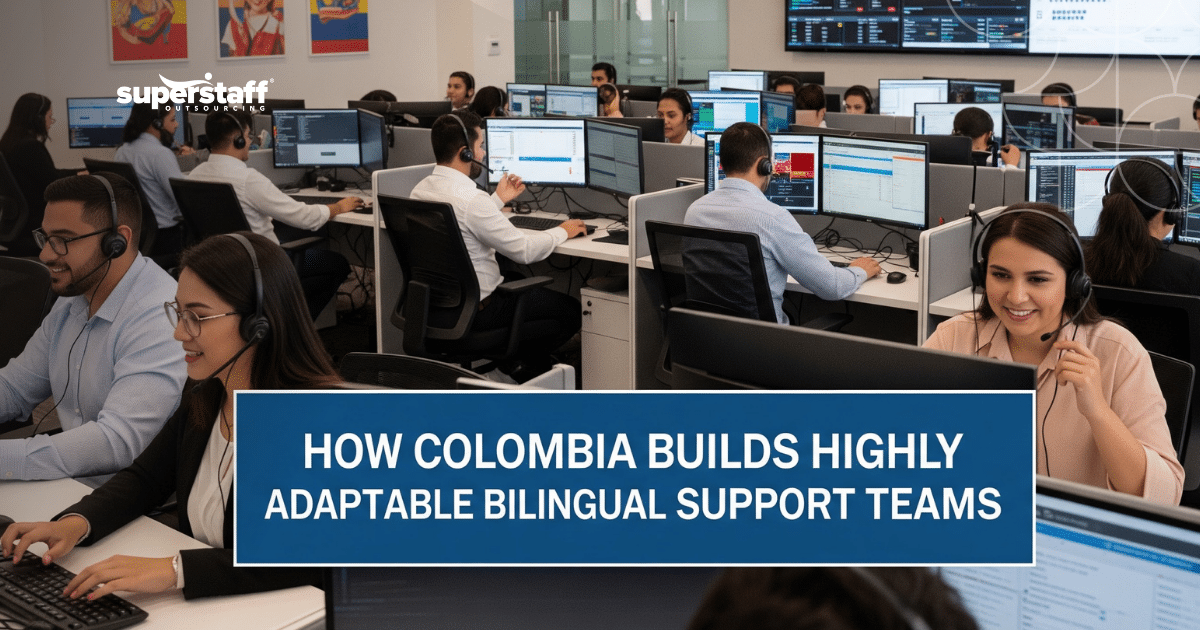
Colombia strengthens nearshore alignment
Colombia continues to grow as a nearshore option for U.S. companies.
It supports real-time collaboration and complements offshore teams in Asia.
- Time zone alignment improves communication
- Bilingual talent supports English and Spanish markets
- Cultural familiarity enhances customer experience
Adding Colombia into a global outsourcing strategy allows companies to balance offshore scale with nearshore responsiveness.
Talent access drives outsourcing decisions
Talent shortages in domestic markets are pushing companies to rethink hiring models.
Outsourcing provides access to skilled professionals without the limitations of local labor supply.
- Specialized roles can be filled faster
- Teams can scale based on demand
- Businesses gain access to trained professionals across functions
A global outsourcing strategy now prioritizes talent availability as much as cost efficiency.
Workforce stability supports long-term growth
Turnover and retention challenges affect many industries. Offshore teams often provide more stability when managed well.
This stability allows companies to maintain consistent service quality and reduce hiring cycles.
- Structured onboarding improves retention
- Career development programs increase engagement
- Dedicated teams build long-term expertise
A stable workforce strengthens the overall effectiveness of a global outsourcing strategy.
Risk management is now a central priority
Risk management is no longer handled separately from outsourcing decisions. It is integrated into planning from the start.
Leaders evaluate operational, regulatory, and data-related risks when selecting outsourcing partners.
- Data protection standards must align with company policies
- Business continuity plans are expected from providers
- Compliance requirements must be clearly defined
A strong global outsourcing strategy includes clear risk mitigation measures at every level.
Technology integration supports better control
Technology plays a key role in managing distributed teams.
Companies expect visibility across operations regardless of location.
- Shared systems allow real-time monitoring
- Automation improves efficiency and accuracy
- Reporting tools provide performance insights
When integrated properly, technology strengthens execution without replacing human oversight.
Blended teams improve performance
A combination of onshore, nearshore, and offshore teams creates a balanced operating model.
Each location serves a specific purpose within the broader strategy.
- Onshore teams handle high-touch or complex tasks
- Nearshore teams support collaboration and time-sensitive work
- Offshore teams provide scale and cost efficiency
This structure allows companies to align operations with business priorities.
Cost efficiency remains relevant but not dominant
Cost savings still matter, but they are no longer the only metric.
Leaders evaluate total value, including productivity, quality, and risk exposure.
- Lower labor costs support margin improvement
- Process optimization reduces operational waste
- Efficiency gains contribute to long-term savings
A modern global outsourcing strategy focuses on sustainable value rather than short-term cost reduction.
Choosing the right outsourcing partner
Selecting the right partner is critical to execution.
Companies look for providers that can support both current needs and future growth.
- Proven operational experience ensures reliability
- Strong management teams support scalability
- Alignment with company goals improves collaboration
A successful global outsourcing strategy depends on partners who understand both execution and strategy.
Building a resilient outsourcing strategy
A global outsourcing strategy in 2026 requires a balanced approach. Diversification reduces risk. Talent access supports growth. Strong governance ensures stability.
Companies that invest in the right structure gain flexibility without losing control. They also position themselves to respond quickly to market changes while maintaining consistent performance.
SuperStaff helps businesses build and execute a global outsourcing strategy that aligns with long-term goals. The company combines experienced teams in the Philippines with scalable support models designed for U.S. businesses. AI is integrated into workflows to improve efficiency, while human oversight remains central to maintaining quality and accuracy.
If you are planning your next phase of growth, now is the time to explore how outsourcing can support your strategy. Connect with SuperStaff to build a structure that is stable, flexible, and ready for the future.