
A shopper lands on your website. They expect fast answers, relevant products, and smooth checkout. If any step feels slow or confusing, they leave. That is the reality many online businesses face. Customer expectations are rising, yet internal teams often struggle to keep up.
This is where smart use of AI can help. Still, success depends on how well it supports real customer needs. Many companies invest in tools but fail to connect them to actual experience goals. That gap leads to wasted budget and poor outcomes.
These tips for AI e-commerce optimization focus on aligning technology with what customers truly want. When done right, AI improves both efficiency and satisfaction.
Why Alignment Matters in AI E-Commerce
Technology alone does not fix customer experience issues. Alignment is the real driver of results.
When businesses apply tips for AI e-commerce optimization, they start by linking AI tools to clear goals such as faster response times or higher conversion rates. Without that connection, even advanced systems can create friction.
Consider these realities:
- Customers expect real-time support
- Personalization influences buying decisions
- Delays increase cart abandonment
Therefore, AI should support these needs directly. That is the foundation of effective tips for AI e-commerce optimization.
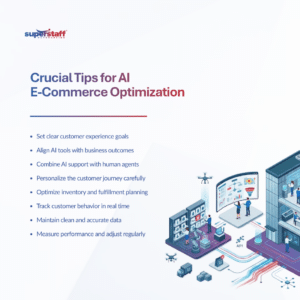
1. Define Clear Customer Experience Goals
Before choosing tools, define what success looks like.
Start with measurable goals:
- Reduce response time to under 1 minute
- Increase conversion rate by 10 percent
- Improve customer satisfaction scores
Next, align AI systems to those targets. This is one of the most important tips for AI e-commerce optimization because it prevents misalignment between tech and outcomes.
As a result, every tool you use will serve a clear purpose.
2. Use AI for Smart Product Recommendations
Customers want relevant suggestions. AI helps deliver that at scale.
Instead of showing generic items, AI can:
- Analyze browsing behavior
- Track past purchases
- Recommend complementary products
However, relevance matters more than volume. Too many suggestions can overwhelm users.
That is why strong tips for AI e-commerce optimization focus on quality over quantity. Keep recommendations simple and useful.
3. Improve Search Accuracy With AI
Search is often the first interaction on an e-commerce site.
If results are inaccurate, customers leave quickly. AI can improve this by understanding intent, not just keywords.
For example:
- Handle misspellings
- Recognize synonyms
- Suggest related products
Better search leads to better conversions. That is why this is a key part of effective tips for AI e-commerce optimization.
4. Enhance Customer Support With AI and Human Teams
AI chatbots can handle simple questions. Yet complex issues still need human support.
The best approach combines both:
- AI handles FAQs and order tracking
- Human agents resolve detailed concerns
This balance ensures faster service without losing quality. Many tips for AI e-commerce optimization highlight this hybrid model because it protects customer trust.
5. Personalize the Customer Journey
Personalization improves engagement at every stage.
AI can tailor:
- Homepage content
- Email campaigns
- Product recommendations
Still, personalization should feel helpful, not intrusive.
Strong tips for AI e-commerce optimization recommend using data responsibly. Focus on improving convenience rather than over-targeting users.
6. Optimize Pricing Strategies With AI
Pricing affects both conversion and profitability.
AI can analyze:
- Competitor pricing
- Demand trends
- Customer behavior
This allows businesses to adjust prices dynamically.
However, transparency is important. Customers should still feel confident in pricing.
That is why balanced tips for AI e-commerce optimization focus on fairness as well as efficiency.
7. Streamline Inventory and Fulfillment
Stock issues can damage customer experience.
AI helps predict demand and manage inventory levels. This reduces:
- Out-of-stock situations
- Overproduction
- Delayed deliveries
Efficient fulfillment improves satisfaction. It also supports long-term loyalty.
This is another reason why operational alignment is part of effective tips for AI e-commerce optimization.
8. Monitor Customer Behavior in Real Time
Understanding customer behavior allows quick adjustments.
AI tools can track:
- Click patterns
- Drop-off points
- Cart abandonment
With this data, businesses can fix issues faster.
For example:
- Simplify checkout steps
- Improve page speed
- Adjust product placement
Real-time insights are essential in modern tips for AI e-commerce optimization.
9. Focus on Data Quality and Integration
AI depends on data. Poor data leads to poor results.
To improve outcomes:
- Clean your data regularly
- Integrate systems across platforms
- Ensure accuracy in customer records
Many businesses overlook this step. Yet strong tips for AI e-commerce optimization always emphasize data quality.
Without it, even advanced tools will underperform.
10. Measure Performance and Adjust Continuously
Optimization is an ongoing process.
Track key metrics such as:
- Conversion rates
- Customer satisfaction scores
- Average order value
Then adjust your strategy based on results.
Continuous improvement is a core part of effective tips for AI e-commerce optimization. It ensures your approach stays relevant as customer expectations evolve.
Bringing It All Together
AI can support every stage of the customer journey. However, success depends on alignment.
Businesses that follow these tips for AI e-commerce optimization focus on:
- Clear goals
- Balanced automation and human support
- Data-driven decisions
This approach leads to better customer experiences and stronger business performance.
Enjoyed These Tips for AI E-Commerce Optimization? Turn Strategy Into Action By Partnering With SuperStaff!
Technology should support people, not replace thoughtful strategy. When aligned with customer needs, AI becomes a practical tool for growth.
These tips for AI e-commerce optimization show that success comes from combining smart systems with clear direction. Each improvement builds a smoother and more reliable experience for customers.
If your business is ready to improve e-commerce performance, the right partner can make a difference. SuperStaff helps companies integrate AI with skilled support teams to deliver consistent and high-quality customer experiences.
Connect with SuperStaff today to explore how outsourcing solutions can support your AI-driven e-commerce strategy and help you scale with confidence.