For many U.S. SMEs and midmarket companies, international IT services are no longer a distant enterprise strategy. They are becoming a practical way to solve staffing gaps, extend support coverage, and strengthen digital operations without overloading internal teams.
The challenge is not simply finding IT talent abroad. The real challenge is finding a partner that understands business urgency, service discipline, cultural alignment, and operational accountability.
This is where Colombia becomes a strong option for U.S. companies. With nearshore accessibility, overlapping work hours, and a growing professional services environment, Colombia gives businesses a practical bridge between local control and global capability.
SuperStaff’s Colombia office supports this shift by helping companies build reliable teams that can handle customer-facing, technical, and operational functions with consistency.
Why U.S. Companies Are Rethinking International IT Services
Many growing companies know they need stronger IT support, but hiring locally can be slow and expensive. Internal teams often get pulled into too many tasks at once.
A small IT department may be responsible for help desk support, system access, software troubleshooting, ticket management, cybersecurity coordination, vendor follow-ups, and user onboarding. Over time, this creates bottlenecks.
International IT services help companies distribute the workload more intelligently.
Instead of asking a limited in-house team to handle every ticket and every escalation, businesses can build a dedicated support layer through a nearshore partner. This gives internal IT leaders more room to focus on strategy, system improvements, security planning, and digital transformation.
For SMEs and midmarket companies, that matters. They need operational maturity, but they may not have the budget or hiring capacity of larger enterprises.
Why Colombia Fits the U.S. Market
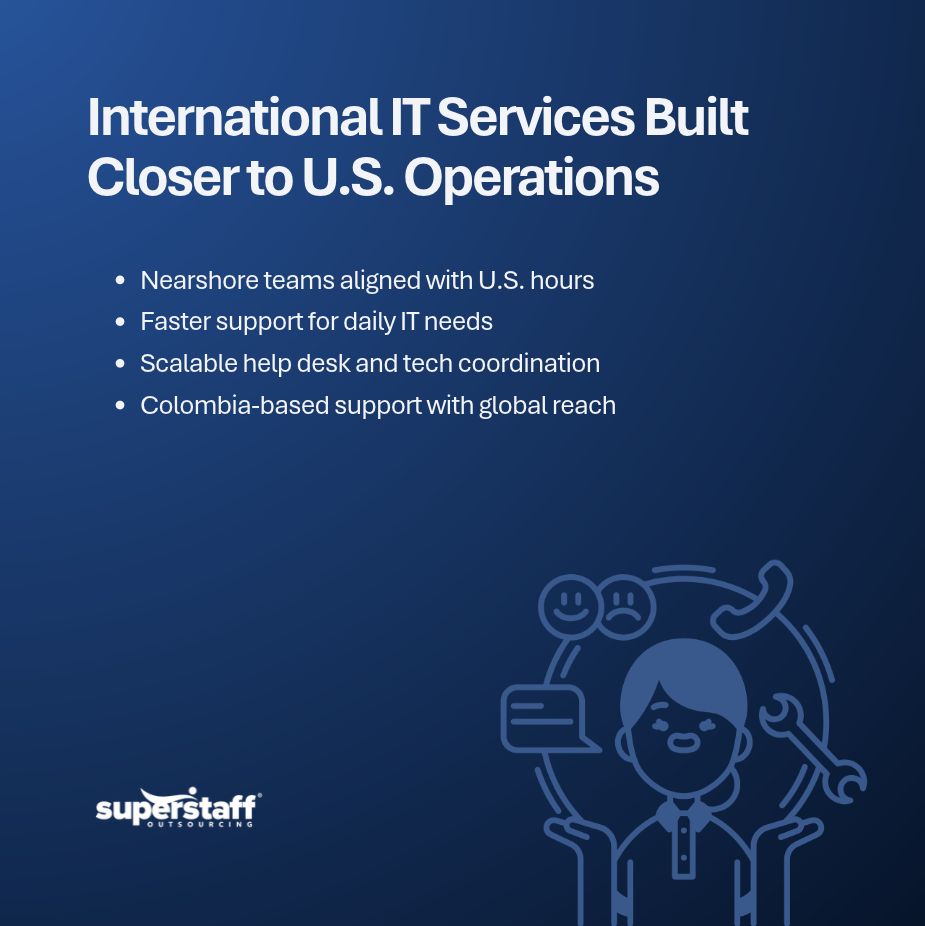
Colombia has become an attractive location for companies that want proximity, communication ease, and stronger workday alignment.
For U.S. businesses, the time zone advantage is especially important. Teams in Colombia can support real-time collaboration, faster issue resolution, and smoother handoffs with internal departments.
That makes Colombia a practical market for international IT services, especially for companies that cannot afford delayed responses or overnight-only support models.
Nearshore delivery also supports stronger supervision. U.S. managers can hold live meetings, review performance, conduct training, and resolve issues without the heavy scheduling friction that sometimes comes with farshore teams.
This does not replace the value of offshore locations like the Philippines. Instead, it creates a blended global support model where companies can match each function to the right region.
What International IT Services Can Support
The scope of international IT services can vary depending on the company’s needs, systems, and maturity level. For many SMEs and midmarket firms, the strongest starting point is operational IT support.
Common functions may include:
- Tier 1 help desk support
- Ticket intake and routing
- Password resets and access support
- Software troubleshooting
- CRM and platform support
- User onboarding assistance
- Device coordination support
- IT documentation updates
- Vendor follow-ups
- Internal customer service for employees
These roles may seem routine, but they have a direct impact on productivity. When employees cannot access tools, resolve account issues, or get quick support, work slows down across the business.
A well-managed international IT services team reduces this friction. It keeps daily operations moving while protecting internal IT teams from repetitive tasks that consume their time.
The Business Case Goes Beyond Cost
Cost remains an important factor, but U.S. executives are looking for more than savings. They want continuity, responsiveness, and better service coverage.
This is why international IT services should be viewed as an operational strategy, not a shortcut.
A strong nearshore IT support team can help companies:
- Improve ticket response times
- Support employees during U.S. business hours
- Reduce workload pressure on internal teams
- Build a more scalable support structure
- Maintain documentation and process consistency
- Improve the employee experience
- Create clearer escalation paths
For a growing business, these outcomes matter. IT issues affect every department. Sales teams need working platforms. Finance teams need secure access. Operations teams need reliable systems. Customer-facing teams need tools that do not fail during peak hours.
International IT services help create the support foundation behind that daily performance.
Why Structure Matters More Than Headcount
Hiring more people does not automatically solve IT support problems. Without the right structure, more headcount can simply create more confusion.
Companies need clear workflows, defined service levels, escalation rules, training materials, quality checks, and performance reporting.
This is where an outsourcing partner becomes valuable. SuperStaff helps companies think through the operational design before expanding the team.
For example, a company may not need a large IT support group right away. It may need two or three trained specialists who can manage ticket intake, categorize issues, document recurring problems, and escalate technical cases to the internal team.
That approach gives leaders visibility. It also creates a clean starting point for growth.
International IT services work best when the team is built around business outcomes, not only task lists.
Colombia as a Nearshore IT Support Hub
Colombia offers a strong fit for U.S. companies that need closer collaboration. Shared or overlapping work hours allow IT teams to participate in daily standups, live troubleshooting, internal meetings, and urgent escalations.
This matters for companies that serve customers in fast-moving industries such as healthcare, logistics, financial services, e-commerce, software, and professional services.
When employees or customers need help, they do not want a long wait. They want someone who understands the issue, communicates clearly, and follows a process.
Colombia-based international IT services can support that standard. The location helps companies combine global talent with real-time responsiveness.
SuperStaff’s Colombia office also gives businesses access to a nearshore model that can work alongside Philippine offshore teams. For companies with broader support needs, this creates flexibility across time zones, functions, and service levels.
What Decision-Makers Should Look For
Choosing a partner for international IT services requires more than comparing hourly rates. U.S. leaders should look for operational readiness.
A strong partner should be able to explain how they manage hiring, onboarding, training, performance, escalation, and quality assurance.
Before choosing a provider, decision-makers should ask:
- Can the team work within our business hours?
- How will agents be trained on our systems?
- Who manages daily performance?
- What happens when an issue needs escalation?
- How are tickets documented and reported?
- Can the team scale as volume grows?
- How will the partner protect process consistency?
These questions help companies avoid a common mistake. They prevent leaders from outsourcing tasks without building a support system around them.
The best international IT services partner should act as an extension of the company’s operating model.
How SuperStaff Supports U.S. Companies From Colombia
SuperStaff brings a people-centered and process-driven approach to outsourcing. For U.S. companies exploring Colombia, the goal is to build teams that feel connected to the business, not detached from it.
Our Colombia office gives clients a nearshore option for customer support, technical support, back-office coordination, and IT-adjacent roles that require communication, consistency, and real-time collaboration.
We help companies define the role, build the workflow, recruit the right talent, train for the account, and manage performance through clear operating standards.
This makes international IT services more practical for SMEs and midmarket firms. They can expand support capacity without building every layer from scratch.
For companies that already have an internal IT team, SuperStaff can support the front line. For companies building their first structured support model, we can help create a scalable foundation.
A Smarter Way to Build Global Support
The future of IT support is not about choosing between local, nearshore, or offshore teams. It is about building the right mix.
Some functions need direct internal ownership. Others can be handled by trained outsourced teams with the right process and supervision.
International IT services give U.S. businesses more room to design that mix. Colombia adds the benefit of proximity and workday alignment. The Philippines adds deep outsourcing experience and strong service delivery capacity.
Together, these markets can help companies build a more resilient support model.
For SMEs and midmarket companies, that flexibility can be a major advantage. It allows leaders to improve service coverage, control costs, support growth, and protect internal teams from burnout.
Build Your Colombia Support Team With SuperStaff
International IT services can help U.S. companies improve support, strengthen operations, and create a more scalable workforce model. The key is choosing a partner that understands both people and process.
SuperStaff’s Colombia office gives your business a nearshore path to dependable support teams that can work closely with your U.S. operations.
Explore SuperStaff’s services today and see how our Colombia-based teams can help you build smarter, faster, and more reliable support.