
For many growing companies, finance work becomes harder to manage as the business expands. More invoices come in. More vendors need attention. More reports are requested by leadership. More compliance checks are required before decisions can move forward. At this stage, a finance shared services center can help companies bring structure, visibility, and consistency to essential finance operations without overloading internal teams.
The goal is not simply to move finance tasks elsewhere. The real value is creating a reliable operating model where routine finance processes are handled with discipline, accuracy, and accountability. For U.S. SMEs and midmarket companies, this can be the difference between a finance team that is always catching up and one that has the space to support business growth.
Why A Finance Shared Services Center Matters Now
A finance shared services center gives companies a centralized way to manage repeatable finance functions. These may include accounts payable, accounts receivable, billing support, collections coordination, expense processing, payroll support, reconciliations, and financial reporting assistance.
As businesses grow, these tasks often become scattered across departments, locations, or individual employees. That creates delays. It also increases the risk of missed invoices, inconsistent reporting, duplicate work, and slow month-end close processes.
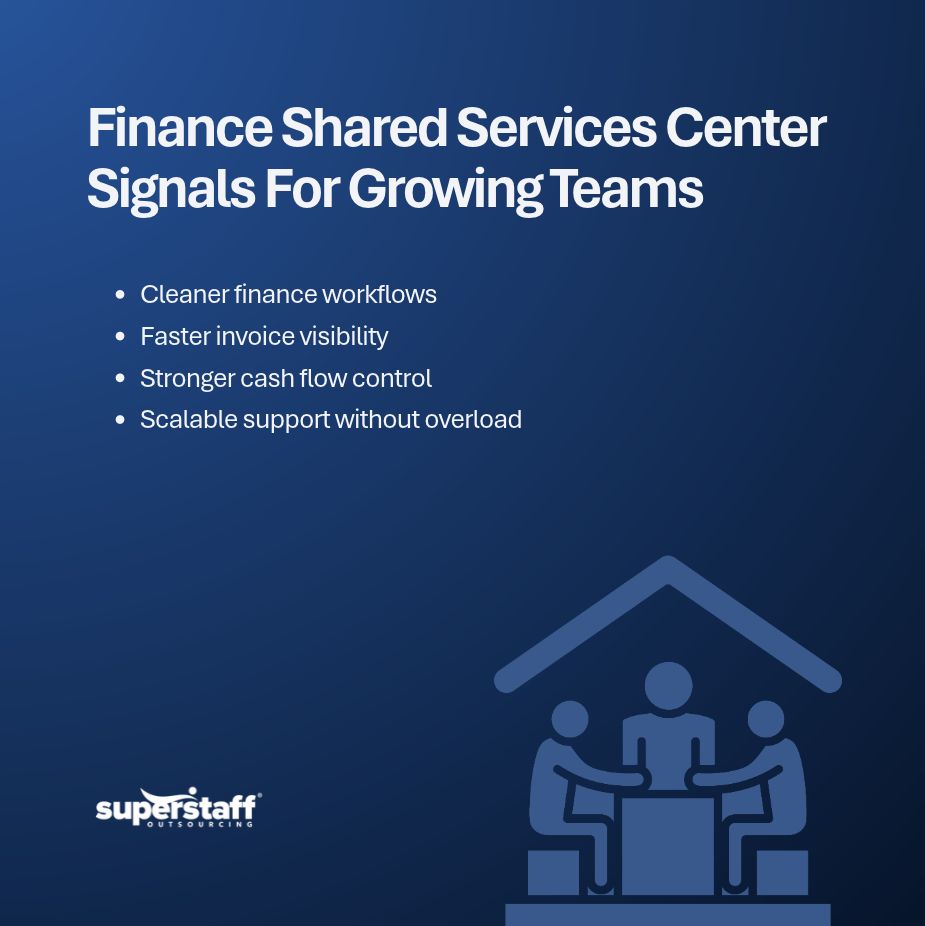
A finance shared services center helps solve these problems by standardizing how finance support work gets done. It creates clearer workflows, defined responsibilities, and better process visibility. This is especially valuable for companies that want to scale but are not ready to build a large in-house finance department.
The Pressure On Lean Finance Teams
Many SMEs operate with small finance teams that carry a wide range of responsibilities. One person may handle vendor payments, customer billing, reporting requests, and internal follow-ups in the same week. That structure may work early on, but it becomes fragile as transaction volume increases.
The pressure often appears in familiar ways.
- Invoices wait too long for review
- Collections follow-ups become inconsistent
- Reports take longer to prepare
- Month-end close becomes stressful
- Senior finance leaders spend too much time on admin work
A finance shared services center can absorb many of these recurring tasks. This allows internal finance leaders to focus on forecasting, cash flow planning, pricing decisions, audits, and business strategy.
The benefit is not only lower cost. It is better use of finance talent.
What Finance Work Can Be Moved To A Shared Services Model
A finance shared services center works best when companies identify tasks that are process-driven, repeatable, and measurable. These are the activities that need accuracy and consistency but do not always require senior finance staff to complete.
Common finance support functions include:
- Accounts payable processing
- Vendor invoice validation
- Payment scheduling support
- Accounts receivable follow-ups
- Billing and invoice generation
- Collections coordination
- Expense report checking
- Data entry and transaction coding
- Bank reconciliation support
- Payroll documentation support
- Financial report preparation
- Audit document organization
These functions may seem administrative, but they influence cash flow, vendor relationships, customer experience, and decision-making. When handled poorly, they create friction across the business. When handled well, they strengthen operational control.
A finance shared services center gives companies a more structured way to manage these functions while keeping oversight in the hands of leadership.
Why The Philippines Is A Strong Delivery Location
The Philippines has long been a trusted outsourcing destination for U.S. companies because of its strong service culture, English proficiency, and experience supporting global business operations. For finance support, these strengths matter.
Finance teams need professionals who can follow detailed processes, communicate clearly, handle sensitive information carefully, and work with internal stakeholders across time zones. A finance shared services center in the Philippines can provide that combination of process discipline and service orientation.
For U.S. SMEs and midmarket companies, the Philippines also offers a practical path to building capacity without the full cost and complexity of expanding local headcount. Companies can access trained finance support professionals while maintaining control over approval authority, reporting standards, and key financial decisions.
This makes the model especially useful for businesses that need more support but still want a close connection between outsourced teams and internal finance leaders.
What Leaders Should Look For In A Finance Shared Services Partner
A finance shared services center should never operate as a disconnected back office. It should function as an extension of the company’s finance operation. That means the right partner must understand more than staffing.
Business leaders should look for a provider that can support clear workflows, documented processes, data protection, performance monitoring, and team management. The partner should also be able to adapt to the company’s systems, approval rules, reporting needs, and communication style.
Important partner qualities include:
- Experience supporting finance and accounting workflows
- Strong recruitment and training processes
- Clear team supervision and escalation paths
- Secure handling of financial information
- Ability to align with U.S. business hours when needed
- Transparent reporting on output and quality
- Flexibility as finance needs change
A finance shared services center succeeds when the provider understands that accuracy, confidentiality, and consistency are non-negotiable. Cost savings may open the conversation, but trust sustains the partnership.
How Shared Services Improve Financial Visibility
One of the biggest advantages of a finance shared services center is better visibility into routine finance activity. When tasks are handled in a structured environment, leaders can track progress more easily.
They can see which invoices are pending. They can monitor aging receivables. They can identify bottlenecks in approvals. They can review task completion, turnaround times, and recurring errors.
This visibility helps finance leaders make better decisions. It also helps them spot process gaps before they become larger problems.
For example, if vendor invoices are often delayed because approvals sit with one department, the issue becomes easier to identify. If collections follow-ups are inconsistent because no one owns the schedule, the workflow can be redesigned. A finance shared services center creates the operational discipline needed to make these improvements visible.
The Role Of Technology And Human Oversight
Automation can improve finance operations, but technology alone does not solve every process issue. Many finance tasks still require judgment, review, communication, and follow-through.
A finance shared services center can work alongside the company’s existing finance tools, accounting platforms, ERPs, CRMs, and ticketing systems. The outsourced team can help keep data updated, prepare documents, monitor queues, and coordinate with stakeholders.
This combination works well because automation handles speed while trained people handle context. A payment may be flagged by a system, but a finance support specialist can check the details, follow the workflow, and escalate the issue properly.
For midmarket companies, this balance is important. They need efficiency, but they also need control. A finance shared services center supports both when processes are clearly defined and managed well.
When It Makes Sense To Build This Model
A finance shared services center is worth considering when internal finance teams are spending too much time on repetitive tasks. It is also useful when transaction volumes are rising, reporting deadlines are harder to meet, or leaders want better cost control without sacrificing operational quality.
Common trigger points include:
- Business expansion into new markets
- Rising invoice and billing volume
- Delays in month-end close support
- Need for better receivables follow-up
- Increased finance documentation requirements
- Difficulty hiring local finance support staff
- Pressure to reduce overhead while improving output
The best time to consider this model is before the finance team reaches a breaking point. Waiting too long can lead to burnout, errors, and slower business decisions.
A finance shared services center gives companies a way to build capacity in a planned and controlled manner.
How SuperStaff Supports Finance Shared Services
SuperStaff helps U.S. companies build outsourced support teams in the Philippines with a focus on service quality, operational fit, and long-term reliability. For finance operations, that means helping businesses access trained professionals who can support daily finance workflows while staying aligned with internal standards.
Our approach starts with understanding the company’s finance processes, team structure, business goals, and pain points. From there, SuperStaff can help recruit, equip, train, and manage finance support talent that fits the work.
This is especially valuable for SMEs and midmarket companies that need dependable finance support but do not want to manage every hiring, onboarding, and administrative detail alone.
A finance shared services center with SuperStaff gives companies access to capable offshore talent, structured operations, and hands-on account support. It also allows internal leaders to stay focused on higher-value financial decisions.
Build A Finance Operation That Can Keep Up
Growth puts pressure on finance teams. More transactions, more reporting needs, and more internal requests can stretch lean teams thin. A finance shared services center helps companies manage that pressure with a smarter operating model.
For U.S. SMEs and midmarket businesses, the right outsourced finance support team can improve consistency, protect internal focus, and create more room for strategic finance work.
SuperStaff helps companies build finance support teams in the Philippines that are practical, well-managed, and aligned with real business needs. Explore SuperStaff’s outsourcing services today and see how the right finance support model can help your business operate with more control, clarity, and confidence.