Sustainability reporting is no longer enough for business leaders. Executives now need systems that turn sustainability goals into daily actions.
This is where AI as a sustainability tool for SMEs becomes practical and measurable. It helps leaders move from static reports to real-time decision-making.
Companies that integrate sustainability into operations can manage costs, reduce risk, and improve long-term performance.
Sustainability Needs to Move Into Daily Operations
Many companies still treat sustainability as a reporting function. Reports are completed quarterly or annually, then set aside.
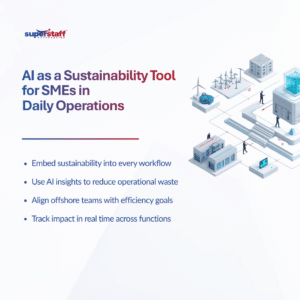
However, leaders need sustainability to guide daily choices. Procurement, staffing, logistics, and customer service all have environmental and social impact.
- Decisions must reflect resource use and efficiency
- Teams need visibility into sustainability metrics
- Leaders must act on data, not just review it
AI as a sustainability tool for SMEs enables this shift by embedding sustainability into workflows. It ensures that sustainability becomes part of how work gets done, not just how performance is measured.
Transitioning from reporting to execution requires better data and faster insights.
AI Connects Data Across Business Functions
Sustainability decisions often fail due to fragmented data. Finance, operations, and customer service teams work in silos.
AI helps unify this data and make it usable.
- Tracks energy use, staffing levels, and service demand
- Identifies inefficiencies across departments
- Links operational decisions to sustainability outcomes
AI as a sustainability tool for SMEs allows leaders to see how small decisions affect overall performance. For example, adjusting staffing schedules can reduce energy consumption in physical offices.
With connected data, sustainability becomes measurable across the entire business.
Real Time Decision Support Improves Efficiency
Static dashboards do not support fast decision-making. Leaders need real-time insights to act effectively.
AI provides continuous monitoring and recommendations.
- Suggests optimal staffing levels based on demand
- Flags waste in processes or resource use
- Recommends adjustments to reduce operational strain
AI as a sustainability tool for SMEs supports faster responses without adding complexity. Managers can act on insights immediately instead of waiting for reports.
This leads to consistent improvements across operations.
Smarter Workforce Management Supports Sustainability
Workforce decisions directly impact sustainability. Overstaffing increases costs and resource use. Understaffing leads to inefficiencies and poor service.
AI helps balance workforce needs.
- Aligns staffing with real demand patterns
- Reduces idle time and unnecessary shifts
- Supports remote and offshore staffing models
AI as a sustainability tool for SMEs also supports outsourcing strategies. Offshore teams reduce the need for large on-site infrastructure, which lowers energy use and operational costs.
This creates a more efficient and sustainable workforce model.
Supply Chain Visibility Reduces Waste
Supply chains often create hidden sustainability challenges. Delays, excess inventory, and poor coordination increase waste.
AI improves visibility and control.
- Predicts demand more accurately
- Reduces overproduction and excess inventory
- Identifies bottlenecks that increase resource use
AI as a sustainability tool for SMEs helps businesses operate leaner supply chains. It ensures that resources are used efficiently from sourcing to delivery.
Better visibility also supports compliance with sustainability standards.
Customer Experience Can Align With Sustainability Goals
Customer expectations are changing. Buyers want faster service and responsible business practices.
AI helps align customer experience with sustainability.
- Optimizes routing to reduce travel and delivery time
- Supports digital interactions instead of physical processes
- Improves response times without increasing resource use
AI as a sustainability tool for SMEs ensures that customer service improvements do not come at the expense of sustainability. Instead, both goals can be achieved together.
This balance is critical for long-term brand trust.
Automation Reduces Operational Waste
Manual processes often lead to inefficiencies. Repetitive tasks consume time and resources.
AI-driven automation addresses this.
- Reduces paper-based processes
- Eliminates redundant tasks
- Improves accuracy and reduces rework
AI as a sustainability tool for SMEs enables companies to streamline operations while reducing waste. Automated workflows also improve consistency across teams.
This creates a more disciplined and efficient organization.
Data Driven Governance Strengthens Accountability
Sustainability requires accountability at every level. Leaders need clear metrics and consistent reporting.
AI supports governance by standardizing data.
- Tracks key sustainability indicators across departments
- Provides audit-ready insights
- Enables transparent reporting to stakeholders
AI as a sustainability tool for SMEs ensures that sustainability is measurable and verifiable. It removes guesswork and supports better governance.
This is especially important for companies working with global clients.
Offshore Teams Support Sustainable Operations
Outsourcing plays a key role in operational sustainability. Offshore teams reduce the need for large on-site infrastructure.
They also enable flexible operations.
- Lower energy use in physical offices
- Reduce commuting-related emissions
- Support 24/7 operations without overburdening local teams
AI as a sustainability tool for SMEs enhances offshore models by optimizing workflows and performance. It ensures that distributed teams operate efficiently and sustainably.
This approach aligns cost efficiency with environmental responsibility.
Leadership Needs to Integrate Strategy and Execution
Sustainability initiatives often fail due to poor execution. Strategies are defined, but daily actions do not align.
Leaders must bridge this gap.
- Align KPIs with sustainability outcomes
- Equip teams with the right tools and insights
- Ensure accountability across departments
AI as a sustainability tool for SMEs provides the structure needed to connect strategy with execution. It enables leaders to monitor progress and adjust in real time.
This creates a more resilient and adaptive organization.
Building a Scalable Sustainability Model
Sustainability efforts must scale with business growth. Small improvements should lead to long-term impact.
AI supports scalability.
- Adapts to changing business needs
- Supports expansion without increasing inefficiencies
- Maintains consistency across locations and teams
AI as a sustainability tool for SMEs ensures that sustainability remains a priority as the business grows. It allows companies to expand without losing operational discipline.
This is essential for midmarket companies planning for long-term growth.
Turning Sustainability Into Daily Action
Sustainability is no longer limited to reporting frameworks. It must be embedded in daily decisions across the organization. AI as a sustainability tool for SMEs provides the structure, insights, and automation needed to make this shift. It connects data, supports real-time decisions, and aligns operations with long-term goals.
SuperStaff helps businesses apply this approach in a practical way. The company integrates AI into workflows while maintaining strong human oversight. This ensures that decisions remain aligned with real business needs and customer expectations.
If your organization is ready to move beyond reporting and build a more sustainable operation, now is the time to act. Connect with SuperStaff to explore how AI-enabled offshore teams can support your goals and strengthen your business performance.