Back-office support keeps every business running smoothly. Teams handle payroll, data entry, customer records, billing, reporting, and daily administrative work. However, many companies struggle with delays, rising costs, and limited manpower. Because of this, businesses now look for faster and more accurate ways to manage operations.
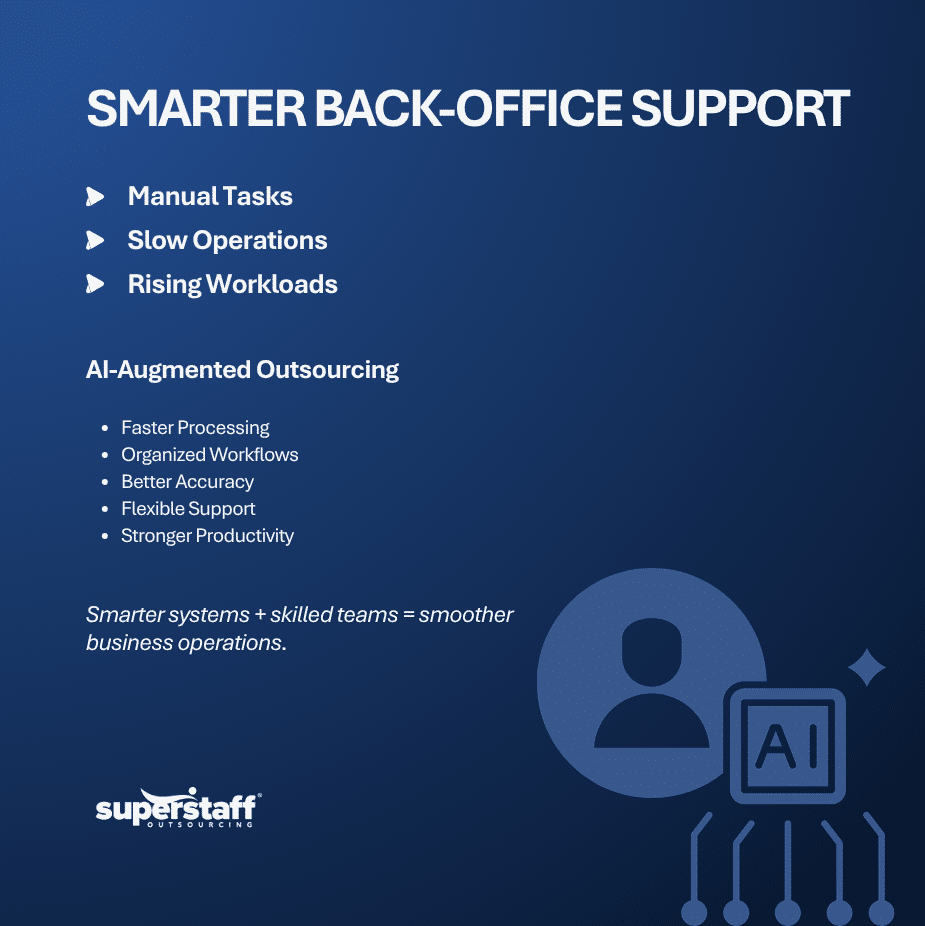
AI-augmented outsourcing helps companies improve back-office support without increasing internal workload. It combines skilled outsourced teams with modern digital tools that help employees work faster and reduce repetitive tasks. As a result, businesses can improve productivity, maintain accuracy, and focus on growth. At the same time, companies gain better flexibility when handling changing workloads and customer demands.
Why Businesses Are Investing in Smarter Back-Office Support
Back-office operations affect customer experience, employee productivity, and business performance. When delays happen in administrative tasks, other departments also slow down. Therefore, companies need systems that support speed and accuracy.
1. Faster Processing of Daily Tasks
Many businesses manage hundreds of repetitive tasks every day. These include invoice processing, data updates, scheduling, and document management. With AI-augmented outsourcing, outsourced teams can complete these tasks faster while reducing manual work.
AI can support activities such as document processing, data classification, and routine administrative workflows. The IBM overview of artificial intelligence explains how AI systems can perform tasks that traditionally require human intelligence, including recognizing patterns, analyzing information, and supporting decision-making.
2. Better Accuracy Across Operations
Manual processes often lead to human errors. Small mistakes in payroll, reports, or customer records can create larger operational problems later. Because of this, companies now prioritize accuracy in back-office support.
Outsourced teams using digital support tools can review and process data more efficiently. However, businesses should still maintain human review and quality checks, especially when AI tools handle sensitive or important information.
3. Improved Cost Management
Hiring and training large in-house teams can increase operational costs. Businesses also spend money on office space, equipment, and employee support services. Therefore, outsourcing becomes a practical option for many growing companies.
Using back-office outsourcing services allows companies to delegate administrative and operational tasks to dedicated teams. This approach can reduce pressure on internal departments while giving businesses access to additional support as workloads change.
4. Stronger Support During Busy Seasons
Workloads often increase during holidays, sales periods, or business expansion phases. Internal teams may struggle to keep up with the additional work. Consequently, delays and employee burnout can become problems.
Outsourcing providers can add support based on business requirements. This flexibility allows companies to manage temporary workload increases without immediately expanding permanent internal teams.
5. More Time for Core Business Functions
Administrative work consumes a large amount of employee time. Because of this, internal teams may have less time for strategy, sales, customer relationships, and other priorities.
By outsourcing repetitive back-office tasks, businesses can shift selected responsibilities to dedicated teams. Internal employees can then spend more time on work that requires their specific knowledge and experience.
Key Areas Where AI-Augmented Outsourcing Helps
Businesses use outsourcing support across different industries and departments. Moreover, many companies now combine outsourcing with digital tools to improve daily operations.
1. Customer Data Management
Customer information must stay accurate and organized. However, managing large databases manually takes time and effort. Outsourced support teams can maintain records, review information, and keep databases organized.
Companies can also use data management outsourcing to support data entry, cleansing, processing, verification, and other information management tasks. When paired with suitable automation tools, these services can reduce repetitive manual work.
2. Finance and Accounting Support
Financial tasks require careful attention to detail. Invoice management, payroll support, accounts payable, accounts receivable, and expense tracking can consume hours of administrative work each week.
Outsourced finance support teams can take responsibility for selected repetitive processes while internal finance professionals focus on analysis, planning, and decision-making. Digital tools can further support document processing, data extraction, and routine checks.
3. Human Resources Administration
HR departments handle recruitment support, employee records, onboarding, attendance management, and other workforce tasks. These responsibilities require consistent monitoring and organization.
With outsourced HR support, companies can shift selected administrative responsibilities away from internal teams. AI and automation can also support tasks such as organizing applications, processing documents, and maintaining employee information.
4. Reporting and Documentation
Many businesses create daily, weekly, or monthly reports for operations and management. Preparing these reports manually can take significant time.
Outsourced back-office professionals can assist with report preparation, document organization, and data processing. Digital tools can support these employees by organizing large amounts of information and reducing repetitive steps.
5. Customer Support Operations
Customer service teams often manage large numbers of inquiries every day. Delays in responses can affect customer satisfaction and brand reputation.
Businesses can use customer service outsourcing to add trained support professionals to their operations. AI tools can assist these teams with tasks such as organizing requests, finding information, summarizing interactions, and directing inquiries to the appropriate agents.
How Businesses Can Maximize Outsourcing Success
Companies achieve better results when they build clear outsourcing strategies. Proper planning also helps internal and outsourced teams work together more effectively.
1. Identify Repetitive Tasks First
Businesses should first identify tasks that consume too much employee time. Repetitive administrative work often provides clear opportunities for outsourcing or automation.
Companies can review processes such as data entry, document handling, invoice processing, scheduling, reporting, and routine customer inquiries. From there, they can determine which activities still require direct internal control.
2. Choose Experienced Outsourcing Partners
Not all outsourcing providers offer the same level of support. Therefore, businesses should evaluate experience, industry knowledge, security practices, technology capabilities, and communication processes carefully.
Companies exploring broader business process outsourcing should also determine how a provider uses technology alongside its workforce. AI should support employees and workflows rather than operate without appropriate review or accountability.
3. Maintain Clear Communication
Clear communication helps outsourced teams understand business expectations and workflows. Without proper communication, delays and misunderstandings can happen.
Businesses should schedule regular updates, feedback sessions, and workflow reviews. They should also define who handles approvals, escalations, and decisions when AI-assisted processes identify unusual cases.
4. Monitor Performance Regularly
Companies should track productivity, turnaround times, accuracy levels, and service quality regularly. Monitoring performance helps businesses identify areas that need improvement.
When AI tools are involved, businesses should also review their outputs for errors or unexpected results. Human oversight remains important for maintaining quality and protecting sensitive business information.
5. Focus on Long-Term Operational Goals
Outsourcing should support long-term business goals instead of only solving short-term staffing problems. Businesses benefit more when outsourcing becomes part of a clear operational strategy.
Companies using AI-augmented outsourcing can determine where technology improves efficiency and where human experience remains necessary. This balance can create more reliable processes as operations grow.
Smarter Support for Better Business Growth
Back-office support affects many parts of business operations. Slow administrative processes can reduce productivity, increase costs, and affect customer experience. Because of this, businesses are exploring outsourcing models that combine trained professionals with digital tools.
AI-augmented outsourcing gives companies access to skilled professionals while using technology to support repetitive and data-heavy processes. Businesses can improve processing speed, reduce manual work, and manage changing workloads while maintaining human oversight where it matters.
Smarter Operations Start With The Right Team
Strong back-office support helps businesses stay organized, productive, and prepared for growth. With the right outsourcing strategy, companies can improve efficiency while reducing operational pressure on internal teams.
SuperStaff provides back-office outsourcing solutions for businesses that need additional support with administrative and operational processes. By combining skilled teams with technology-supported workflows, companies can build a more flexible approach to everyday operations.
Reach out to SuperStaff today to learn how AI-augmented outsourcing can support your back-office operations and long-term business goals.