An AI system can produce an answer in seconds. However, a fast answer is not always the right answer. A customer request may contain missing details, a financial record may have an error, or a technical question may fall outside the information the system can handle. In these cases, someone needs to check the result before the business acts on it.
That is where AI output validation comes in. It gives employees a clear role in reviewing AI-generated results before those results affect customers, employees, finances, or business operations. Rather than checking every output manually, companies can set rules that identify which results need human attention.
The goal is simple: let AI handle suitable tasks while giving people control when a result needs closer review.
Why AI Results Need Human Review
AI can support many business tasks, but companies should not assume that every output deserves automatic approval. Instead, they need to understand when a result requires additional attention. A human-in-the-loop approach to AI helps businesses keep people involved when automated systems need additional checks.
1. AI Can Misread Information
AI systems rely on the information available to them. If a request contains unclear wording, missing data, or conflicting details, the system may produce an incorrect result.
For example, an AI tool reviewing an invoice may identify an amount that looks unusual. However, only a person with access to the right business context may know whether the amount reflects a legitimate change or an actual error.
2. Some Tasks Carry Greater Risk
Not every AI output has the same impact. A suggested email response may need little review, while a billing adjustment or hiring recommendation may require much closer attention.
Therefore, companies should consider the possible effect of an incorrect result. The higher the risk, the stronger the need for human review.
3. Context Can Change the Answer
AI can identify patterns in data, but business decisions often depend on circumstances outside that data. A customer may have a special agreement, a supplier may have an unusual contract, or an employee may have a situation that standard rules do not cover.
As a result, human reviewers can add context before the company accepts an AI-generated result.
4. Confidence Needs Clear Limits
Businesses can use confidence scores or other signals to identify outputs that may need review. However, a confidence score should not serve as the only measure of accuracy.
Instead, companies can combine confidence levels with business rules. For example, they can require human approval when the system reports low confidence, conflicting information, or an unusual result.
5. Errors Can Spread Quickly
An AI output can move into another system or trigger another action. If the first result contains an error, that error can affect later steps.
Human review can stop certain errors before they reach customers, financial systems, operational records, or other business processes.
Where AI Output Validation Matters Most
Companies do not need to review every AI result manually. Instead, they can focus human attention on tasks where accuracy, context, and accountability matter most.
1. Customer Service
AI can handle common questions, sort requests, and suggest responses. However, complaints, refunds, unusual requests, and sensitive customer issues may require a trained employee.
A human reviewer can check the customer’s history, understand the situation, and adjust the response before sending it.
2. Finance and Accounting
AI can help organize financial information, identify patterns, and process routine records. Still, an incorrect result can affect invoices, payments, refunds, or financial reports.
Therefore, companies can require human approval for unusual transactions, high-value amounts, conflicting records, or changes that fall outside normal rules.
3. Recruitment
AI can help organize applications and identify candidates who match specific requirements. However, hiring involves more than matching keywords or qualifications.
Human reviewers can check whether the AI result makes sense within the role, assess relevant experience, and make sure the final decision follows company requirements.
4. Technical Support
AI can suggest solutions to common technical problems. Yet, unusual system behavior may require deeper investigation by a technical specialist.
A human can review the AI’s recommendation, check system details, and determine whether the suggested fix is appropriate before taking action.
5. Logistics and Operations
AI can help monitor orders, schedules, inventory, and shipments. However, unexpected delays, missing information, or conflicting updates can make an automated recommendation unreliable.
Human validation gives operations teams a chance to confirm the information and choose the right next step.
How Companies Can Build a Review Process
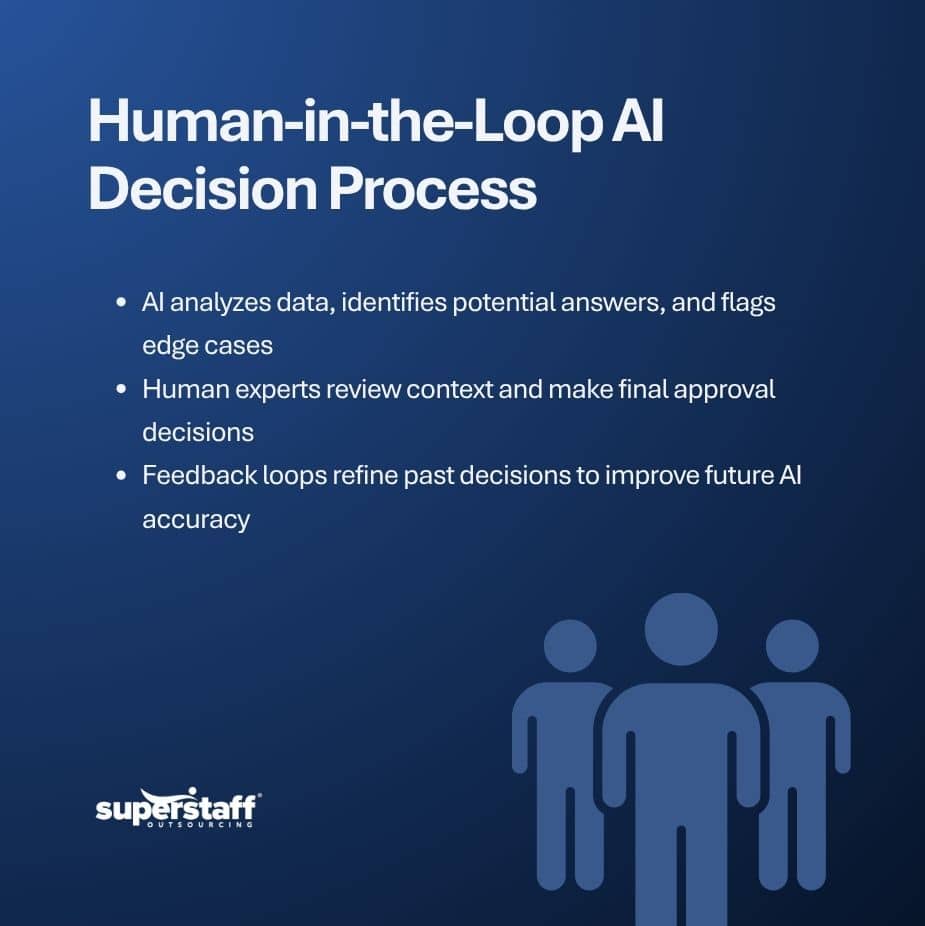
A useful review system should tell employees what to check, when to step in, and what to do with the result. Clear rules also help prevent employees from reviewing too many low-risk outputs.
1. Define Which Outputs Need Review
Start by listing the AI tasks used across each department. Then, identify the results that could create financial, customer, operational, or compliance concerns.
For example, a company might allow automatic handling of routine customer questions while requiring human approval for refunds or account changes.
2. Set Clear Review Triggers
Review triggers should give employees an objective reason to check an output. These triggers can include:
- Low confidence
- Missing information
- Conflicting records
- Unusual recommendations
- High-value transactions
- Customer complaints
- Policy exceptions
- Sensitive decisions
Clear triggers make the process easier to manage. Employees know when they need to act instead of making different decisions for similar cases.
3. Give Reviewers Enough Context
A reviewer needs more than the AI’s final answer. They should also see the information used to produce that result and, where possible, the reason the system reached its recommendation.
This helps employees make decisions faster. Additionally, it makes the review process easier to audit and improve. The NIST AI Risk Management Framework provides guidance on identifying AI risks and establishing appropriate oversight.
4. Give Employees Decision Authority
Human review only works when employees have permission to act. A reviewer should be able to approve, change, reject, or escalate an AI result based on the company’s rules.
At the same time, businesses should define who owns the final decision. This prevents confusion when an AI recommendation conflicts with a human reviewer’s judgment.
5. Record Review Outcomes
Companies should track what happens after employees review AI outputs. These records can show which types of results often contain errors or require changes.
Over time, the information can help teams improve prompts, data, workflows, employee training, and escalation rules.
Make Human Review Part of the Workflow
AI output validation should not exist as an extra task that employees remember to perform. Instead, companies should build it into the workflow from the start.
1. Start With Low-Risk Tasks
Businesses can begin with processes where AI provides useful support without creating major consequences. This allows teams to understand how the system performs and where human review adds value.
Then, companies can expand the use of AI as they gain more experience with the workflow.
2. Match Review Levels to Risk
Some outputs may need a quick check, while others may require a detailed review by a specialist. Companies can create different review levels based on the type of task and its potential impact.
This approach also helps employees focus their time where it matters most.
3. Keep Reviewers Trained
Employees need to understand both the business process and the limits of the AI system. They should know how to question an output instead of simply accepting or rejecting it without checking the underlying information.
Regular training can also help teams recognize common AI errors and unusual cases.
4. Measure More Than Speed
AI can reduce processing time, but speed should not become the only measure of success. Companies should also track accuracy, correction rates, escalations, customer issues, and other useful results.
These measures show whether the AI workflow actually improves the process.
5. Improve the Process Over Time
AI workflows should change when businesses learn something new. If reviewers repeatedly correct the same type of output, the company should investigate why.
Perhaps the system needs better information, clearer instructions, stronger rules, or a different review point. Consequently, human feedback becomes part of improving the overall process.
Businesses that need support with AI-related tasks can consider SuperStaff’s AI outsourcing services to help manage work that requires structured processes and human oversight.
Know When People Should Check AI
AI can handle many routine tasks, but businesses still need clear rules for reviewing its work. AI output validation helps companies decide which results can move forward automatically and which ones need a person to check them.
The strongest approach does not require employees to question every AI output. Instead, it gives them clear triggers, enough context, and the authority to review results when the situation calls for it.
SuperStaff helps businesses build teams for technical support, recruitment, accounting, logistics, and other business functions that can support AI-enabled workflows. Businesses looking to improve their review processes can contact SuperStaff to discuss how human support can fit into their operations.