
The Philippine BPO sector continues to support global clients across insurance, finance, healthcare, and customer service. At the same time, service expectations continue to shift toward speed, accuracy, and data-supported outcomes. Because of this shift, AI maturity in the Philippines has become a key topic among BPO leaders and decision-makers. Many providers already use basic automation, yet gaps remain between early tools and fully integrated systems.
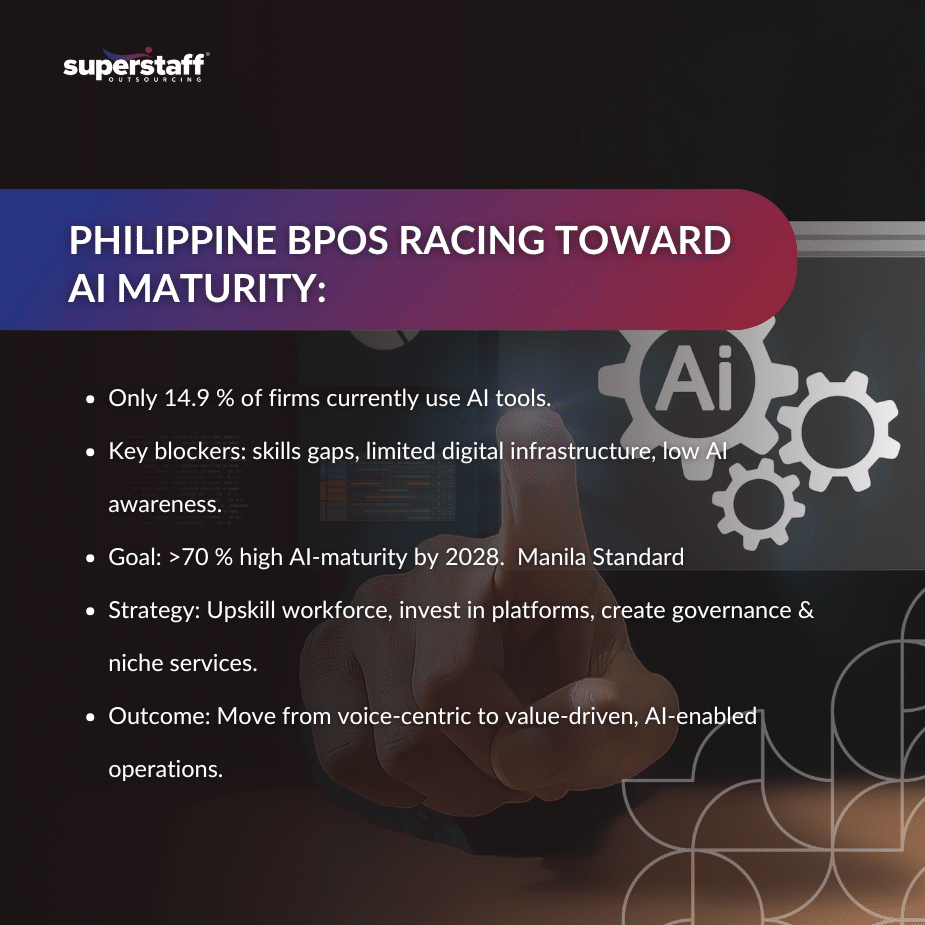
Therefore, the focus now turns to readiness. Building AI maturity in the Philippines by 2028 requires steady investment in skills, infrastructure, and governance. When BPOs take a structured approach, they can strengthen service quality while preparing for long-term demand in the global outsourcing market.
Defining AI Maturity in the BPO Sector
AI maturity refers to how well BPOs integrate intelligent tools into daily operations while maintaining control, accuracy, and accountability. In practice, maturity develops in stages and supports both people and processes.
1. Early Automation Adoption
Most BPOs begin with rule-based automation for repetitive tasks. These include data entry, document checks, and ticket routing. As a result, teams reduce manual effort and processing time.
2. Analytics-Driven Operations
The next stage introduces reporting and analytics tools. These systems help teams review trends and performance data. Over time, insights support better planning and workload management.
3. Integrated Process Design
More mature providers connect tools across departments. Workflows for customer support, claims, or back-office tasks operate within shared systems. This integration reflects growing AI maturity in the Philippines.
4. Predictive Support Capabilities
Advanced systems identify risks such as delays or errors before they occur. This capability supports service reliability. Consequently, clients receive more consistent outcomes.
5. Human Oversight and Governance
Even at higher maturity levels, people guide decisions. Teams review outputs, refine rules, and ensure compliance. This balance keeps operations stable and transparent.
Current Readiness of Philippine BPOs
The Philippines remains a strong outsourcing destination, yet readiness levels differ across providers. Some firms advance quickly, while others move at a slower pace.
1. Widespread Use of Basic Tools
Many BPOs already use automation for standard tasks. These tools support efficiency gains. However, they represent only an early step toward AI maturity in the Philippines.
2. Strong Workforce Capabilities
The local workforce shows adaptability and strong communication skills. With proper training, teams adjust well to new systems. This strength supports further digital growth.
3. Uneven Technology Investment
Larger firms invest more heavily in platforms and infrastructure. Smaller providers often face access limits. As a result, readiness remains uneven.
4. Limited Advanced Analytics
Some providers use dashboards and performance reports. However, predictive and integrated analytics remain less common. This gap slows progress.
5. Rising Regional Competition
Other outsourcing markets continue to advance automation and analytics. Therefore, Philippine providers must continue strengthening AI maturity in the Philippines to remain competitive within the AI in BPO industry.
Barriers That Slow AI Maturity
Several challenges continue to affect adoption speed and depth across the sector.
1. Skills and Training Gaps
Many roles still focus on manual execution. Training programs for analytics and system management remain limited. Therefore, workforce readiness affects progress.
2. Infrastructure Constraints
Reliable connectivity and secure cloud systems remain essential. Some providers still lack these foundations. This limits advanced tool use.
3. Cost Pressures
Technology platforms require upfront investment. Smaller BPOs may delay adoption due to budget concerns. These delays widen readiness gaps.
4. Data Privacy and Governance
Client data requires strict controls. Without clear governance, firms hesitate to scale digital tools. This caution slows BPO digital transformation Philippines initiatives.
5. Change Management Challenges
Employees may worry about role changes. Without clear guidance, resistance increases. Strong leadership helps address these concerns.
Why AI Maturity Matters for Long-Term Growth
Higher maturity levels deliver clear benefits for both BPOs and clients.
- Faster and more accurate service delivery
- Improved reporting and compliance support
- Better customer experience across channels
- Expanded roles focused on analysis and quality
As client expectations evolve, AI maturity in the Philippines helps providers deliver consistent and reliable support.
Practical Steps Toward AI Maturity by 2028
Progress requires structured action rather than rushed implementation. Clear steps support steady advancement.
1. Focus on Workforce Upskilling
Training programs should cover data analysis, system navigation, and technical support. These skills prepare teams for evolving roles. As a result, readiness improves.
2. Invest in Scalable Systems
Cloud-based platforms support growth and flexibility. Secure systems allow providers to expand services without disruption. This step supports AI maturity in the Philippines.
3. Start with Hybrid Workflows
Human-led processes supported by automation balance efficiency and control. This approach builds confidence. Over time, automation expands naturally.
4. Strengthen Data Governance
Clear policies protect client information and support compliance. Governance frameworks enable safe scaling. Therefore, trust remains intact.
5. Collaborate With Technology Partners
Global partners provide system expertise and training support. These collaborations accelerate learning. They also guide how Philippine BPOs can achieve AI maturity by 2028.
Government and Industry Support Roles
Public and private collaboration helps reduce readiness gaps.
1. Policy and Incentive Programs
Government initiatives can support infrastructure investment. Incentives reduce financial barriers. These programs encourage sector-wide progress.
2. Education Alignment
Academic institutions can align programs with industry needs. Skills in analytics and automation should form part of standard curricula. This alignment strengthens talent supply.
3. Industry Association Initiatives
Shared training and best-practice forums support smaller providers. Collaboration improves overall readiness. Knowledge sharing benefits the entire sector.
4. Learning From Regional Models
Other markets offer examples of structured digital growth. Philippine BPOs can adapt these lessons locally. This approach supports steady improvement.
Opportunities Emerging From Higher Maturity
As readiness improves, BPOs can expand into higher-value services.
- Advanced reporting and analytics support
- Compliance monitoring services
- Process optimization consulting
- Data-driven customer insights
These opportunities position providers as strategic partners within the AI in BPO industry.
Building a Sustainable Path Forward
AI maturity develops through continuous review and adjustment. Providers should track workforce skills, system use, and service outcomes. Regular assessments support informed decisions. Over time, this approach strengthens AI maturity in the Philippines while supporting stable job growth.
SuperStaff supports Philippine BPOs through skilled teams, structured processes, and scalable support models. By focusing on training, secure systems, and operational readiness, SuperStaff helps organizations move closer to AI maturity in the Philippines. If you want to strengthen your outsourcing operations and prepare for the road to 2028, reach out to us and start building a more resilient and future-ready BPO strategy today.