Customers do not think in channels. They start with a chat, follow up by email, call when the issue becomes urgent, and expect your team to remember the full story. For growing U.S. companies, this creates a real operational challenge. Working with an omnichannel support outsourcing provider can help businesses manage customer conversations across phone, email, chat, social media, and back-office workflows without building every role in-house.
For SMEs and midmarket companies, the pressure is not only about answering faster. It is about protecting customer relationships while controlling hiring costs, improving coverage, and keeping service quality consistent. This is where an EOR-focused outsourcing model becomes valuable.
Instead of treating customer support as a seat-filling exercise, companies need a partner that can help them build managed teams, support compliance, stabilize staffing, and create a better customer experience from the first interaction.
Why an omnichannel support outsourcing provider matters
A modern support operation has more moving parts than most internal teams can manage alone. Customers expect quick replies, clear answers, and consistent service across every touchpoint.
An omnichannel support outsourcing provider helps connect those touchpoints into one operating model. The goal is to reduce gaps between channels, improve visibility, and give customers a smoother experience.
For example, a customer may ask a billing question through chat, send a document by email, and later call to confirm the update. If each channel works separately, the customer repeats the same details. If the support process is connected, the agent can continue the conversation with context.
That difference matters. It affects customer satisfaction, team productivity, and brand trust.
The EOR angle behind better support teams
An Employer of Record model helps companies hire and manage talent in another country without opening a local entity. For customer support, this gives growing businesses more flexibility when they need skilled agents, team leads, quality analysts, or back-office support staff.
An omnichannel support outsourcing provider with EOR capabilities can help manage employment, onboarding, payroll, compliance, and local HR administration. This allows your company to focus on service strategy while the outsourcing partner handles the operational foundation.
This model works well for companies that want more control than traditional outsourcing but less administrative burden than direct international hiring.
It can support roles such as:
- Customer service representatives
- Email and chat support agents
- Voice support agents
- Social media support specialists
- Technical support representatives
- Billing and account support staff
- Quality assurance analysts
- Workforce coordinators
- Team leaders and supervisors
The result is a more structured support team that can grow with your customer base.
What makes omnichannel support different from multichannel support
Many companies use multiple channels, but that does not always mean they have an omnichannel operation.
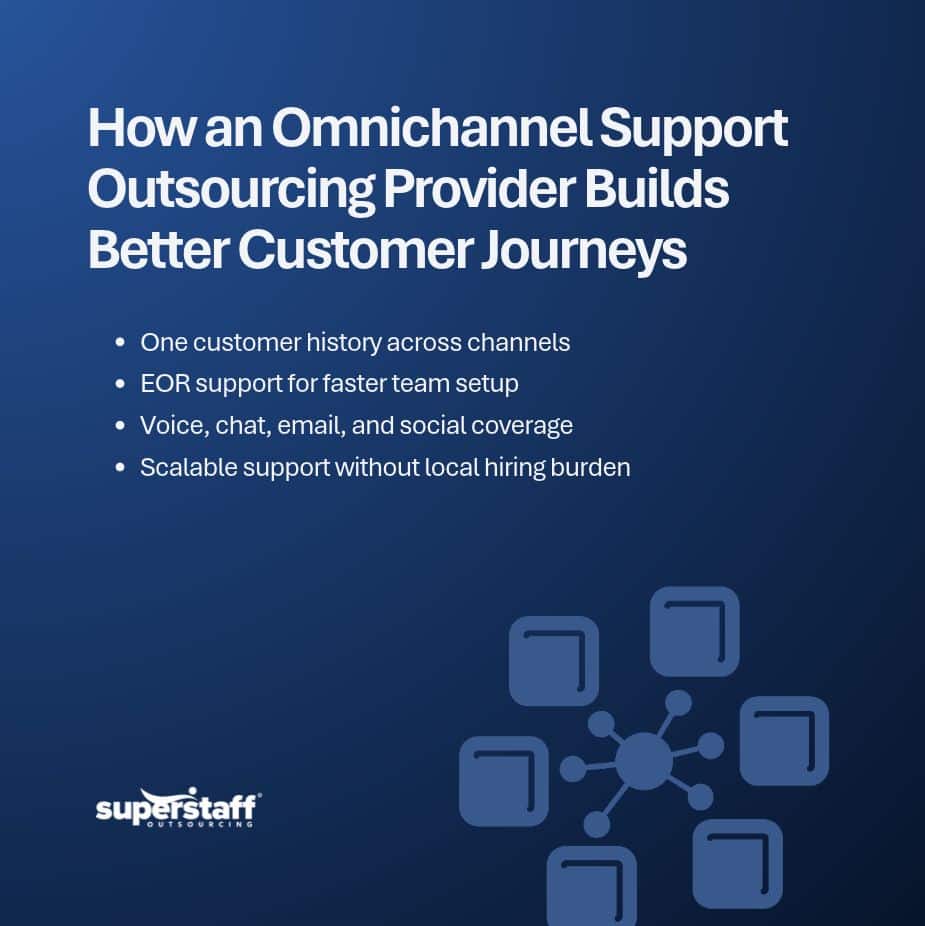
Multichannel support means customers can reach you through different platforms. Omnichannel support means those platforms work together. The customer history, context, and service standards stay connected across each interaction.
An omnichannel support outsourcing provider should help you build that connected experience. This includes clear escalation rules, shared documentation, CRM discipline, and channel-specific training.
For example, a chat agent may need to resolve simple questions quickly. A voice agent may need stronger empathy and de-escalation skills. An email agent may need better written communication and documentation accuracy. Each channel has a different rhythm, but the customer experience should feel consistent.
That consistency is what makes omnichannel support valuable.
Why U.S. SMEs are looking to the Philippines
The Philippines remains one of the strongest destinations for outsourced customer support. Filipino agents are known for strong English communication, cultural alignment with U.S. customers, and experience in service-driven industries.
For SMEs and midmarket companies, the advantage goes beyond labor savings. The bigger value comes from building dependable teams that can handle real customer conversations with professionalism and care.
An omnichannel support outsourcing provider in the Philippines can help companies expand coverage during U.S. business hours, overnight shifts, weekends, or seasonal spikes. This is especially useful for industries with urgent customer needs, such as healthcare, e-commerce, logistics, finance, real estate, and technology.
The right provider does not simply assign agents. It builds an environment where agents can learn your product, follow your standards, and represent your brand with confidence.
How EOR support reduces hiring friction
Hiring internationally can be difficult when a company does not have local infrastructure. There are labor rules, payroll requirements, benefits administration, HR policies, and compliance obligations.
An omnichannel support outsourcing provider with EOR support helps remove much of that complexity. The provider becomes the local employment partner while your business gains access to trained support talent.
This is especially helpful when companies want to test a new market, expand a customer support team, or add specialized roles without long setup timelines.
The EOR model also gives leaders more room to adjust. A company can start with a small team, review performance, and scale based on volume. This is a practical path for businesses that need flexibility but still want operational structure.
What decision-makers should look for
Choosing the right partner requires more than comparing hourly rates. Customer support affects revenue, retention, and reputation. A weak provider can create more problems than it solves.
When evaluating an omnichannel support outsourcing provider, decision-makers should look at several areas.
- Experience handling voice, email, chat, and back-office support
- Ability to recruit for role-specific skills
- Clear onboarding and training processes
- Strong team management and QA support
- Data security and compliance practices
- Transparent reporting and communication
- EOR capabilities for hiring and HR administration
- Capacity to scale without sacrificing quality
A strong provider should ask about your customer journey, escalation process, tools, service expectations, and internal pain points. If the conversation begins and ends with headcount, that is a warning sign.
The right outsourcing partner should understand how support fits into your broader business goals.
Where omnichannel outsourcing creates business value
A well-managed support team can improve more than ticket response times. It can help leaders see patterns in customer concerns, identify process gaps, and reduce pressure on internal teams.
An omnichannel support outsourcing provider can also help standardize workflows across channels. This matters when customer issues move between departments, such as billing, logistics, sales, product, or account management.
For example, an e-commerce company may need agents who can handle order tracking, returns, product questions, and payment concerns. A healthcare company may need support staff who can manage appointment scheduling, patient inquiries, and documentation workflows. A SaaS company may need technical support agents who can triage issues before escalating to engineers.
Each use case requires a different mix of skills. The outsourcing model should adapt to the work, not force every company into the same structure.
How SuperStaff approaches omnichannel support
SuperStaff helps growing businesses build customer support teams in the Philippines with the structure, training, and management needed for consistent service delivery. The focus is not only on finding people. It is about creating teams that can support customers across channels while aligning with your company’s standards.
As an omnichannel support outsourcing provider, SuperStaff supports companies that need voice, chat, email, social media, technical support, and back-office customer operations. With EOR capabilities, SuperStaff can also help businesses manage hiring, compliance, payroll, and local employment requirements in the Philippines.
This gives U.S. companies a practical way to expand support capacity without taking on the full burden of international employment administration.
SuperStaff works well for businesses that want a partner who can understand the customer experience, support operational execution, and help teams scale responsibly.
A smarter path to scalable customer support
Customer expectations will continue to rise. Internal teams will need more support, better coverage, and stronger systems to keep up. For many SMEs and midmarket companies, building everything locally is no longer the most practical option.
The better path is to work with a partner that can combine omnichannel support, EOR support, talent management, and operational discipline.
An omnichannel support outsourcing provider gives your business the ability to serve customers across channels while keeping your internal team focused on growth, strategy, and core operations.
SuperStaff helps U.S. companies build support teams in the Philippines that are trained, managed, and ready to represent your brand. Explore SuperStaff services today and see how the right outsourcing partner can help you deliver more consistent customer support while scaling with confidence.