
U.S. companies are under pressure to scale customer support without breaking what already works. Growth brings volume, new channels, and higher customer expectations. The risk is real. Expansion can fragment systems, dilute brand voice, and strain internal teams. This is where contact center integration becomes critical.
For many growing firms, the Philippines has become the preferred destination for building integrated offshore support teams. The value is not speed alone. It is continuity. When done correctly, contact center integration allows U.S. brands to add capacity while preserving CX discipline, operational visibility, and leadership control.
Why Integration Matters More Than Outsourcing Alone
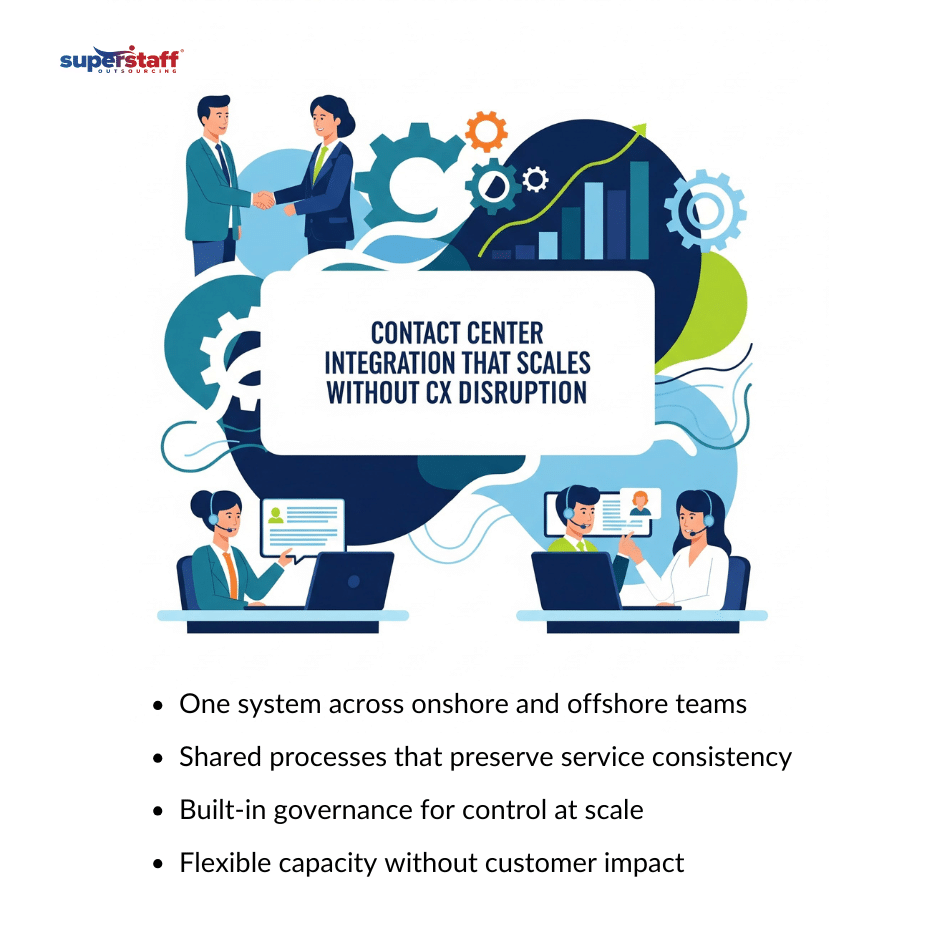
Traditional outsourcing focused on transferring tasks. Integration focuses on embedding teams into existing operations. That distinction shapes outcomes.
Contact center integration aligns offshore agents with the same tools, workflows, and expectations used by onshore teams. Customers experience consistency. Leaders maintain oversight. Teams operate as one system.
For growing organizations, this approach reduces risk. It also shortens the time required to realize value. Instead of rebuilding processes offshore, companies extend what already works.
This is why contact center integration for U.S. companies has become the dominant model for sustainable scale.
Why the Philippines Is Built for Integrated CX Models
The Philippines offers more than labor availability. It offers operational maturity.
Most Philippine-based CX teams already work inside U.S. platforms. CRMs, ticketing systems, workforce tools, and QA frameworks are familiar. This makes contact center integration Philippine operations faster to deploy and easier to govern.
Cultural alignment also matters. Philippine teams are accustomed to U.S. service standards, escalation norms, and performance reporting. That familiarity reduces friction during onboarding and daily operations.
When integration is the goal, this readiness is a strategic advantage.
Technology Alignment Comes First
Successful contact center integration begins with shared systems. Offshore agents must operate inside the same environment as internal teams.
This includes telephony, CRM access, knowledge bases, and analytics dashboards. Parallel systems create blind spots. Integrated systems preserve visibility.
With proper access controls and security governance, Philippine teams become an extension of the internal operation. Leaders see performance in real time. CX leaders retain confidence in service delivery.
This is where many outsourced contact center integration efforts succeed or fail.
Process Integration Protects CX Consistency
Technology enables access. Process alignment protects experience.
Integrated teams follow the same workflows, escalation paths, and service standards as internal agents. Customers should not detect a difference based on location.
Clear SOPs matter. So do exception-handling rules. When offshore agents know how to respond to edge cases, CX remains stable even under pressure.
Contact center integration also allows process improvements to roll out across all teams at once. This keeps operations unified as the business evolves.
Training That Mirrors Internal Standards
Training defines behavior at scale.
In a true contact center integration model, offshore onboarding mirrors internal programs. Agents learn brand voice, compliance requirements, and customer expectations from the start.
Calibration sessions ensure alignment. Shadowing internal agents reinforces context. Ongoing coaching keeps standards consistent as volumes grow.
This approach supports long-term quality. It also reduces rework and escalations that strain leadership bandwidth.
One Performance Framework Across Locations
Integrated teams succeed when performance management is unified.
Shared KPIs, QA scorecards, and service-level expectations create accountability. Leaders can compare performance across teams without adjusting for location.
Contact center integration also improves data quality. When everyone reports through the same framework, trends surface faster. Decisions improve.
This level of transparency is essential for executives managing growth.
Governance Keeps Scale Under Control
Scaling support teams introduces complexity. Governance reduces chaos.
Clear ownership, reporting cadence, and escalation protocols ensure issues are resolved quickly. Contact center integration works best when offshore leaders and U.S. stakeholders operate within defined decision rights.
This structure protects CX during periods of rapid growth or seasonal demand spikes. It also supports compliance and audit readiness.
For U.S. firms in regulated industries, governance is not optional.
Scaling Without Disrupting the Customer
Growth should not force trade-offs between speed and service quality.
Integrated contact center models allow companies to ramp capacity in phases. Volume forecasting aligns with hiring plans. Surge support activates without rebuilding teams.
Contact center integration enables this flexibility. Offshore teams scale with the business while CX standards remain intact.
This is especially valuable for SMEs and midmarket firms that lack excess internal capacity.
Communication and Culture Sustain Integration
Integration is not purely technical. It is human.
Overlapping work hours, shared goals, and consistent feedback loops strengthen collaboration. Philippine teams that feel connected to the broader organization perform better over time.
Contact center integration thrives when leaders invest in communication. This builds trust and reduces attrition.
Stable teams protect customer relationships.
Strategic Value Beyond Cost
Cost efficiency matters. It is not the only benefit.
Contact center integration improves resilience. Distributed teams reduce burnout. Operations remain steady during demand volatility.
This long-term stability is why many leaders now evaluate integration models through a strategic lens rather than a cost lens alone.
The Philippines continues to play a central role in this shift.
Scaling With Confidence Through Contact Center Integration
Contact center integration allows U.S. brands to scale support operations without disrupting CX or losing operational control. When technology, process, training, and governance align, offshore teams strengthen the business rather than fragment it.
SuperStaff supports U.S. companies through structured integration models built for visibility, consistency, and growth. Our Philippine-based teams operate inside your systems, follow your standards, and scale alongside your business.
If you are evaluating contact center integration as part of your growth strategy, explore how SuperStaff can help you expand with confidence while protecting the customer experience that defines your brand.