
Many companies began their remote work journey by hiring freelancers. The model provided quick access to skills without long term commitments. However, as companies scale, leaders often discover that freelance arrangements can create gaps in consistency, accountability, and operational continuity.
This shift has led many organizations to explore a different model. Instead of managing dozens of individual contractors, companies now build a dedicated remote team that works together, follows structured workflows, and supports long term business growth. For U.S. companies looking to stabilize operations while controlling costs, this model is gaining serious attention.
Why the Freelancer Model Often Reaches Its Limits
Freelancers play an important role in modern business. They allow companies to quickly access specialized skills and manage short term projects. Yet many leaders find that relying heavily on freelancers becomes difficult as operations expand.
Freelancers typically work across multiple clients at once. Their availability can change quickly. Communication may become fragmented when several contractors are involved in a single workflow.
Operational challenges often emerge such as:
- Inconsistent service quality
- Limited process ownership
- Difficulty managing schedules across contractors
- Higher administrative oversight
A dedicated remote team addresses these challenges by providing structured staffing that works within a company’s operational framework. Instead of coordinating multiple freelancers, leaders work with a unified team aligned with internal processes.
As a result, companies can focus on growth rather than managing individual contractors.
How Dedicated Remote Teams Support Long-Term Operations
Many business functions require ongoing support rather than project based work. Customer service, back office operations, finance support, and technical assistance all demand continuous attention.
A dedicated remote team operates as a stable extension of a company’s internal workforce. Team members follow company policies, maintain consistent schedules, and participate in regular performance monitoring.
This structure allows organizations to build continuity in several areas:
- Institutional knowledge
- Customer interaction standards
- Operational workflows
- Service level expectations
With a stable team environment, employees gain deeper familiarity with systems and processes. Over time, this familiarity improves efficiency and reduces operational disruptions.
Companies that adopt this model often experience stronger process alignment and more predictable outcomes.
Operational Control Improves With Team Based Remote Support
One of the biggest concerns for executives when outsourcing is maintaining oversight. When work is distributed across freelancers, accountability can become difficult to manage.
A dedicated remote team provides a clearer structure for supervision and reporting. Team leaders monitor performance, track productivity, and ensure that workflows follow established guidelines.
Operational control improves through:
- Structured reporting processes
- Defined escalation paths
- Centralized communication channels
- Consistent work schedules
Managers gain visibility into team performance without needing to supervise each individual contributor directly. This allows internal leaders to focus on strategic planning instead of day to day task coordination.
For many companies, this level of control is a key factor in transitioning away from freelance models.
Building Institutional Knowledge Through Dedicated Teams
Freelancers typically rotate across multiple projects. As a result, knowledge retention often remains limited. When contractors leave, valuable operational knowledge may leave with them.
A dedicated remote team solves this issue by building long term familiarity with company systems and procedures. Team members develop a deeper understanding of customer expectations, internal policies, and workflow requirements.
Institutional knowledge grows in several ways:
- Documentation of recurring processes
- Standardized training programs
- Continuous process improvement discussions
- Long term customer support experience
Over time, the team becomes more efficient and requires less direct supervision. This creates operational stability that freelance models rarely provide.
Organizations benefit from stronger knowledge continuity across departments and functions.
Improving Customer Experience With Stable Support Teams
Customer support operations require consistency. Customers expect accurate information, professional service, and reliable response times.
Freelance staffing models often struggle to maintain consistent service standards because each contractor may follow slightly different processes.
A dedicated remote team ensures that customer interactions follow uniform guidelines. Agents receive structured training, quality monitoring, and regular coaching.
Customer experience benefits include:
- Consistent communication standards
- Faster resolution times
- Familiarity with customer history
- Alignment with brand expectations
When support teams remain stable, customer relationships become stronger. Agents understand recurring issues and can address concerns more efficiently.
For companies that rely on customer loyalty, this stability is essential.
Financial Predictability Matters for Growing Companies
Freelancer costs can fluctuate depending on project demand, hourly rates, and contractor availability. These variables make financial forecasting difficult.
A dedicated remote team offers greater cost predictability. Staffing levels remain consistent, and pricing structures typically follow long term service agreements.
Companies gain clearer financial planning through:
- Stable monthly operating costs
- Predictable staffing capacity
- Reduced contractor sourcing expenses
- Lower administrative oversight
This financial clarity allows leadership teams to plan budgets more effectively while maintaining operational flexibility.
For many growing companies, predictable cost structures become a major advantage.
Dedicated Remote Teams Support Process Standardization
As companies grow, processes must become more structured. Informal workflows that worked for small teams often become inefficient when workloads increase.
A dedicated remote team allows companies to formalize operational processes and implement standard procedures across teams.
Standardization typically includes:
- Defined workflow documentation
- Clear quality assurance checkpoints
- Structured training programs
- Continuous improvement reviews
These processes help organizations maintain consistent service delivery even as demand increases.
Companies that adopt structured teams often find it easier to scale operations without sacrificing quality.
The Role of Outsourcing Partners in Building Dedicated Teams
Establishing a dedicated remote team requires more than simply hiring remote workers. Infrastructure, compliance, recruitment, and workforce management must all be addressed.
This is where outsourcing providers play a critical role. Experienced partners manage recruitment, onboarding, training support, and workforce administration.
For U.S. companies, working with established providers in the Philippines offers several advantages:
- Access to experienced professionals
- Strong English communication skills
- Mature outsourcing infrastructure
- Time zone alignment with U.S. operations
An outsourcing partner ensures that remote teams operate within a structured environment while aligning with client expectations.
This support allows companies to scale operations without building internal offshore management infrastructure.
Why the Philippines Remains a Leading Destination for Remote Teams
The Philippines continues to serve as one of the most reliable locations for building a dedicated remote team. The country has developed a mature business process outsourcing industry that supports companies across multiple sectors.
Professionals in the Philippines bring strong communication skills, cultural compatibility with U.S. clients, and experience working within structured service environments.
Industries that frequently build remote teams in the Philippines include:
- Customer support
- Technical support
- Finance and accounting operations
- Healthcare administration
- E commerce support
This depth of talent allows companies to build specialized teams that align closely with operational requirements.
Many organizations find that Philippine teams integrate smoothly with existing workflows and management structures.
Long-Term Growth Requires Scalable Workforce Models
Companies that plan for long term growth must think carefully about workforce strategy. While freelancers provide flexibility, they may not support sustained operational expansion.
A dedicated remote team creates a scalable workforce model that evolves alongside business needs.
Companies can expand teams gradually, introduce new roles, and implement improved operational structures over time.
This approach supports growth through:
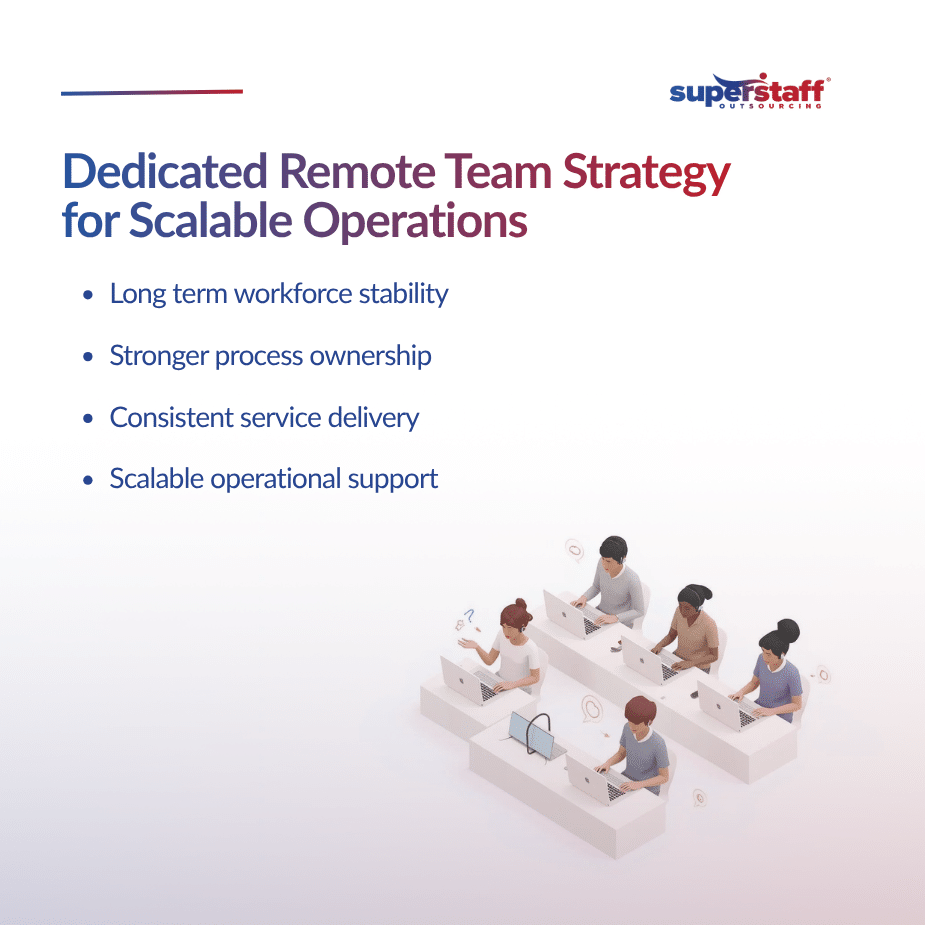
- Consistent service delivery
- Operational continuity
- Process improvement initiatives
- Workforce stability
As companies scale, a structured remote team often becomes a core component of operational strategy.
Leaders gain the ability to expand capacity without disrupting internal teams.
Strategic Workforce Planning Is Shifting Toward Team-Based Models
The remote work environment continues to evolve. Organizations are moving beyond transactional hiring and toward strategic workforce planning.
Freelancers will continue to serve specific project needs. However, companies increasingly recognize the value of building structured remote teams that operate as long term operational partners.
This shift reflects broader business priorities including operational stability, quality control, and customer experience.
By transitioning from contractor based staffing to a dedicated remote team structure, companies strengthen operational alignment while maintaining cost efficiency.
The model allows leadership teams to focus on growth while reliable teams handle day to day operations.
Building Sustainable Growth With the Right Team Structure
Companies that rely heavily on freelancers often face operational limitations as they scale. Workflows become fragmented, institutional knowledge disappears, and leadership teams spend too much time coordinating individual contributors.
Building a dedicated remote team creates a more stable and scalable operational foundation. Teams develop expertise in company processes, support consistent service delivery, and operate under structured management systems.
For U.S. companies seeking reliable offshore support, the Philippines offers an experienced workforce capable of integrating into complex operations. Organizations can build remote teams that strengthen service quality while controlling costs.
SuperStaff helps companies build and manage dedicated remote teams that support long term growth. Our experienced professionals integrate with your workflows, support your customers, and strengthen your operations.
If you are ready to move beyond freelancers and build a more stable workforce model, explore how SuperStaff can help you establish a dedicated remote team that grows with your business.