
Economic swings are now a constant reality for many companies. Leaders face fast-moving changes in demand, cost structures, and funding conditions. Decisions must happen quickly, yet they must also be grounded in reliable insights. That pressure explains why many firms now outsource financial analysis services to maintain clarity and confidence when markets shift.
Finance leaders no longer rely only on internal teams. External expertise helps them move from raw numbers to practical direction. Offshore support also expands bandwidth without inflating overhead. As volatility rises, financial analysis becomes less about reporting and more about guiding strategy.
Volatility demands faster financial clarity
Unstable markets compress decision timelines. Leaders cannot wait weeks for detailed financial modeling. They need rapid insights to guide pricing, hiring, and investments.
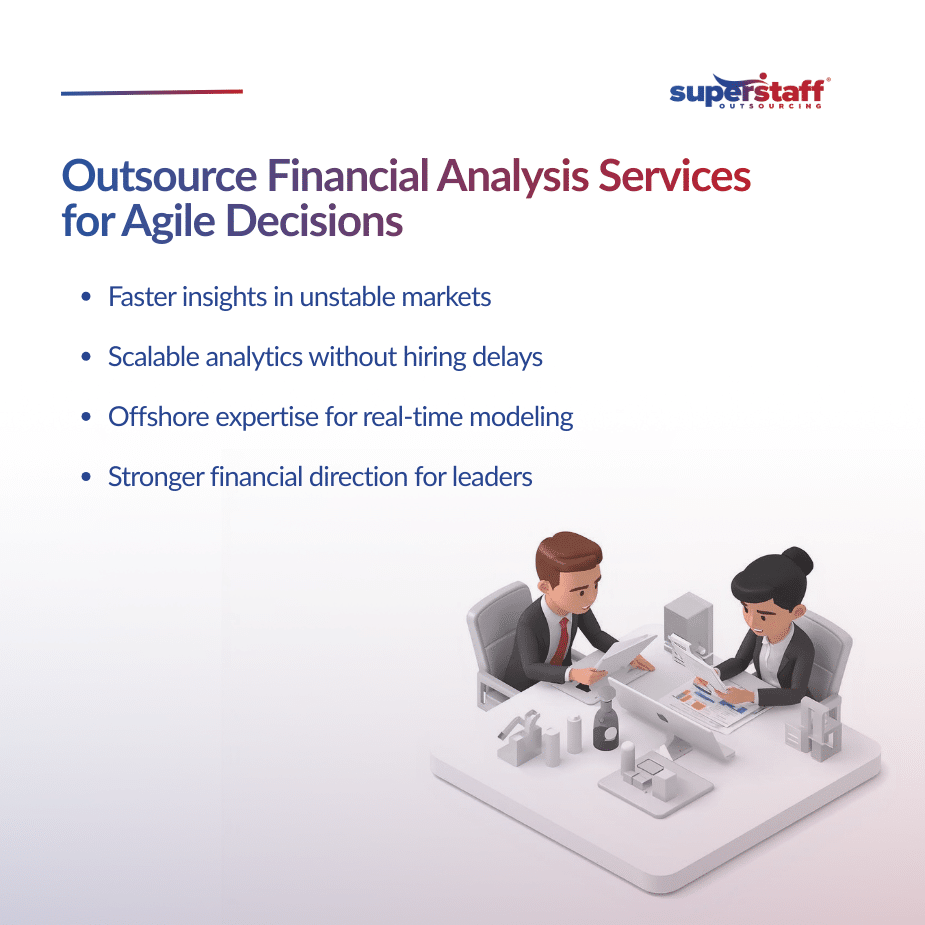
Outsourced analysts help meet that demand by delivering:
- Faster financial modeling cycles
- Real-time scenario comparisons
- Clear summaries for executive decisions
Companies that outsource financial analysis services gain access to teams trained to deliver insights under tight timelines. That speed often determines whether a firm reacts early or falls behind.
Internal finance teams are stretched thin
Many SMEs operate with lean finance departments. Controllers and CFOs often juggle reporting, compliance, and planning simultaneously. Adding deep analytics to that workload creates strain.
External analysis support provides relief through:
- Dedicated modeling resources
- Forecasting support without hiring delays
- Specialized expertise on demand
When firms outsource financial analysis services, they avoid overloading internal teams while still maintaining strategic visibility.
Data complexity continues to grow
Financial data now flows from multiple sources. SaaS tools, ERPs, payment systems, and operational dashboards all generate inputs. Synthesizing these sources requires structured expertise.
Outsourced analysts bring process discipline by:
- Consolidating fragmented financial inputs
- Normalizing datasets across platforms
- Translating dashboards into clear business insights
Companies that outsource financial analysis services benefit from professionals trained to manage complexity and reduce noise in financial reporting.
Scenario planning becomes essential
Volatile markets make long-term projections less reliable. Leaders must prepare multiple paths rather than rely on single forecasts. Scenario modeling becomes a critical capability.
External analysis teams support:
- Best-case and worst-case modeling
- Cash runway projections
- Sensitivity testing for pricing or cost shifts
When organizations outsource financial analysis services, they gain flexible scenario planning without building a full internal analytics department.
Cost discipline remains a priority
Economic uncertainty forces tighter cost control. Many firms want deeper financial insights but hesitate to expand payroll. Outsourcing offers a practical alternative.
Benefits include:
- Lower total cost than full-time analysts
- Predictable monthly spend
- Flexible scaling based on workload
Companies that outsource financial analysis services often balance insight depth with cost efficiency, which is critical during uncertain periods.
Access to specialized financial expertise
Advanced financial analysis requires niche skills. Expertise in valuation, FP&A modeling, or capital planning is not always available internally. Hiring specialists can be slow and expensive.
Outsourced partners provide access to:
- FP&A professionals with cross-industry experience
- Analysts familiar with U.S. reporting standards
- Experts in forecasting and financial storytelling
Firms that outsource financial analysis services tap into talent pools that would otherwise be difficult to build internally.
Stronger decision support for leadership
Executives rely on finance to guide strategy, not just report numbers. Financial insights must translate into actionable recommendations. That shift elevates the role of analysis.
Outsourced teams support leadership by:
- Turning raw data into concise executive summaries
- Highlighting risks and opportunities
- Supporting board-level presentations
Organizations that outsource financial analysis services strengthen their decision-making infrastructure without expanding internal headcount.
Better alignment between finance and operations
Financial insights are most valuable when connected to operations. Pricing, supply chains, and staffing decisions all rely on financial interpretation. Alignment between departments becomes essential.
External analysts help bridge gaps by:
- Linking financial metrics to operational drivers
- Supporting cross-functional planning sessions
- Building dashboards aligned with business goals
Companies that outsource financial analysis services often see stronger collaboration between finance and operational teams.
Scalability during unpredictable cycles
Demand volatility creates uneven workloads. Some quarters require heavy modeling, while others focus on routine reporting. Hiring full-time analysts for fluctuating demand is inefficient.
Outsourcing provides flexibility through:
- On-demand analytics support
- Rapid scaling during peak planning cycles
- Reduced idle capacity during slower periods
Firms that outsource financial analysis services gain the ability to scale insights in step with business needs.
Offshore delivery supports round-the-clock progress
Time zone advantages create additional value. Offshore analysts can work while U.S. teams are offline. That overlap accelerates project timelines and improves responsiveness.
This model supports:
- Overnight modeling cycles
- Faster turnaround for leadership requests
- Continuous progress on financial planning
When companies outsource financial analysis services to experienced offshore teams, they extend productivity without extending workdays.
Strategic outsourcing strengthens resilience
Volatile markets reward agility. Firms that adapt quickly often outperform slower competitors. Financial clarity plays a central role in that adaptability.
Outsourcing contributes to resilience by:
- Expanding analytical capacity without structural risk
- Enabling rapid pivots based on real-time data
- Supporting strategic planning during uncertainty
Businesses that outsource financial analysis services position themselves to respond confidently to economic shifts rather than react defensively.
Why offshore financial analysis aligns with broader outsourcing trends
Outsourcing has evolved beyond transactional support. Companies now seek strategic partners that enhance decision-making capabilities. Financial analysis fits naturally into this evolution.
Many firms already outsource:
- Customer support
- Back-office operations
- Technical support functions
Adding financial analytics to that model creates continuity. Organizations that outsource financial analysis services alongside other functions often build integrated global teams that operate efficiently across time zones.
The role of the Philippines in finance outsourcing
The Philippines has long been recognized for customer support excellence. However, the talent pool has expanded into higher-value services, including finance and analytics. Skilled professionals now support global clients across FP&A, accounting, and data analysis.
Key advantages include:
- Strong English proficiency
- Familiarity with Western business practices
- Experience supporting U.S. SMEs and midmarket firms
Companies that outsource financial analysis services to the Philippines often benefit from both cost efficiency and strong cultural alignment.
Connecting financial insights to customer operations
Financial analysis does not operate in isolation. It connects closely with revenue performance and customer experience. Call center operations, for example, generate data that feeds financial planning.
Insights from outsourced analysis can help:
- Optimize customer acquisition costs
- Improve service ROI tracking
- Align staffing with demand forecasts
When companies outsource financial analysis services alongside customer support functions, they create a more cohesive operational strategy.
Choosing the right outsourcing partner
Not all providers deliver the same level of analytical value. Strategic alignment matters as much as technical capability. Businesses should evaluate partners carefully.
Important considerations include:
- Experience supporting U.S. financial leaders
- Ability to translate data into executive insights
- Strong communication and reporting standards
Firms that outsource financial analysis services successfully often prioritize partners who combine analytical rigor with business understanding.
From numbers to strategic direction
Financial data alone does not drive growth. Interpretation turns data into decisions. That transformation is where outsourcing delivers real value.
With the right partner, businesses can:
- Accelerate planning cycles
- Improve decision confidence
- Maintain financial discipline during uncertainty
Companies that outsource financial analysis services often shift finance from a reporting function to a strategic driver.
Turning Financial Insight Into Strategic Direction
Market volatility is unlikely to fade in the near term. Leaders must navigate shifting conditions with clarity and confidence. Strong financial insights help organizations stay focused even when external signals are unclear. Many firms now outsource financial analysis services to access deeper expertise, faster insights, and flexible support without expanding internal teams.
SuperStaff helps businesses build offshore teams that support both operational and analytical needs. From customer support to finance-adjacent services, the right outsourcing strategy strengthens resilience and improves decision quality.
If your organization is exploring ways to improve financial visibility while maintaining agility, consider how outsourcing can support your next phase of growth. Connect with SuperStaff to learn how global talent can support smarter, faster business decisions.