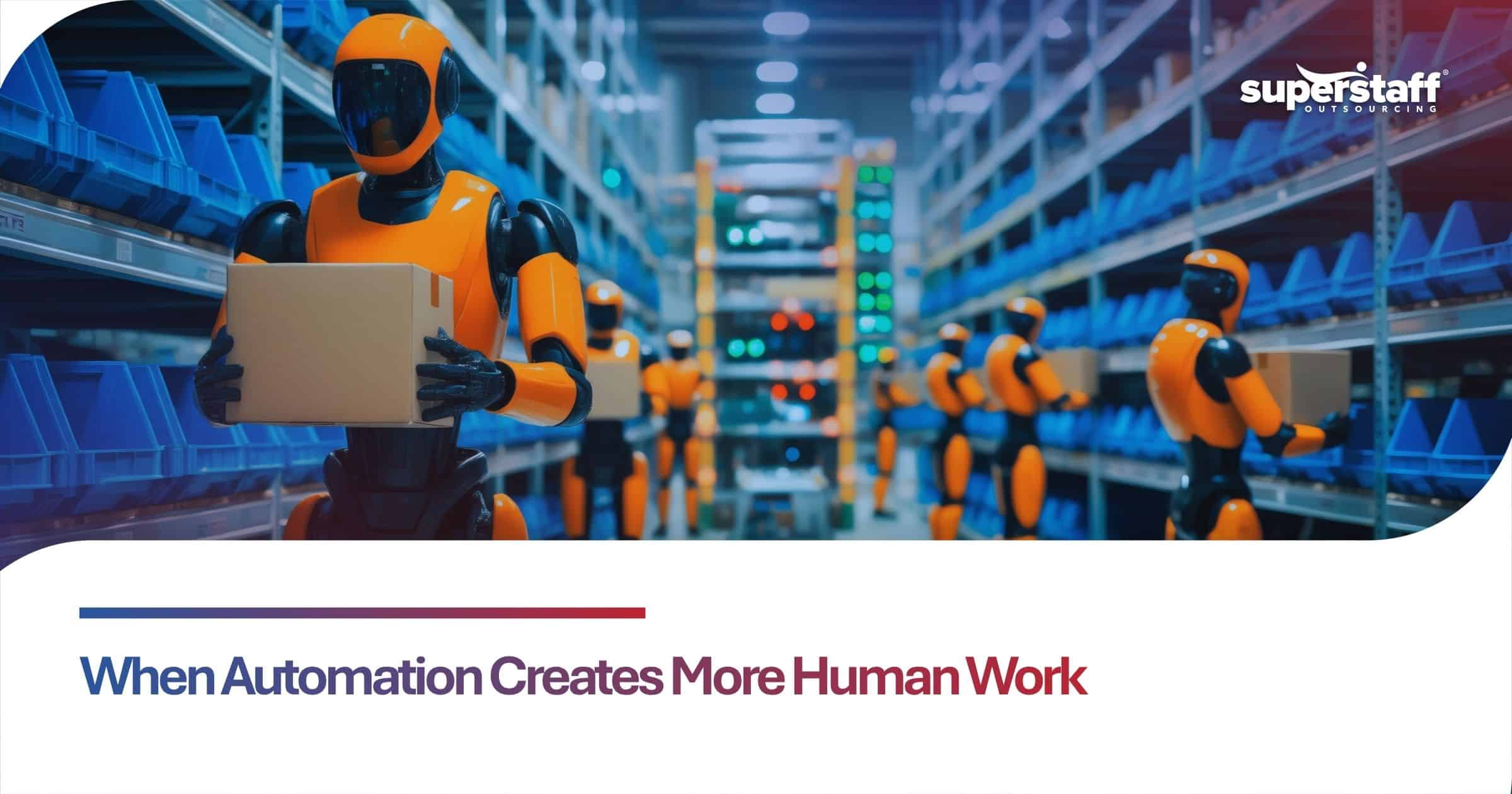
A company adds AI to reduce repetitive work. Then employees start checking every output, correcting small errors, rewriting awkward sentences, reviewing missing details, and sending results back for another round. The workload changes, but it does not always disappear.
This is one of the less discussed effects of human-in-the-loop (HITL) systems. AI can produce content, decisions, summaries, records, and recommendations quickly. However, people still need to inspect those outputs before the company can use them. As a result, AI-generated work can create new tasks that did not exist in the same form before automation.
That does not mean HITL has failed. Instead, it raises an important question: Are companies using AI to remove work, or are they simply moving the work to a different stage of the process?
Why AI-Generated Work Creates New Tasks
AI can reduce the time needed to produce an output. However, the output still needs to meet a company’s standards, which creates several review tasks. Companies must consider these extra steps when deciding which tasks to automate and which to delegate to people.
1. Every Output Needs a Quality Check
AI can generate large amounts of work in a short time. Yet, employees still need to check whether the information makes sense, follows instructions, and meets company standards.
Therefore, a task that once required one person to create may now involve AI production followed by human review. The total work may decrease, but some of it remains necessary.
2. Small Errors Require Human Attention
AI can make simple mistakes, such as using the wrong detail, missing context, or producing an incomplete answer. These errors may take only a few minutes to fix, but they become significant when they appear across hundreds of outputs.
As a result, employees may spend their time correcting AI instead of completing the original task directly.
3. Employees Must Check Tone and Context
AI can follow instructions, but business communication often depends on context. A customer email, sales message, report, or internal document may require adjustments based on the audience and situation.
Consequently, employees may need to rewrite AI output before sending or publishing it. The work shifts from creating the first draft to checking and improving it.
4. More Output Can Mean More Review
Automation can increase production capacity. However, producing more content or decisions also creates more items for people to inspect.
For example, a team that previously created 100 documents may now produce 500 with AI. Even if each document takes less time to create, the team still needs a system for reviewing the larger volume.
5. AI Can Create Exception Work
Routine cases may move through automation easily. However, unusual cases often require human attention.
Therefore, employees may end up handling the cases that AI cannot confidently process. These cases can require more research, communication, and judgment than the original routine task.
HITL Changes Where People Spend Time
Human involvement does not simply add another approval step. It changes the type of work employees perform.
1. From Creation to Editing
Employees may spend less time starting a task from scratch. Instead, they review an AI output and decide what needs to change.
This can save time when the initial output has a strong starting point. However, if employees need to rewrite most of the result, the expected efficiency gain becomes smaller.
2. From Processing to Verification
AI can process large amounts of information. People then verify whether the results meet the required standards.
This shift can work well for structured tasks. However, companies need clear review criteria so employees know what to check and do not spend unnecessary time reviewing every detail.
3. From Routine Work to Exceptions
HITL can remove many routine tasks from an employee’s workload. At the same time, it can concentrate unusual cases in the human queue.
For example, AI may handle standard customer requests while employees manage complaints, unclear requests, and complex account issues. The number of tasks may fall, but the remaining tasks may require more attention.
4. From Execution to Oversight
Employees may also become responsible for monitoring AI performance. They track errors, identify repeated problems, and report issues to managers or technical teams.
As a result, companies create a new layer of operational work around AI systems. That work can provide value, but leaders should include it when measuring automation costs.
5. From One Task to Several Checks
A single automated task can create multiple human checks. Employees might review accuracy, compliance, formatting, tone, and customer impact.
Therefore, companies should map the entire workflow rather than measure only the time saved during AI production. The NIST AI Risk Management Framework provides guidance on assessing AI risks and managing oversight, which can help businesses decide where review is necessary.
How Companies Can Reduce Unnecessary AI Work
The answer is not to remove humans from AI workflows. Instead, companies should decide where human effort provides the most value.
1. Set Review Levels
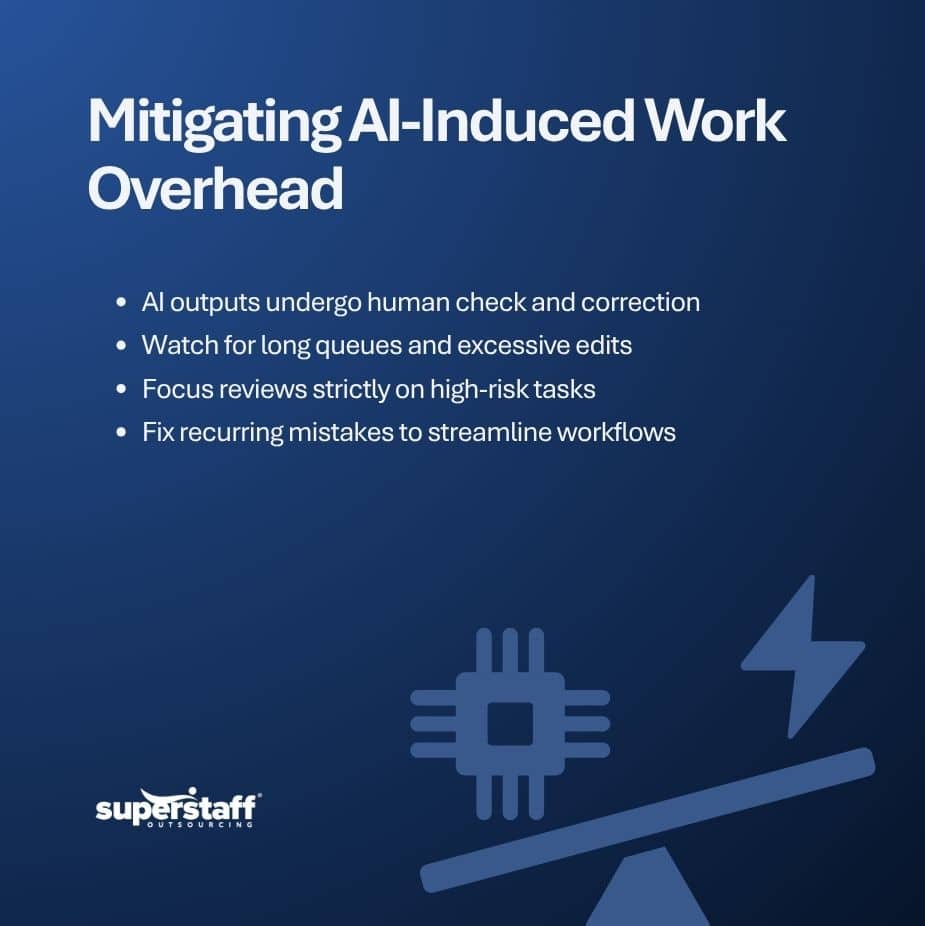
Not every AI output needs the same level of attention. Companies can create different review levels based on risk and impact.
For example:
- Low-risk outputs can receive random checks.
- Medium-risk outputs can receive targeted reviews.
- High-risk outputs can require full human approval.
- Unusual cases can move directly to specialists.
This approach helps teams avoid spending equal time on every AI-generated result.
2. Define What Counts as an Error
Reviewers need clear standards. Otherwise, two employees may judge the same output differently.
Companies should define common issues such as:
- Incorrect information
- Missing details
- Poor formatting
- Policy violations
- Wrong customer context
- Unsupported claims
Clear standards make reviews faster and produce better feedback for improving the system.
3. Track Correction Time
Companies should measure how long employees spend fixing AI outputs. This provides a more accurate view of automation performance.
If an AI system saves five minutes during production but requires four minutes of correction, the actual time savings may be much smaller than expected. Tracking correction time helps leaders make better decisions about where automation makes sense.
4. Use Human Feedback to Improve Workflows
Repeated corrections often point to a process problem. If employees keep fixing the same issue, the company should investigate why it happens.
The solution may involve better instructions, better source data, stronger rules, or a different workflow. In that way, human review can improve the system instead of becoming a permanent correction task.
5. Avoid Automating Tasks That Need Constant Rework
Automation does not always make sense simply because AI can perform a task. If employees must heavily edit every output, the company should reassess the process.
Sometimes, a smaller amount of automation can deliver better results. The goal should be useful automation, not maximum automation.
The Real Cost of AI-Generated Work
AI-generated work can reduce production time while increasing review requirements. Companies therefore need to measure the complete workflow instead of looking only at what AI produces.
1. Measure Before and After
Teams should compare the full process before and after AI adoption. This includes creation, review, corrections, escalation, and final approval.
Only then can leaders determine whether the workflow actually saves time.
2. Count Human Touchpoints
Every human interaction with an AI output adds work. Some touchpoints provide important control, while others may exist because the AI system lacks enough accuracy.
By identifying each touchpoint, companies can decide which ones they should keep, reduce, or remove.
3. Separate Useful Review From Rework
Human oversight adds value when employees catch important errors or make decisions that AI cannot handle. However, repeated correction of basic mistakes creates rework.
This distinction matters because not all human involvement improves the process.
4. Give Employees Better Tools
Reviewers need clear dashboards, approval rules, escalation paths, and access to relevant information. These tools help them make decisions without switching between multiple systems.
Moreover, companies can use review data to identify which tasks consume the most employee time.
5. Keep the Human Role Intentional
HITL works best when companies define why people remain involved. Human reviewers should not exist simply because the organization does not fully trust its AI system.
Instead, they should handle decisions that need judgment, context, accountability, or specialized knowledge. Businesses that need additional help with output validation, data review, and quality checks can use SuperStaff’s AI outsourcing services to support these tasks.
Better AI Work Starts With Better Workflow Design
AI can reduce repetitive work, but it can also create new review, correction, and approval tasks. Companies need to account for those tasks when evaluating the value of automation.
The goal should not be to remove every human touchpoint. Instead, companies should use people where their involvement improves accuracy, manages exceptions, and protects business standards.
SuperStaff can support businesses with teams that handle AI review, quality checks, customer support, back-office tasks, and other operational needs. By combining technology with the right human support, companies can manage AI-generated work without creating unnecessary rework.
Contact SuperStaff to discuss how your business can improve AI-supported workflows and manage the extra work that comes with reviewing automated outputs.