When an AI system returns “I’m not sure,” the next step matters. A business cannot always stop a process and wait for another system response. Someone needs to check the information, understand the situation, and decide what should happen next. That person is the human behind AI.
Human-in-the-loop (HITL) gives people a defined role when AI reaches a limit. Instead of expecting automation to handle every situation, companies set clear points where people review results, correct mistakes, and make decisions. This approach keeps AI useful while giving employees control over work that needs judgment.
The goal is not to remove AI from the process. Instead, it gives people responsibility when the system cannot provide a reliable answer.
Why AI Needs a Human Decision Layer
AI can process large amounts of information quickly. However, speed does not guarantee that an output fits the situation. Human review helps businesses manage cases where the system lacks enough information or produces an uncertain result. This is one reason human involvement remains important when AI systems need training, validation, and exception handling.
1. AI Can Miss Important Context
AI works from the information available to it. Therefore, missing details can affect the result. A customer request, financial record, or operational issue may contain information that requires human understanding.
For example, an AI system may flag a customer transaction as unusual. A trained employee can review the account history and determine whether the activity actually needs attention.
2. Some Decisions Need Judgment
Not every decision follows a fixed rule. Employees often need to consider policies, customer needs, business goals, and possible risks before choosing an action.
As a result, companies should identify tasks where AI can recommend an action but should not make the final decision alone.
3. Human Review Can Catch Errors
AI can produce incorrect information, even when the response appears reasonable. A human reviewer can check the output against source records, business rules, and other available information.
This extra review also creates an opportunity to correct recurring problems. Teams can record common errors and use those findings to improve the process.
4. Uncertainty Should Trigger Action
An “I’m not sure” response should not create confusion about what happens next. Companies can create clear escalation rules that tell employees when they need to step in.
These rules may include:
- Low confidence scores
- Conflicting information
- Missing records
- Unusual customer requests
- High-value transactions
- Decisions with legal or financial impact
5. Accountability Still Matters
Someone needs to own the final decision when an AI-assisted process affects customers, employees, or business operations. HITL gives that responsibility to a qualified person instead of leaving it unclear.
Therefore, businesses should define who reviews the output, what they should check, and who approves the final action.
How HITL Works When AI Reaches Its Limit
A strong HITL process does not ask employees to review everything. Instead, it sends specific cases to the right person based on clear rules.
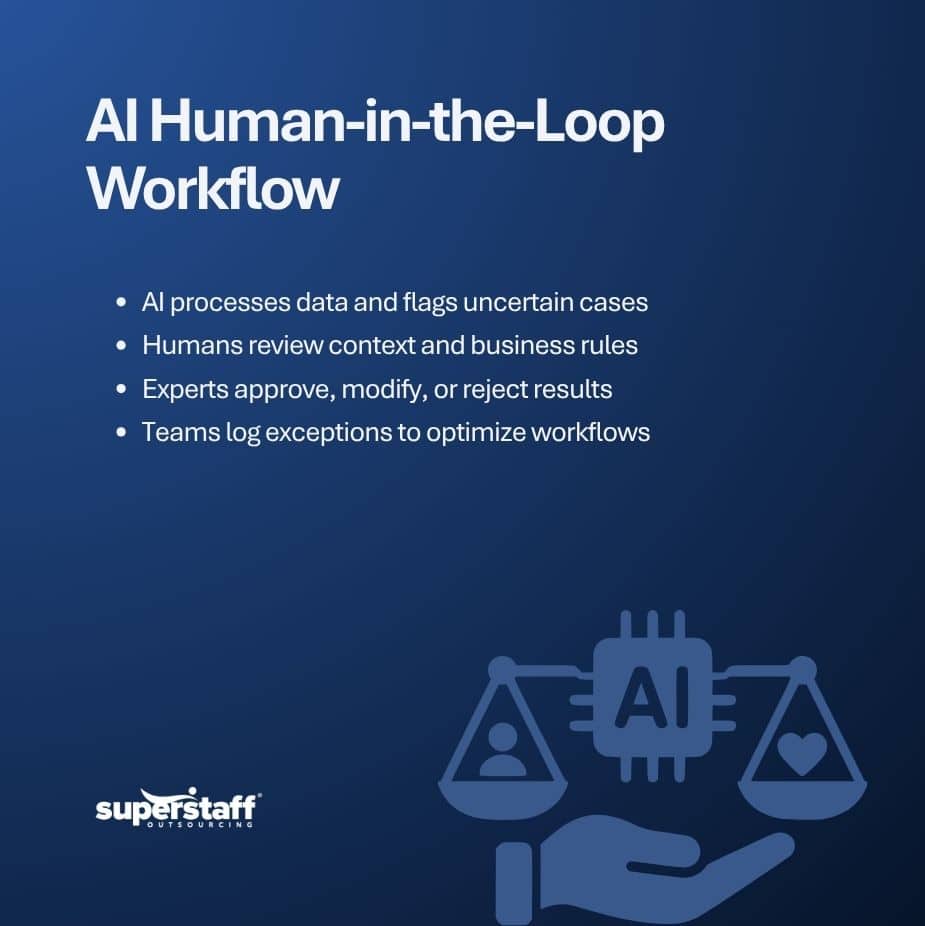
1. AI Handles the First Step
AI can review information, classify requests, identify patterns, or prepare a recommendation. This reduces repetitive work and allows employees to focus on cases that need closer attention.
However, the system should also identify situations that require review rather than forcing every case through automation.
2. The System Flags Uncertain Results
Next, the workflow needs an escalation point. When the AI detects uncertainty, missing information, or an unusual case, it should send the task to a human reviewer.
This step prevents employees from having to search for problems manually. Instead, the workflow brings attention to cases that need it.
3. Employees Check the Output
The reviewer should compare the AI result with the available facts. They can confirm the recommendation, change it, request more information, or reject it.
The human behind AI should have enough information to make that decision. A review screen should show the relevant records, AI recommendation, reason for escalation, and available actions.
4. Humans Make the Final Call
Once the employee reviews the case, they can approve or change the result. For higher-risk tasks, the workflow may require a second reviewer or manager approval.
This structure keeps decision authority with people while still allowing AI to handle routine parts of the process. The NIST AI Risk Management Framework also provides guidance on managing AI risks and defining human responsibilities when overseeing AI systems.
5. The Process Learns From Exceptions
Every escalation can provide useful information. Teams can review why cases reached human employees and look for patterns.
For instance, repeated escalations may show that the AI lacks certain data or that the business rule needs an update. Consequently, exception handling becomes part of process improvement.
Where Human-in-the-Loop Adds the Most Value
Companies can apply HITL across many business functions. The best use cases usually involve decisions where accuracy, context, or accountability matters.
1. Customer Service
AI can sort requests and suggest responses. However, employees should handle complaints, sensitive cases, unusual requests, and situations where the customer needs a clear resolution.
2. Finance and Accounting
AI can review records and identify possible issues. Human reviewers can then verify unusual transactions, approve important changes, and investigate discrepancies.
3. Healthcare Operations
AI can help organize information and support administrative tasks. Still, trained professionals should review outputs when a decision could affect a patient or require professional judgment.
4. Recruitment
AI can help organize applications and identify candidates based on defined criteria. Human recruiters can review the results, consider relevant experience, and make the final hiring decision.
5. Fraud and Risk Management
AI can flag unusual activity at scale. Employees can investigate those alerts, compare records, and determine whether the activity requires further action.
For businesses that need additional people to support AI workflows, AI outsourcing services can provide support for tasks such as data annotation, output validation, content moderation, and quality review.
Build a Clear Path From AI to People
HITL works best when companies treat human review as part of the workflow rather than an emergency response.
A practical process can follow five steps:
- Define the AI task. Decide exactly what the system should handle.
- Set escalation rules. Identify when a person must review the result.
- Assign reviewers. Give specific employees responsibility for different types of cases.
- Record decisions. Track approvals, corrections, and rejected recommendations.
- Review the data. Use human feedback to improve the workflow over time.
This structure also helps employees understand their role. They do not need to question every AI output, but they should know when a review is required.
Keep People Responsible for the Right Decisions
AI can support business processes, but companies still need people who can question results and act when the system cannot provide a dependable answer. The human behind AI provides that layer of judgment.
HITL also gives businesses a practical way to balance automation with responsibility. Instead of asking AI to handle every situation, companies can divide work based on what technology does well and what people do well.
SuperStaff can help businesses build teams that support AI-enabled workflows, from customer service and technical support to accounting, recruitment, and other back-office functions. Businesses looking to add human review to their AI-supported operations can contact SuperStaff to discuss their workforce needs.