For U.S. companies evaluating nearshore customer support, an inclusive work environment is more than an internal culture goal. It is an operating advantage. When agents feel respected, prepared, and supported, they communicate better with customers, stay engaged through complex interactions, and represent the brand with greater consistency.
This matters even more in Colombia, where bilingual support teams often serve customers across cultures, time zones, and service expectations. Companies do not only need agents who can answer calls. They need teams that can listen carefully, adapt quickly, and handle customer concerns with professionalism.
SuperStaff’s Colombia office gives SMEs and midmarket companies access to nearshore talent with strong communication skills, cultural alignment, and a people-first workplace model. That combination helps businesses build support operations that feel connected, reliable, and scalable.
Why an inclusive work environment matters in customer support
An inclusive work environment helps call center teams perform with clarity and confidence. Agents interact with different customer personalities, accents, frustrations, and expectations every day. When they work in a setting that values fairness, respect, and open communication, they are better equipped to extend those same qualities to customers.
Customer support is a human function. Scripts help, systems help, and training helps. Still, the quality of each interaction often depends on whether the agent feels supported enough to solve problems rather than simply move through tickets.
For U.S. businesses, this has direct operational value. An inclusive work environment can support stronger collaboration, clearer escalation paths, and more consistent service delivery. It also helps teams stay aligned when customer volumes rise or processes change.
Inclusion supports better agent performance
A strong call center team needs more than hiring speed. It needs structure, coaching, and workplace practices that allow people to contribute at their best.
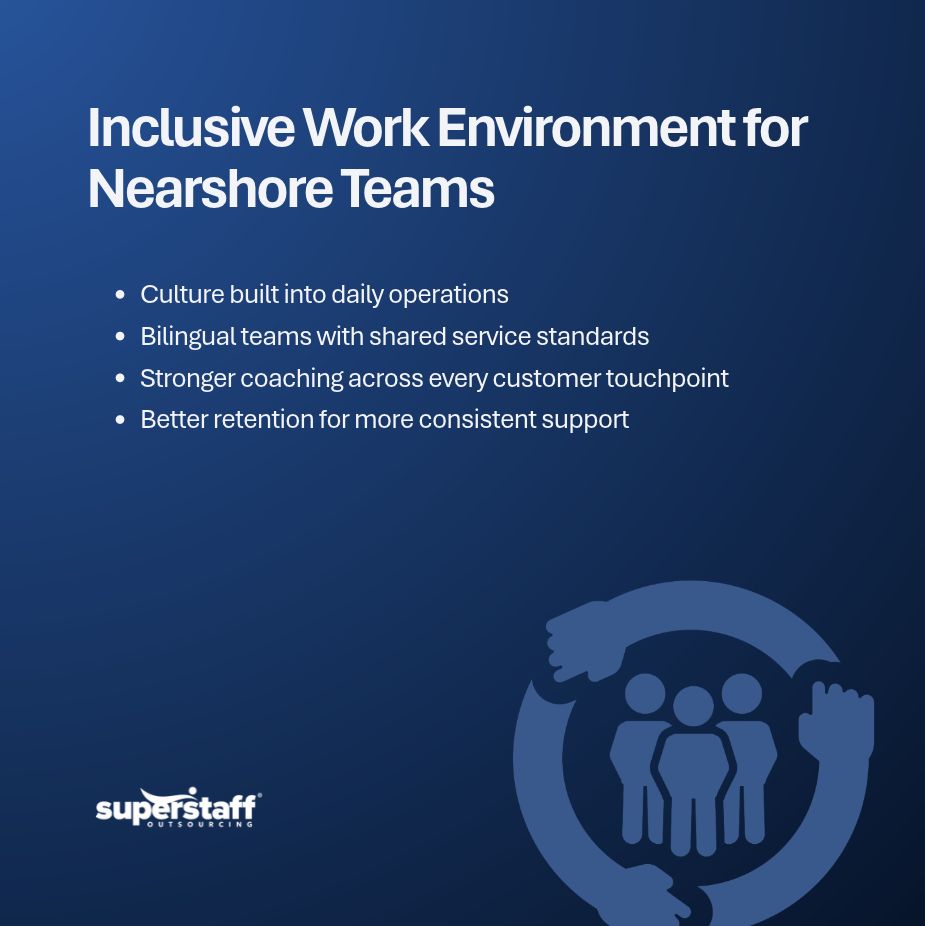
An inclusive work environment gives agents room to ask questions, raise concerns, and improve how they serve customers. This is especially important for outsourced support teams that work closely with U.S. brands. Agents need to understand the client’s tone, customer promise, product standards, and escalation rules.
When inclusion is built into daily operations, teams can improve faster. Supervisors can identify where agents need support. Agents can share recurring customer issues. Quality teams can coach without creating fear or confusion.
That kind of environment helps reduce avoidable friction. It also creates stronger alignment between the client’s business goals and the outsourced team’s day-to-day execution.
Colombia gives U.S. companies a nearshore advantage
For many U.S. companies, Colombia offers a practical path to customer support expansion. Its time zone alignment makes real-time collaboration easier. Bilingual talent supports English and Spanish-speaking customers. Cultural familiarity also helps agents navigate conversations with U.S. consumers more naturally.
An inclusive work environment makes this nearshore advantage stronger. It helps teams from different backgrounds work with shared expectations and a common service standard. That matters when customer experience teams handle sensitive concerns, urgent requests, or high-value accounts.
Nearshore outsourcing is often chosen for speed and accessibility. However, long-term success depends on the quality of the people and the environment supporting them. Companies that invest in inclusive operations are more likely to build teams that stay engaged, communicate well, and grow with the account.
What inclusion looks like inside a call center
Inclusion should show up in practical ways. It should not remain a statement on a careers page or a one-time training topic.
In a call center setting, an inclusive work environment often includes:
- Clear communication between agents, team leads, and managers
• Fair access to coaching, learning, and performance feedback
• Respect for different communication styles and backgrounds
• Safe channels for raising workplace concerns
• Consistent expectations across onsite, hybrid, and remote teams
• Leadership that listens before making process changes
These practices help agents feel informed and accountable. They also help managers lead with better context. For clients, the result is a support team that can operate with less confusion and more ownership.
Inclusion improves customer conversations
Customers can feel the difference between a rushed interaction and a well-handled one. They notice when an agent listens closely, explains clearly, and remains professional even when the issue is frustrating.
An inclusive work environment helps agents develop those habits because it models the same behaviors internally. Agents who experience respect and clear communication at work are more likely to bring patience and structure into customer conversations.
This is especially valuable in industries where support interactions require care and accuracy. Healthcare, e-commerce, logistics, finance, legal services, and technology companies all need agents who can follow processes while still sounding human.
For U.S. SMEs and midmarket firms, that balance is critical. Customers expect fast answers, but they also expect empathy, accuracy, and accountability. Outsourced teams must deliver both.
A stronger workplace supports retention
Call center hiring is only one part of the equation. Retention matters just as much. When agents leave frequently, businesses lose product knowledge, customer context, and process familiarity.
An inclusive work environment can help support stronger retention because employees are more likely to stay where expectations are clear and growth feels possible. This does not mean every workplace challenge disappears. It means teams have better systems for addressing issues before they affect morale or service quality.
For outsourced customer support, retention protects continuity. Clients benefit when agents understand their brand, learn from past interactions, and build confidence over time. Experienced agents can also support new hires, improve workflows, and help stabilize the account during seasonal spikes.
Inclusion strengthens client partnerships
Outsourcing works best when the provider operates as an extension of the client’s business. That requires trust, transparency, and shared standards.
An inclusive work environment supports that partnership because it encourages better communication across teams. Agents can surface recurring customer concerns. Supervisors can provide clearer performance insights. Account managers can work with clients on practical improvements rather than waiting for problems to escalate.
For U.S. companies, this creates a more strategic outsourcing relationship. The provider does more than supply labor. The provider helps protect the customer experience, improve efficiency, and support growth.
This is where SuperStaff’s Colombia office can create strong value. Nearshore support teams can collaborate with U.S. clients during overlapping business hours while delivering service with professionalism and cultural awareness.
What decision-makers should look for in a partner
Executives should evaluate more than cost when choosing an outsourcing partner. Pricing matters, but workplace quality affects performance, retention, and customer outcomes.
A provider with an inclusive work environment should be able to show how it supports agents in daily operations. That includes recruitment, onboarding, training, coaching, leadership access, and employee engagement.
Decision-makers should ask practical questions.
How are agents trained for client-specific expectations? How are performance concerns addressed? How does the provider support bilingual teams? What communication channels exist between agents, supervisors, and clients? How does the provider maintain consistency across locations?
These questions reveal whether inclusion is part of the operating model or only part of the branding.
Building support teams that can grow with the business
Growth creates pressure on customer operations. More customers mean more calls, more tickets, more escalations, and more chances for service gaps. Companies need support teams that can scale without losing quality.
An inclusive work environment helps create that foundation. It supports people, processes, and performance at the same time. It gives agents the structure to do their jobs well and gives clients the confidence that their customers are being handled with care.
For U.S. companies considering nearshore outsourcing, Colombia offers strong potential. The right partner can provide bilingual talent, time zone alignment, and a workplace culture built for sustainable performance.
Choose a partner that builds teams with intention
An inclusive work environment is not separate from customer experience. It shapes how agents communicate, how leaders coach, and how support teams respond under pressure.
SuperStaff helps businesses build customer support teams that combine nearshore accessibility with strong operational support. Through its Colombia office, SuperStaff gives U.S. SMEs and midmarket companies a practical way to expand service capacity while maintaining quality, communication, and control.
Explore SuperStaff’s outsourcing services today and see how the right nearshore call center team can support your next stage of growth.