Your AI project may have thousands of images, videos, audio files, or text records that need accurate labels. As the dataset grows, an internal team may struggle to keep up while also handling model development, testing, and other technical work.
This is where companies can outsource data annotation to add trained people without building a large internal labeling team. External teams can take on repetitive annotation work while your AI specialists focus on development and other project priorities.
For companies managing large datasets, outsourcing also makes it easier to adjust annotation capacity as project requirements change. However, getting good results requires clear guidelines, quality controls, and the right outsourcing partner.
Why Companies Decide to Outsource Data Annotation
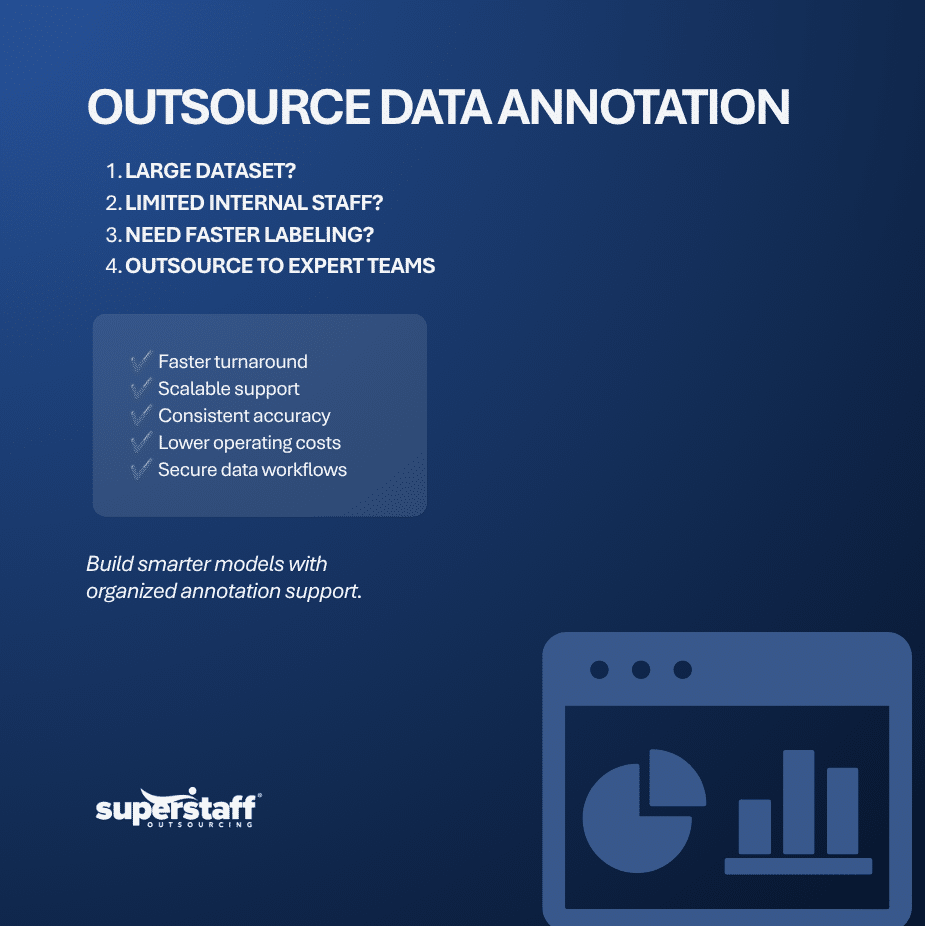
Large AI datasets require time, people, and consistent labeling standards. Outsourcing can provide additional capacity when internal resources are limited.
1. Control Annotation Costs
Building an internal annotation team involves recruitment, salaries, training, management, software, and other operational expenses. These costs can increase as datasets grow.
When companies outsource data annotation, they can add resources based on the size and duration of the project. This gives businesses more control over staffing without permanently expanding internal teams.
2. Access Trained Annotation Teams
Different datasets require different labeling methods. Image annotation may involve bounding boxes, polygons, or classification, while text projects may require intent, entity, or sentiment labels.
Working with teams experienced in AI data annotation outsourcing gives businesses access to people who already understand common annotation workflows, quality checks, and labeling platforms.
3. Scale Capacity Based on Dataset Size
A small pilot dataset may only require a few annotators. A production project involving hundreds of thousands of records may require a much larger workforce.
Outsourcing allows businesses to adjust team size as volumes change. Companies can increase capacity during large annotation cycles and reduce it when workloads decline.
4. Keep Internal Teams Focused
Data annotation can consume a large amount of employee time. Engineers and data scientists may be better used for model development, evaluation, troubleshooting, and product improvements.
Moving repetitive labeling tasks to a dedicated external team allows internal specialists to spend more time on work that requires their technical expertise.
5. Add Structured Quality Controls
Annotation quality directly affects the usefulness of training data. NIST research notes that inconsistent reference data can reduce the accuracy of machine learning methods.
A reliable outsourcing partner should use clear labeling guidelines, reviewer checks, error tracking, and feedback processes to keep annotation consistent across large datasets.
Steps to Outsource Data Annotation Successfully
Outsourcing works best when companies define the project before handing data to an external team. Clear requirements reduce confusion and unnecessary rework.
1. Define Your Dataset and Requirements
Start by identifying what needs to be labeled. Document the data type, volume, annotation method, expected output format, timeline, and quality requirements.
Create detailed guidelines with positive and negative examples. Annotators should know how to handle unclear records, edge cases, and data that does not fit the available labels.
2. Research Potential Providers
Look for providers with experience handling the type of data involved in your project. A team that mainly works with text classification may not be the right choice for a complex computer vision project.
Companies can also consider broader AI outsourcing services when projects require annotation specialists, quality reviewers, validation teams, or other human support roles.
3. Compare Processes, Not Just Pricing
Request information about team structure, annotation tools, quality assurance, security practices, turnaround times, and scalability.
The lowest price does not automatically provide the best value. Poor annotation can create additional review work and require sections of a dataset to be labeled again.
4. Establish Communication and Reporting
Decide how questions, feedback, and project updates will move between teams. Assign clear contacts on both sides and establish a process for handling annotation questions.
Regular reporting can include completed records, rejected annotations, accuracy results, unresolved edge cases, and current project capacity.
5. Run a Pilot Before Scaling
Start with a representative sample instead of sending the entire dataset immediately.
Review the pilot for accuracy, consistency, turnaround time, and adherence to your guidelines. Use the results to improve instructions and correct misunderstandings before expanding the project.
How to Choose the Right Data Annotation Partner
The provider you select can affect dataset quality, project timelines, and data security. Evaluate several areas before making a decision.
1. Relevant Annotation Experience
Ask whether the provider has worked with similar data types and annotation methods.
Some projects may also require industry knowledge. Medical images, financial records, legal documents, and technical datasets may require annotators who understand specific terminology or workflows.
2. Quality Assurance Process
Ask how annotations are reviewed before delivery. Depending on the project, quality controls may include secondary reviews, random sampling, consensus labeling, or escalation of difficult cases.
Structured human review is especially important when companies use AI training data and human-in-the-loop support across ongoing model development cycles.
3. Data Security Practices
Understand how the provider receives, stores, accesses, and transfers your information.
Ask about access permissions, confidentiality agreements, employee security training, data retention, secure work environments, and relevant security or compliance requirements.
4. Technology and Tool Compatibility
The annotation platform should support your required data formats and labeling methods. It should also fit your existing data workflow whenever possible.
Discuss import and export formats before the project begins. This prevents technical issues when your team receives the completed dataset.
5. Communication and Support
A reliable provider should have a clear process for questions, changes, and escalations.
For larger projects, having a dedicated project manager can simplify communication between internal teams, annotators, and quality reviewers.
Common Challenges and How to Address Them
Large annotation projects can still encounter problems even with experienced teams. Preparing for common issues can reduce delays and rework.
1. Inconsistent Labels
Different annotators may interpret the same item differently. Clear guidelines, examples, and reviewer checks reduce these differences.
Update the annotation guide whenever the team encounters a new edge case. This gives everyone the same reference for future decisions.
2. Tight Deadlines
Large datasets can create pressure when model training depends on completed annotations.
Break the project into batches and set milestones for each stage. This makes progress easier to track and allows technical teams to begin working with completed sections while annotation continues.
3. Complex or Specialized Data
Some datasets require subject knowledge. Medical, financial, legal, and technical data may need additional training or specialist review.
Identify these requirements before selecting an annotation team. A provider should explain how it assigns qualified people to specialized tasks.
4. Data Security Across Larger Teams
Increasing the number of people working on a dataset can also increase the importance of access controls.
Limit access according to role, establish clear data handling procedures, and review the provider’s security controls before transferring sensitive information.
5. Changes to Annotation Guidelines
AI projects change as teams learn more about their datasets. Categories may need to be added, removed, or clarified during the project.
Keep a version-controlled annotation guide and communicate every update to the team. Determine whether previously completed records need another review whenever major rules change.
Managing an Outsourced Data Annotation Team
Good management continues after the provider starts working. Internal and external teams need clear standards and regular feedback throughout the project.
Companies should:
- Provide detailed annotation guidelines with examples.
- Set measurable accuracy and output targets.
- Review completed batches regularly.
- Track common errors and unclear cases.
- Give annotators clear and specific feedback.
- Maintain one source for updated labeling instructions.
- Review performance before increasing project volume.
For larger AI projects, companies may also need outsourced data annotation services that can adjust staffing as dataset volumes change. The goal is to create a repeatable process that keeps labels consistent as the project grows.
Scale Data Annotation With the Right Support
Large datasets can quickly exceed the capacity of a small internal team. When companies outsource data annotation, they can add trained annotators, quality reviewers, and project support based on the needs of each development cycle.
SuperStaff provides AI support teams for image, text, audio, and video annotation, along with validation and other human review tasks. A structured outsourcing setup can give your internal AI team more time to focus on model development while dedicated specialists manage high-volume annotation work.
Need support for your next dataset? Contact SuperStaff to discuss your annotation requirements and build a team based on your project size, data type, and workflow.