AI can review a document, flag an issue, score a request, or recommend an action in seconds. However, speed does not always mean the decision is correct. A system can approve something that needs another look, reject something that deserves attention, or miss a detail that only a person would notice.
That is where human-in-the-loop changes the way companies think about the AI approval process. Instead of treating an AI decision as the final answer, organizations can add people at the points where judgment matters most.
This approach does not mean people need to review every AI output. Instead, it asks a better question: Which decisions need human attention, and what should happen when AI gets them wrong?
Where the AI Approval Process Falls Short
An AI system follows its data, rules, and instructions. Therefore, even a well-designed workflow can produce an outcome that does not match the situation. Businesses adopting AI workforce solutions need to consider how human judgment fits into automated processes.
1. AI Can Approve Without Full Context
AI can assess the information available to it. However, it may not understand details that sit outside the data, such as a special customer request, an unusual business case, or a recent change in policy.
For example, an AI system may approve a customer refund because the transaction meets the usual conditions. A human reviewer may notice that the customer already received a replacement, which changes the decision.
2. Rules Do Not Cover Every Situation
Companies often build approval workflows around clear rules. Yet, real business cases do not always follow standard patterns.
AI may apply the correct rule to the wrong situation. As a result, the workflow can produce an answer that looks reasonable but does not fit the actual case.
3. Confidence Can Create False Trust
Some AI systems provide confidence scores or similar signals. While these scores can help prioritize reviews, they do not guarantee that the output is correct.
Therefore, teams should avoid treating a high confidence score as automatic approval. A human should still review decisions when the cost of an error is high or when the case falls outside normal conditions.
4. AI Can Miss Business Priorities
An AI model may optimize for the task it receives. However, businesses often balance several priorities at once.
For instance, a system may recommend rejecting a late payment based on company rules. A human may know that the customer has a long history with the business and that an exception fits the company’s retention policy.
5. Errors Can Repeat Across Many Cases
One incorrect decision may seem small. However, the same mistake can affect hundreds or thousands of cases when a company automates the same workflow.
For that reason, human review should not only catch individual errors. It should also help teams identify patterns that require changes to the AI system, its rules, or the workflow.
What Human Review Adds to AI Decisions
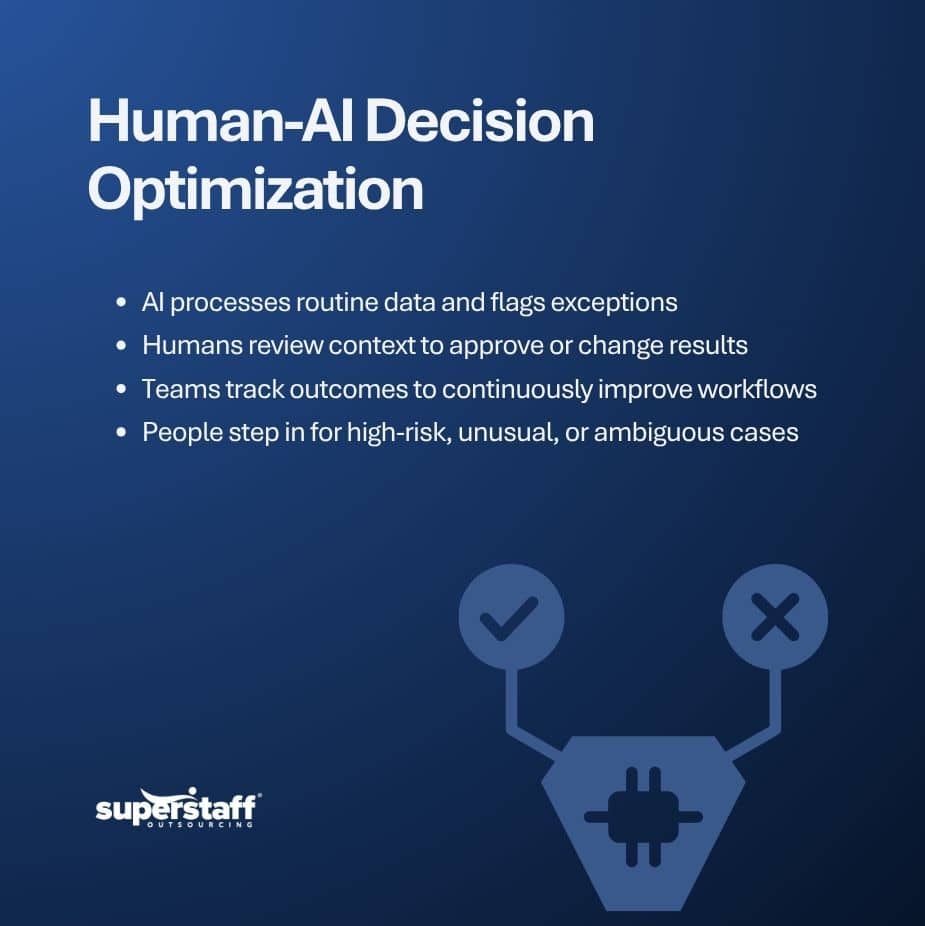
Human-in-the-loop does not mean removing AI from the process. Instead, it gives people defined responsibilities before, during, and after AI decisions.
1. People Check Exceptions
Human reviewers can focus on cases that do not fit normal patterns. This approach allows AI to handle routine work while people spend their time on decisions that require more judgment.
As a result, companies can maintain automation without removing human oversight.
2. People Question the Output
AI can provide a recommendation, but people can ask whether the recommendation makes sense. This simple step can reveal missing information, incorrect assumptions, or unusual circumstances.
Moreover, reviewers can compare the AI output with company policies and customer needs before approving an action.
3. People Handle High-Risk Decisions
Not every AI decision carries the same level of risk. A minor administrative task may need little review, while a financial, compliance, hiring, or customer-impacting decision may require stronger controls.
Companies can therefore create different review levels based on risk. For example:
- Low-risk cases can move through automation.
- Medium-risk cases can receive sample reviews.
- High-risk cases can require human approval.
- Unusual cases can move directly to a specialist.
4. People Provide Feedback
Human review becomes more useful when companies track what reviewers change. Each correction can reveal something about the system’s performance.
Over time, teams can use this information to improve prompts, rules, training data, workflows, or escalation criteria. The OECD AI Principles also emphasize human oversight, transparency, and accountability in the development and use of AI systems.
5. People Take Responsibility
An AI system cannot take business responsibility for a decision. People still need to define policies, set approval limits, manage exceptions, and decide what the organization considers acceptable.
Therefore, the human role should remain clear even when AI handles most of the work.
How to Build Better Approval Workflows
The goal should not be to add people to every AI task. Instead, companies should design a workflow that sends the right decisions to the right people.
1. Define the Approval Point
First, determine exactly where human involvement should happen. The review may occur before an AI recommendation reaches a customer, after the system flags an exception, or before the company takes an irreversible action.
A clear approval point prevents employees from becoming responsible for vague or unnecessary checks.
2. Set Clear Escalation Rules
Next, establish conditions that require human attention. These conditions might include missing information, conflicting records, unusual requests, low confidence, or high financial impact.
Clear rules also help reviewers understand when they should act instead of simply accepting the AI recommendation.
3. Give Reviewers Enough Information
A reviewer cannot make a good decision without the right context. Therefore, the workflow should show the AI recommendation, relevant source information, applicable rules, and any reason for escalation.
This setup reduces unnecessary back-and-forth and helps employees make decisions faster.
4. Track Human Overrides
Companies should record when employees accept, change, or reject an AI recommendation. This data can show where the system performs well and where it needs improvement.
For example, a high override rate in one type of case may indicate that the AI needs better instructions or that the approval rule needs revision.
5. Review the Process Regularly
Approval workflows should change as business needs change. New products, policies, customers, regulations, and operating conditions can affect how AI should make recommendations.
Therefore, teams should review performance data and human feedback regularly. This keeps the workflow aligned with actual business requirements instead of relying on old assumptions.
Human Review Makes AI More Accountable
Human-in-the-loop reveals a simple fact: AI approval is not only a technology issue. It is also a process and accountability issue.
1. Faster Does Not Always Mean Better
AI can reduce the time needed to review large volumes of information. However, speed only creates value when the resulting decisions meet business requirements.
Human review helps companies balance efficiency with accuracy, especially when mistakes have real consequences.
2. Automation Needs Boundaries
AI works best when companies clearly define what it can approve and what it should escalate. Without those limits, teams may allow automation to handle decisions that require more judgment.
Therefore, organizations should establish approval thresholds before expanding AI into new processes.
3. Reviewers Need Clear Roles
Human oversight works better when employees know what they are expected to check. They should understand when to approve, when to reject, and when to escalate a case.
Clear responsibilities also prevent employees from simply accepting AI recommendations without reviewing them.
4. Data Can Reveal Process Problems
Human corrections can expose problems beyond the AI system. They may reveal unclear policies, inconsistent business rules, incomplete information, or weak workflows.
As a result, companies can use approval data to improve the wider operation, not just the AI model. Businesses that need support with AI quality checks and output validation can use AI outsourcing services to help manage review tasks and maintain consistent workflows.
5. Trust Should Follow Evidence
Companies should build trust in AI based on performance, review results, and measurable outcomes. They should not assume that an automated decision deserves approval simply because the system produced it.
A strong human-in-the-loop model creates a practical balance. AI handles suitable tasks, while people review decisions that need context, judgment, or accountability.
Better Approval Starts With Human Oversight
The AI approval process works best when companies know where automation ends, and human judgment begins. Human-in-the-loop helps organizations identify weak points, manage exceptions, review high-risk decisions, and improve workflows over time.
For companies exploring AI-enabled operations, the goal should not be to remove people from every decision. Instead, it should be to place people where their judgment creates the most value.
SuperStaff can help businesses build teams that support AI-enabled workflows, from review and quality checks to customer support and back-office operations. Companies looking to improve their approval processes can contact SuperStaff to discuss their operational needs.