
A business can outsource many tasks, but not every task should follow the same process. Some work needs speed and consistency, while other work requires judgment, communication, and a clear understanding of the situation. That difference matters when companies decide which responsibilities to assign to an external team.
Human-in-the-loop outsourcing lets businesses combine structured processes with human expertise. Instead of removing people from the workflow, it places trained professionals where their knowledge can improve decisions, resolve exceptions, and support customers.
For example, a support team can handle routine requests while trained specialists review unusual cases. Likewise, a claims team can process standard documents while experienced staff checks complex records. This approach helps businesses assign the right work to the right people while keeping human judgment involved where it adds real value.
Where Human Expertise Matters Most
Not every outsourced task needs the same level of human involvement. So businesses should first identify the activities where experience, judgment, and communication can improve outcomes.
1. Handling Complex Customer Concerns
Customers do not always explain their concerns clearly. A trained professional can ask the right questions, understand the situation, and respond in a way that matches the customer’s needs.
Human support is especially useful when a customer has a complaint or unusual request. A clear conversation can prevent confusion and help the business reach a better resolution.
2. Reviewing Exceptions
Standard processes work well when information follows expected rules. However, some cases contain missing details, unusual requests, or conflicting information.
Human reviewers can examine these exceptions and decide what action makes sense. As a result, businesses can avoid forcing every situation through the same process.
3. Making Context-Based Decisions
Information alone does not always explain the right next step. Employees can consider customer history, company policies, business goals, and other details before deciding.
This matters in areas such as customer service, claims processing, recruitment, billing, and technical support. Human judgment helps teams consider the full situation instead of relying only on standard rules.
4. Managing Sensitive Conversations
Some conversations require patience and careful communication. Customers may need help with complaints, account issues, billing concerns, or service problems.
A trained outsourced professional can listen, explain options, and escalate the matter when needed. So outsourcing doesn’t have to mean reducing the human element of customer service.
5. Checking High-Impact Work
Some tasks can affect revenue, customers, compliance, or business relationships. These activities deserve additional review before the company takes action.
Human specialists can check important information, confirm details, and approve the final outcome. This creates another level of accountability within the workflow.
How Human-in-the-Loop Outsourcing Works
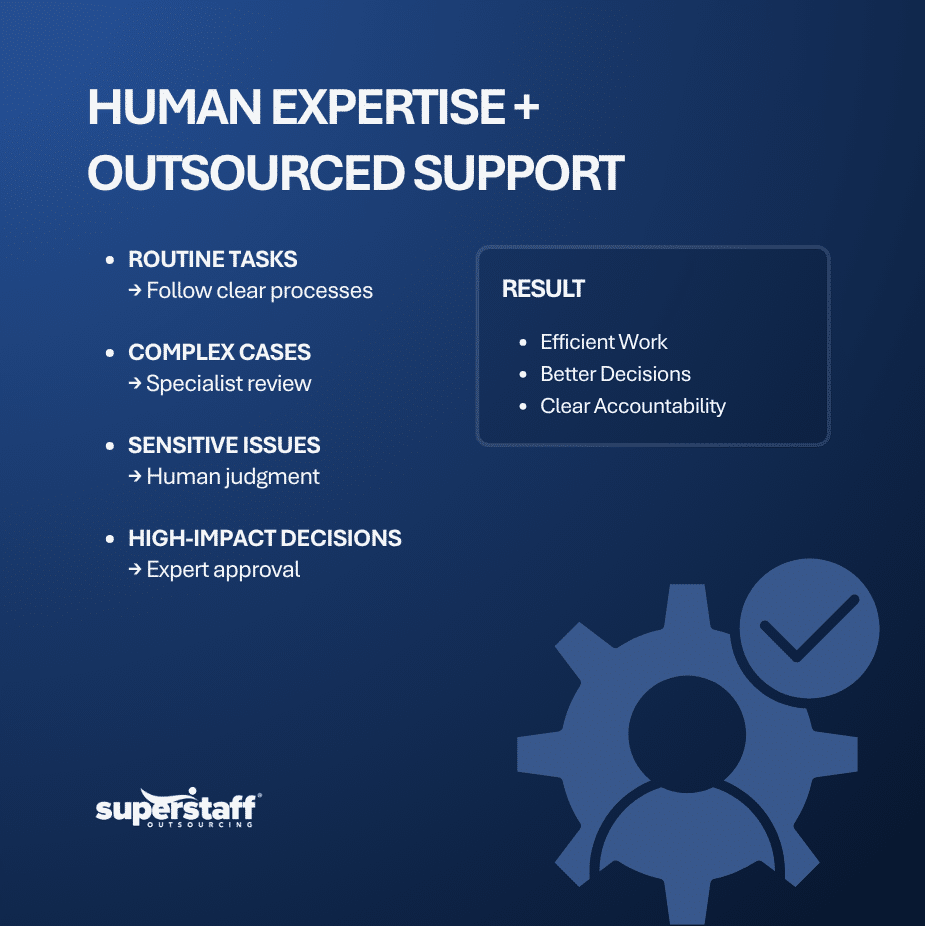
Human-in-the-loop outsourcing works best when businesses clearly define where people should enter the process. The goal is not to involve employees in every task, but to give them responsibility at the points where their skills matter most.
1. Routine Work Follows Clear Steps
A business can assign repeatable tasks to an outsourced team using clear procedures. These tasks may include data entry, document review, appointment scheduling, customer updates, or record maintenance.
Because the process follows defined steps, support professionals can complete the work consistently. Meanwhile, more experienced team members can focus on cases that require closer attention.
2. People Review Selected Cases
The workflow should identify situations that require human review. For example, an unusual customer request can move to a specialist instead of continuing through the standard process.
This approach helps employees focus their time on meaningful decisions. It also reduces unnecessary reviews of simple cases.
3. Specialists Handle Exceptions
An exception process gives outsourced professionals clear instructions for cases that fall outside normal requirements. They can gather additional information, review records, or contact the appropriate person for clarification.
The business can also set clear rules for when the team should resolve a case and when it should escalate it.
4. Managers Monitor Results
Outsourcing requires clear performance measures. Managers can track accuracy, response times, resolution rates, escalations, customer feedback, and other relevant results.
These measures help businesses identify areas that need improvement. They also show whether the outsourced team supports the business goals effectively.
5. Teams Improve the Process
Human review can reveal problems that standard reports may not show. If employees repeatedly encounter the same exception, managers can examine the cause and update the workflow.
Over time, this process can improve instructions, training, and quality checks. As a result, the outsourced team becomes an active part of process improvement.
Business Functions That Benefit From Human Expertise
Many business functions can use a human-in-the-loop approach. The key is to identify work where trained professionals can improve accuracy, customer experience, or decision quality.
1. Customer Support
Outsourced customer support teams can handle common questions and requests while escalating complex cases to trained specialists. This allows businesses to maintain service coverage without asking internal teams to handle every customer interaction.
For example, a support specialist can resolve a standard account question while a more experienced team member handles a complaint involving several previous interactions.
2. Healthcare Support
Healthcare-related administrative work often requires careful handling of records and information. Outsourced teams can support activities such as medical billing, claims processing, transcription, and administrative coordination.
Human review remains important when information appears incomplete or requires additional context. As a result, trained staff can help maintain accuracy throughout the process.
3. Finance and Accounting
Financial records require attention to detail. Outsourced professionals can handle routine bookkeeping, invoice processing, account reconciliation, and related administrative tasks.
However, unusual transactions or discrepancies may require experienced review. A human-in-the-loop approach gives specialists a clear role in checking these situations before the business moves forward.
4. Recruitment
Recruitment teams often manage large volumes of applications and candidate information. Outsourced recruitment professionals can organize applications, schedule interviews, update records, and support communication.
Yet hiring decisions require a deeper understanding of skills, experience, and business needs. Human recruiters can review qualified candidates and support hiring managers throughout the selection process.
5. Technical Support
Technical support often starts with standard troubleshooting steps. However, some issues involve unique configurations, unclear symptoms, or multiple possible causes.
An outsourced support team can resolve common problems while escalating complex cases to experienced technicians. This creates a structured process without removing human problem-solving from the workflow.
Build Better Outsourcing With Human Expertise
A successful outsourcing model needs more than task lists and service targets. Businesses also need to determine which activities require human judgment and how outsourced professionals should handle those responsibilities.
Start With the Right Tasks
Begin by separating routine work from work that requires judgment. Consider factors such as customer impact, business risk, complexity, and the level of expertise required.
Then, assign each task to the team best equipped to manage it.
Create Clear Escalation Rules
Employees need to know when they can make a decision and when they should ask for additional support. Clear escalation rules prevent delays and reduce uncertainty.
For example, businesses can define specific conditions that require supervisor approval or specialist review.
Train Teams for Real Situations
Training should cover more than standard procedures. Teams should also learn how to handle exceptions, communicate with customers, document decisions, and escalate concerns.
Additionally, managers should update training when processes or customer needs change.
Measure Human Contribution
Track where human review improves the process. Look at corrected errors, resolved exceptions, customer satisfaction, response times, and other relevant measures.
These results can help businesses determine which tasks benefit most from expert involvement.
Keep Accountability Clear
Outsourcing does not remove business responsibility. Companies should define who owns each decision, who reviews important work, and who handles escalations.
With clear accountability, internal and outsourced teams can work together without confusion.
Put Human Expertise Where It Matters
Human-in-the-loop outsourcing gives businesses a practical way to use external support while keeping skilled people involved in important decisions. Instead of treating every task the same, companies can create workflows that match the level of human expertise each activity requires.
The approach works across customer support, healthcare administration, finance, recruitment, technical support, and other business functions. More importantly, it allows companies to gain operational support without removing human judgment from areas where it matters.
SuperStaff helps businesses build outsourced teams that support routine work while giving trained professionals clear roles in review, decision-making, customer communication, and exception handling. Reach out to SuperStaff to explore how human-in-the-loop outsourcing can support your operations and put human expertise where it creates real value.