
Law firms manage growing workloads every year. Client expectations continue to rise, while legal teams face tighter deadlines and increasing operational costs. At the same time, firms need to maintain accuracy, protect sensitive information, and deliver reliable legal support across every case.
Because of these pressures, many firms now explore legal process outsourcing trends to improve daily operations. Outsourcing gives legal teams access to skilled professionals who can handle time-consuming tasks such as document review, legal research, contract management, and administrative support. As a result, firms can focus more on client service and case strategy instead of repetitive work.
Law firms of all sizes now use outsourcing to improve efficiency, reduce internal pressure, and manage legal processes more effectively. Understanding these changes can help firms stay organized and respond to changing client and operational needs.
Why Law Firms Continue to Expand Outsourcing Services
Legal teams need support that allows them to handle larger workloads without slowing operations. As firms grow, outsourcing can provide additional capacity for specific legal and administrative tasks.
1. Firms Want Better Cost Control
Hiring full-time legal staff requires salaries, benefits, office space, technology, and training expenses. However, outsourcing allows firms to add support based on their current workload.
For firms evaluating different approaches, legal process outsourcing services can provide support for selected legal and administrative functions without requiring every role to remain in-house.
2. Legal Teams Need Faster Turnaround Times
Clients expect timely responses and steady case progress. Therefore, many firms outsource document review, transcription, research support, and other time-consuming activities.
With dedicated support teams, firms can distribute workloads more effectively instead of assigning every repetitive task to attorneys and internal legal staff.
3. Firms Need Flexible Staffing Options
Legal workloads can change throughout the year. Litigation, large transactions, regulatory projects, or new client matters may create temporary increases in work.
Outsourcing gives firms the flexibility to adjust support based on current demands. This approach can be useful when additional capacity is needed for a specific project without creating a permanent internal position.
4. Administrative Tasks Continue to Increase
Legal professionals spend significant time on scheduling, billing, data entry, file management, and other administrative activities. Although these tasks are necessary, they can reduce the time available for substantive legal work.
Using legal back-office outsourcing can move selected administrative processes to dedicated support teams while attorneys remain focused on client matters and case preparation.
5. Firms Seek Extended Support Coverage
Some outsourcing providers operate across different locations and schedules. This can give firms additional coverage outside their regular office hours.
However, firms should establish clear handoff procedures, deadlines, and communication rules when teams work across different time zones.
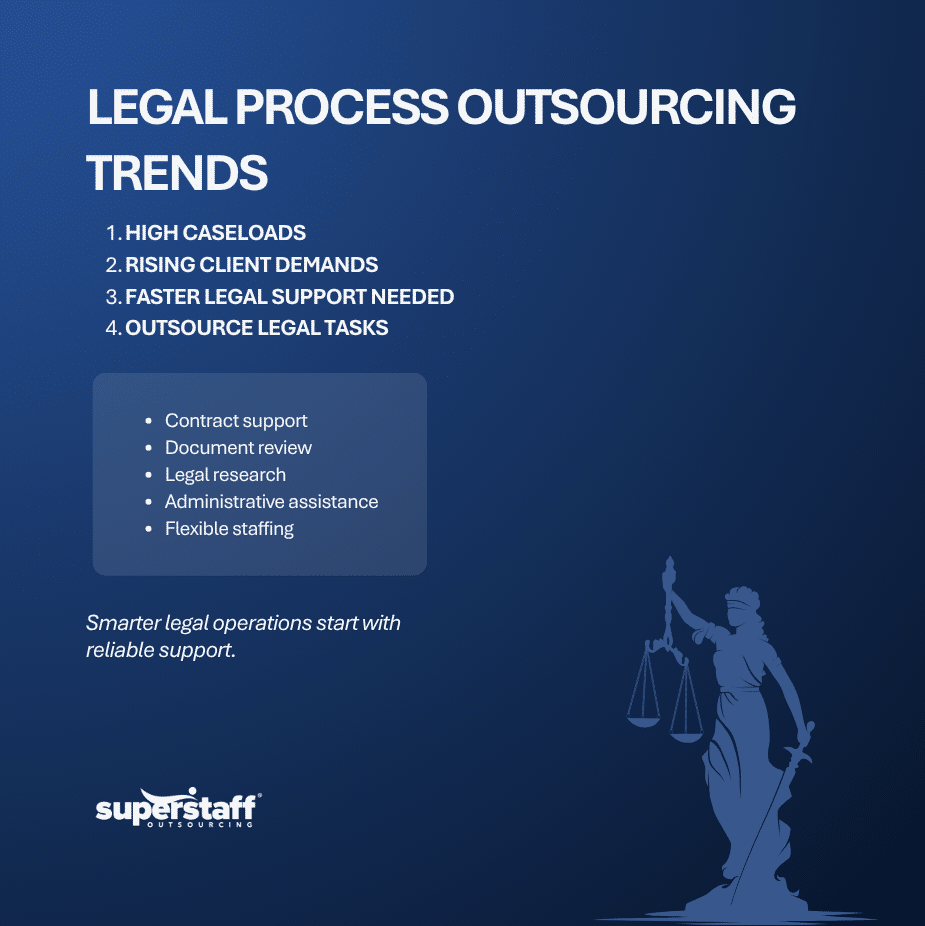
Legal Process Outsourcing Trends Shaping Modern Law Firms
Several legal process outsourcing trends are influencing how firms manage operations, technology, staffing, and client support.
1. Contract Management Outsourcing Continues to Grow
Law firms and corporate legal departments can handle large volumes of contracts. Reviewing, organizing, tracking, and maintaining these agreements requires consistent administrative support.
Outsourced teams can assist with contract organization, data entry, deadline tracking, renewal monitoring, and other defined processes. Attorneys can then focus on legal review, negotiation, and decisions that require professional judgment.
2. Document Review Services Remain Important
Litigation and investigations can involve large volumes of emails, documents, records, and other electronically stored information.
External teams can provide additional capacity for defined document review workflows. Firms may also use legal document review outsourcing to support high-volume projects while maintaining internal oversight of legal strategy and final decisions.
3. Data Security Becomes a Major Priority
Law firms handle confidential client information every day. Therefore, security should be evaluated carefully before legal work or data is transferred to an outside provider.
The American Bar Association has highlighted cybersecurity as an important concern for law firms. Firms considering outsourcing should review how providers control data access, train employees, secure systems, manage incidents, and protect confidential information.
4. Specialized Legal Support Services Are Expanding
Some outsourcing providers now offer support for specific legal practice areas or processes, including:
- Intellectual property
- Immigration
- Real estate
- Healthcare
- Corporate compliance
Specialized support can be useful when a firm needs additional operational capacity for a particular area. However, firms should verify a provider’s actual experience before assigning specialized work.
5. Technology Is Changing Legal Outsourcing
Technology now plays a larger role in document processing, research workflows, contract management, e-discovery, and administrative tasks.
AI and automation can assist with repetitive work, but firms still need appropriate human review, security controls, and professional oversight. Legal teams should determine which tasks can use technology and which decisions must remain with qualified legal professionals.
How Law Firms Choose the Right Outsourcing Partner
Selecting the right provider affects service quality, communication, security, and workflow efficiency. Firms should evaluate several areas before building a long-term partnership.
1. Industry Experience Matters
Law firms should look for providers with relevant experience in legal support. Experienced teams are more likely to understand legal terminology, document workflows, confidentiality requirements, and common administrative processes.
Firms should also ask for details about the specific services the provider has handled rather than relying only on general legal industry experience.
2. Communication Standards Affect Productivity
Clear communication keeps projects organized and reduces unnecessary delays. Firms should establish points of contact, reporting schedules, escalation procedures, and expected response times.
Dedicated account or project managers can also make coordination easier when several external team members work on the same project.
3. Security Policies Require Careful Review
Data protection remains a major consideration when outsourcing legal work. Firms should review access controls, confidentiality agreements, employee training, data handling procedures, and applicable security standards.
Security requirements should also reflect the type of information involved. Highly sensitive client or case information may require stronger controls than routine administrative data.
4. Scalability Supports Changing Workloads
Legal workloads can increase quickly based on new clients, cases, transactions, or regulatory requirements. A provider should be able to explain how it handles changes in staffing requirements.
Scalability should not come at the expense of training or quality. Firms should understand how new team members are prepared before they begin handling assigned work.
5. Service Quality Requires Clear Standards
Law firms should establish measurable expectations before outsourcing begins. These may include accuracy targets, turnaround times, response requirements, review procedures, and escalation rules.
Regular performance reviews can then show whether the outsourced team continues to meet those standards.
Common Challenges Firms Face During Outsourcing
Outsourcing can provide additional capacity, but firms still need to manage the relationship carefully. Clear processes can reduce many common operational problems.
1. Training External Teams Takes Time
External teams need to understand the firm’s workflows, terminology, systems, and expectations.
Detailed process documents, examples, and initial training sessions can improve consistency. Firms should also update instructions when procedures change.
2. Different Time Zones Require Coordination
Global teams may work different schedules. Therefore, firms should establish overlapping working hours when real-time collaboration is necessary.
Shared project tools and clear handoff procedures can also keep work moving when teams are not online at the same time.
3. Maintaining Quality Requires Oversight
Outsourcing does not remove the need for quality control. Firms should review work regularly and provide clear feedback when problems appear.
Defined quality checks also make it easier to identify repeated errors and adjust training or processes.
4. Internal Staff May Need Time to Adjust
Employees may have questions about how outsourcing changes their responsibilities. Firms should explain which tasks are being outsourced and how internal roles will work with the external team.
Clear responsibilities reduce duplicated work and confusion during the transition.
5. Vendor Selection Requires Careful Review
Providers can differ significantly in experience, pricing, security, staffing models, and service quality.
Law firms should compare providers using consistent criteria and verify important claims before transferring client information or assigning work.
Strong Legal Support Starts With Smart Partnerships
Legal teams need reliable support to manage growing workloads while maintaining accuracy, security, and client service. Keeping up with legal process outsourcing trends can help firms identify which repetitive, administrative, and high-volume tasks may be suitable for external support.
SuperStaff provides legal outsourcing solutions for firms that need additional support with document-related processes, research assistance, administrative work, and other back-office functions. A structured outsourcing strategy can give attorneys and internal teams more time to focus on client matters and work that requires their direct expertise.
Want to discuss your firm’s support requirements? Contact SuperStaff to learn how scalable legal outsourcing can fit your operations.