Predictability has become a priority across logistics operations. U.S. businesses are facing tighter delivery windows, higher customer expectations, and constant pressure to manage rising transportation costs. This makes supply chain support a central driver of performance. Companies now look to nearshore partners to strengthen visibility, reduce operational strain, and maintain speed across every shipment.
Nearshoring creates an environment where teams can track exceptions faster, communicate with carriers in real time, and handle customer inquiries without delay. It is a practical way to stabilize workflows while giving internal teams more capacity to focus on growth.
Why Track and Trace Needs Nearshore Strength
Track and trace teams play a large role in daily logistics performance. They monitor shipments, verify movement updates, manage exceptions, and respond to customers when delays occur. These responsibilities increase as order volumes fluctuate. Nearshore supply chain support solves this pressure by giving companies a reliable team that scales in step with demand.
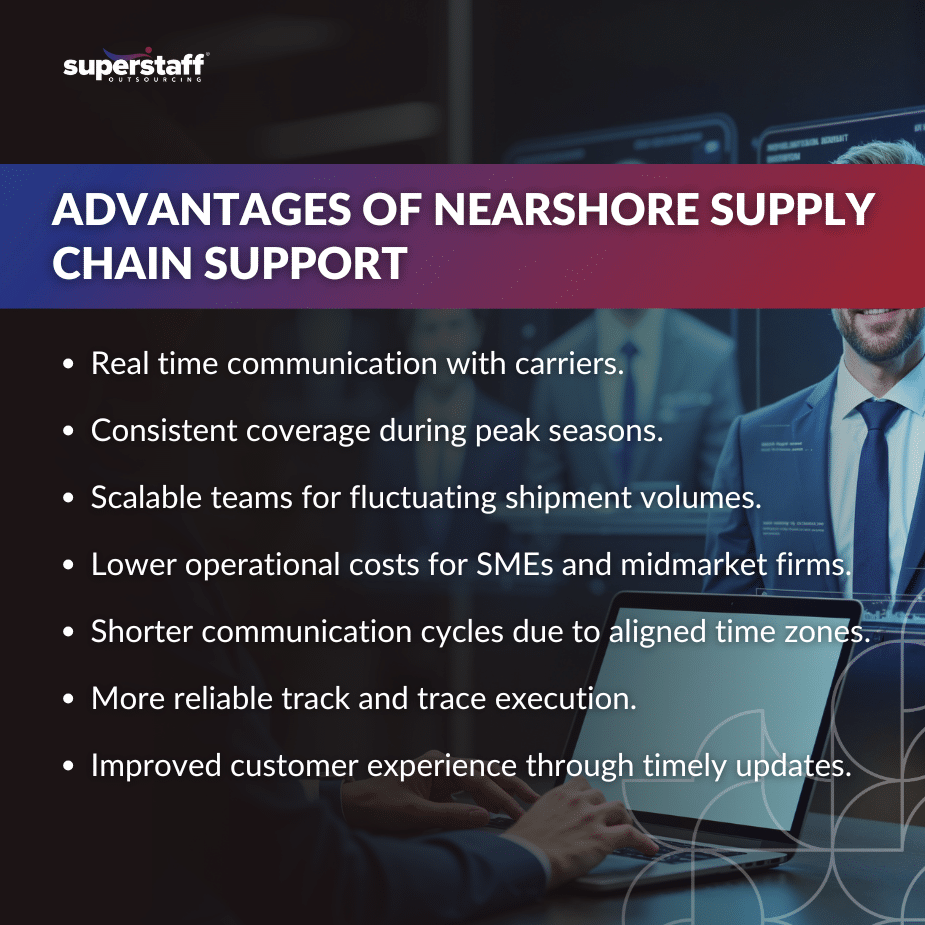
Nearshore teams work in similar time zones, which shortens communication cycles. This makes it easier to manage carrier follow-ups, schedule checks, and status updates. It also improves collaboration between U.S. operations teams and their nearshore counterparts.
Key advantages include:
- Faster customer updates
- Stronger delivery accuracy
- Higher issue resolution speed
- Consistent coverage during peak periods
These strengths position nearshore supply chain support as a dependable extension of internal logistics operations.
How Nearshore Teams Improve Daily Logistics Execution
Shipment tracking requires constant attention. Carriers operate on tight schedules, routes shift, and customers expect accurate visibility. A nearshore team provides the manpower to monitor each movement without overwhelming in-house staff.
Teams can:
- Check load status across multiple carriers
- Validate proof of delivery
- Document delays and escalate exceptions
- Manage pickup and delivery confirmations
This creates an environment where every event is captured and communicated promptly. Nearshore supply chain support ensures nothing falls through the cracks, even during high-volume seasons.
The Cost Structure Advantage for U.S. SMEs
Operational costs in logistics continue to rise. Maintaining larger in-house teams can strain budgets, especially for small and midmarket companies. Nearshore supply chain support gives businesses a more flexible cost structure. Companies can expand or reduce their team based on shipment volume without lengthy hiring cycles.
A nearshore model provides stability by aligning labor costs with predictable monthly spending. It also reduces the need for extensive training, HR overhead, and equipment investments. This frees internal resources for strategic initiatives like technology upgrades or customer experience improvements.
Better Collaboration and Real Time Response
Logistics success relies on continuous communication. Companies must coordinate with carriers, dispatch teams, warehouses, and customers. Nearshore supply chain support enhances this process with teams who work within overlapping hours and can respond quickly.
This improves alignment across departments because teams can jump into calls, support crisis situations, or resolve delays while they are happening. It shortens response times and prevents minor issues from escalating into customer dissatisfaction.
Scenario examples include:
- A carrier reports a missed pickup and the nearshore team initiates recovery steps immediately.
- A customer flags a missing delivery and the nearshore team verifies the last scanned location.
- A warehouse needs confirmation on inbound freight and the nearshore team secures carrier updates.
These interactions help build stronger operational flow and prevent miscommunication.
Elevating the Customer Experience
Shippers and receivers depend on accurate updates. When visibility is slow, frustration increases. Nearshore logistics services benefit customer experience by offering consistent communication and timely information.
Teams can:
- Provide proactive notifications
- Manage updated ETAs
- Handle inquiries with clarity
- Offer dependable support throughout the delivery cycle
This builds trust. Customers see a company that values transparency and service quality. For U.S. businesses, this becomes an advantage in competitive markets.
Scalability for Seasonal and High Volume Periods
Seasonal spikes create stress across logistics operations. Internal teams often struggle to manage the increased workload. Nearshore supply chain support removes this pressure by providing a structure that expands quickly.
Businesses can scale up assistance during:
- Holiday shipping
- Industry peak cycles
- New market launches
- Unexpected demand increases
Once volume stabilizes, companies can adjust the team size without long-term commitments. This creates a flexible, efficient model that matches the pace of business growth.
A More Resilient Logistics Operation
Supply chain disruptions have become more frequent. Companies need stable systems to maintain continuity even when challenges arise. Nearshore supply chain support contributes to resilience by providing consistent monitoring, rapid escalation, and steady coverage.
Nearshore teams can maintain performance when:
- Weather impacts transportation routes
- Carriers experience delays
- Inventory levels shift
- Customers request same-day visibility
- Operations teams need surge support
Resilience comes from having reliable people who ensure operations stay on track regardless of external factors.
Why Nearshore Is Becoming the New Standard
U.S. businesses are moving toward nearshore models because they deliver predictable performance. The combination of language alignment, cultural familiarity, cost efficiency, and time zone compatibility makes nearshore supply chain support a practical long-term solution.
Companies that adopt nearshore models benefit from:
- Shorter operational cycles
- Stronger collaboration
- Faster exception handling
- Lower operational strain
- Better customer satisfaction
- More strategic internal focus
These advantages make nearshore support a core part of modern logistics strategies.
SuperStaff and the Future of Scalable Supply Chain Support
Nearshore teams help logistics organizations operate with precision and consistency. As demand increases, businesses rely on dependable partners who strengthen visibility and support growth. Nearshore supply chain support provides the structure needed to manage daily operations with confidence.
SuperStaff helps logistics companies build scalable track and trace teams that improve communication, enhance shipment visibility, and maintain reliable performance. With trained specialists in Colombia and the Philippines, we provide the talent and operational support businesses need to meet market expectations.
Strengthen your logistics operation with nearshore teams that deliver accuracy, responsiveness, and stability. If you’re still wondering how and why nearshore supply chain support improves track and trace at scale, contact us and explore how we can empower your operations today.