Why Many Companies Still Rely on Global BPO Teams When Moving Operations Back Onshore
Many companies are bringing some of their operations closer to home. Business leaders want better control, faster communication, and closer coordination with their internal teams. As a result, offshore to onshore operations have become an important part of workforce planning across different industries.
However, moving certain roles onshore does not mean companies must stop working with global outsourcing partners. Instead, many businesses are adjusting how they divide responsibilities between local employees and offshore teams. Some functions benefit from direct local oversight, while others can remain with experienced global teams.
This blended approach allows companies to maintain control over important business activities without taking on the full cost of moving every role back onshore. By combining local management with global support, businesses can protect service quality, manage expenses, and maintain the flexibility needed to grow.
Why Companies Are Moving Some Operations Onshore
Bringing selected roles closer to the business can improve communication and give managers more direct control. However, most companies make these changes based on specific operational needs rather than relocating their entire workforce.
Several factors influence this decision.
- Closer coordination between teams
Onshore employees usually work within the same business hours as local managers and departments. This makes it easier to schedule meetings, discuss problems, and make decisions. Faster communication can be especially useful for projects that require frequent collaboration.
- Greater management oversight
Some business leaders prefer having certain employees nearby so they can monitor daily activities more closely. Onshore operations give managers more direct access to their teams and make it easier to address performance concerns.
- Changing customer expectations
Some customers prefer speaking with local representatives, particularly when dealing with complex concerns or services that require regional knowledge. Companies may move selected customer-facing roles onshore to meet these expectations.
- Compliance and internal requirements
Certain business functions involve local regulations, company policies, or contractual requirements. Keeping these responsibilities onshore can make oversight easier and help companies manage sensitive processes.
- Long-term workforce planning
Companies may also bring specific positions closer to their main offices to support leadership development, collaboration, and internal training. This allows them to build local capabilities while maintaining access to global talent.
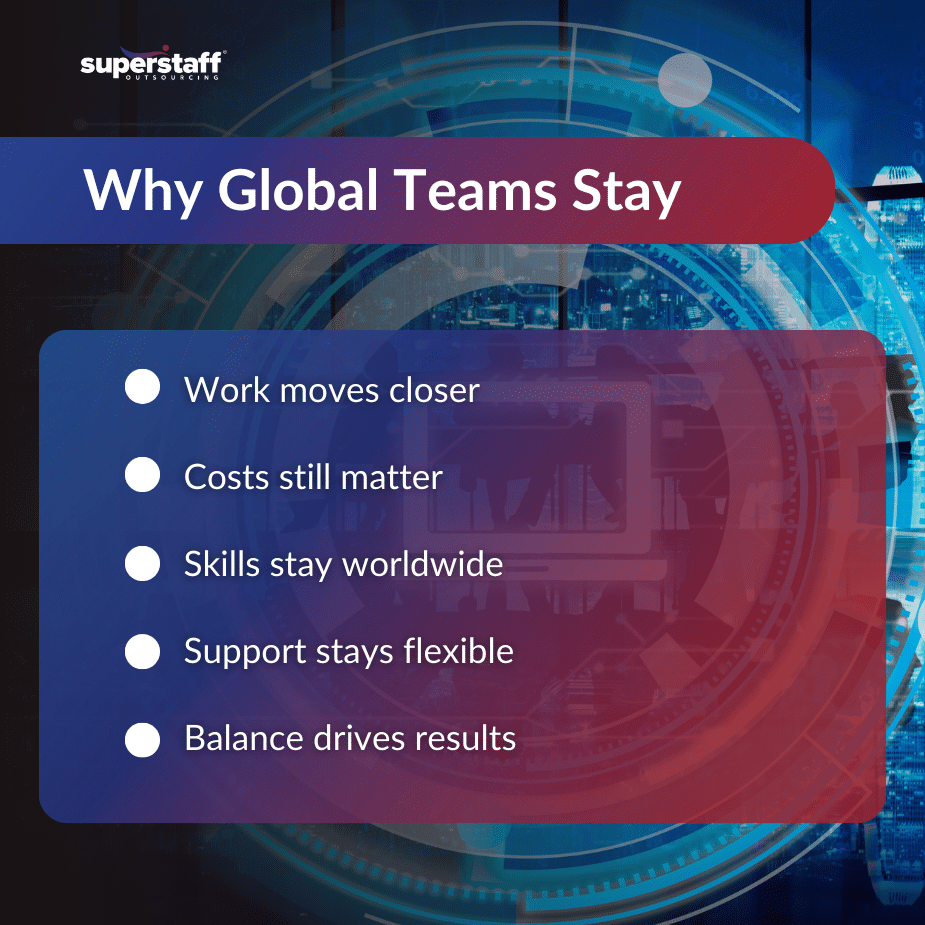
offshore to onshore operations
Why Global BPO Teams Still Play a Key Role
Even when companies move selected functions onshore, global outsourcing teams continue to handle many important responsibilities. These teams provide access to skilled employees, flexible staffing arrangements, and operational support that may be difficult or expensive to maintain locally.
Here are some reasons businesses continue working with global BPO providers.
- Access to specialized skills
Global BPO providers recruit employees with experience in customer service, technical support, accounting, administrative work, and other business functions. This gives companies access to skills that may be limited in their local labor markets.
- Better control over operating costs
Hiring locally can increase payroll, office, and employee-related expenses. Global teams give companies another way to manage these costs while maintaining the support needed for daily operations.
- Faster workforce expansion
Outsourcing partners can help businesses add employees when workload increases. This can reduce the time and effort involved in recruiting, hiring, and training a larger in-house workforce.
- Support for routine business tasks
Companies do not need to move every administrative or repetitive task onshore. Global teams can continue handling data entry, reporting, order processing, and customer inquiries while local employees focus on management and decision-making.
- Continuity with established partners
Businesses that already have successful outsourcing relationships may prefer to maintain them during a transition. Keeping experienced global teams involved helps preserve existing processes and reduces unnecessary disruption.
SuperStaff’s outsourcing teams and services in the Philippines provide examples of how global talent can support different business functions.
How Offshore to Onshore Operations Actually Work
Most companies do not move every position at the same time. Instead, they review their processes and decide which responsibilities should stay local and which can remain with global teams.
A blended workforce model usually follows a few common practices.
- Shared responsibility between locations
Onshore employees may handle leadership, planning, and sensitive business decisions, while offshore teams manage selected daily tasks. This arrangement allows managers to maintain oversight without handling every operational responsibility themselves.
- Task allocation based on business needs
Companies assign responsibilities according to the skills, location, and experience required for each role. Tasks that require local knowledge may stay onshore, while functions that can be handled remotely remain with global teams.
- Gradual transition planning
Moving operations requires careful preparation. Companies often transfer selected roles in stages to give employees enough time to adjust, document processes, and maintain service quality.
- Shared reporting systems
Onshore and offshore employees need access to consistent performance information. Shared platforms help teams monitor deadlines, track completed tasks, and identify problems across locations.
- Regular performance reviews
Managers should evaluate the output of both local and global teams. Reviewing service levels, productivity, and operating costs helps determine whether the current workforce arrangement is meeting business goals.
A blended setup can also support business continuity and operational flexibility. Forbes discusses this in its article on how onshoring can support business resilience.
The Value of Global Outsourcing Strategies
Keeping global teams involved is not only about reducing expenses. It also gives companies access to talent and operating capacity that can support different business needs.
A well-planned global outsourcing strategy offers several advantages.
- Access to a wider talent pool
Companies are not limited to candidates in their immediate location. They can work with outsourcing partners that recruit employees with the skills needed for specific roles.
- Extended business coverage
Teams in different time zones can support operations beyond regular local working hours. This is useful for companies that serve international customers or need continuous administrative support.
- Business continuity
Having employees across multiple locations can reduce dependence on a single office or labor market. If one location experiences staffing or operational problems, other teams may help maintain essential services.
- Flexible workforce arrangements
Global outsourcing strategies allow businesses to adjust team size and responsibilities as demand changes. This makes it easier to respond to seasonal workloads, new projects, and business expansion.
- More predictable workforce planning
Companies can compare local and offshore staffing costs before deciding where each function should be handled. This helps managers allocate resources based on business priorities.
For companies that need extended customer support coverage, nearshore outsourcing and time zone alignment also show how location choices can affect communication and service availability.
Onshore Operations Advantages That Influence Decisions
Although global outsourcing offers several benefits, some responsibilities are easier to manage locally. Companies must consider the nature of each task before deciding where employees should work.
The following onshore operations advantages often influence these decisions.
- Faster internal communication
Employees working in the same location or time zone can coordinate more easily. This is helpful for projects that require frequent discussions and quick approvals.
- Closer cultural alignment
Local employees may have a better understanding of regional customer expectations, communication styles, and business practices. This can be useful for roles that involve direct interaction with local clients.
- Easier training and development
Managers can conduct face-to-face training, coaching, and team meetings. This may help when employees need close guidance or must learn complex internal procedures.
- Direct handling of sensitive responsibilities
Some tasks involve information, approvals, or decisions that companies prefer to keep under local supervision. Onshore teams can provide closer oversight when required.
- Stronger leadership involvement
Having certain employees nearby allows managers to provide direct feedback and guidance. This can help with strategic projects, leadership development, and responsibilities that require frequent coordination.
Why Companies Still Depend on Global Teams
The decision to move operations onshore does not automatically make offshore teams less valuable. In many cases, companies discover that their existing global partners can continue handling essential functions while local employees manage responsibilities that require closer supervision.
For example, a company may keep its senior management and strategic planning teams onshore while assigning customer support, data processing, and back-office work to an offshore provider. This allows each team to focus on responsibilities that match its strengths.
It also prevents businesses from spending heavily on local recruitment for positions that can be handled effectively by trained global employees. Instead of choosing between local and offshore operations, companies can use both to build a workforce that meets their needs.
Managing Risks During the Transition
Moving responsibilities between locations can create problems if companies do not prepare properly. Employees need clear instructions, managers must understand their new responsibilities, and outsourcing partners should be involved before major changes take place.
A few practical steps can help reduce disruption.
- Create a clear communication plan
Inform employees about upcoming changes and explain how responsibilities will be divided. Everyone should understand who handles specific tasks and where to direct questions.
- Document existing processes
Record workflows, reporting requirements, and important procedures before moving any responsibilities. This gives incoming teams a clear reference and helps maintain consistency.
- Train employees across locations
Onshore and offshore teams should understand how their work connects. Joint training sessions can help prevent confusion and reduce errors during the transition.
- Set performance benchmarks
Establish measurable targets before making changes. Managers can compare results after the transition to identify improvements or areas that need attention.
- Involve outsourcing partners early
Existing BPO providers should understand the transition plan and their role in it. Early coordination helps prevent gaps in staffing, communication, and daily operations.
Offshore to Onshore Operations as a Long-Term Strategy
Workforce planning does not end once a company moves selected positions onshore. Business needs change, customer expectations shift, and operating costs can increase or decrease over time.
Companies should regularly review which responsibilities need local oversight and which can be handled by global teams. They should also consider whether existing staffing arrangements still provide the right balance of cost, productivity, and service quality.
The most effective offshore to onshore operations are flexible. Rather than following a fixed approach, companies adjust their workforce based on actual performance and business requirements.
This also means maintaining strong relationships with outsourcing partners. Experienced providers can help businesses adjust team size, introduce new support functions, and manage changes without rebuilding their entire workforce.
Smart Balance Drives Better Business Outcomes
Companies do not always need to choose between onshore control and offshore efficiency. A blended workforce can provide both, allowing local employees to manage strategic responsibilities while global teams support daily operations.
This approach also helps businesses avoid unnecessary relocation costs and retain access to experienced outsourcing professionals. SuperStaff’s back-office support services can help companies manage administrative responsibilities through dedicated teams in the Philippines and Colombia.
The key is to assign each function to the location and team best suited to handle it. With clear responsibilities, shared reporting systems, and regular performance reviews, companies can build an operating model that supports long-term business goals.
Build a Workforce That Fits Your Business Needs
Moving selected operations onshore does not mean giving up the benefits of global outsourcing. Companies can maintain local oversight while relying on experienced BPO teams for the support, skills, and flexibility they need.
SuperStaff helps businesses build dedicated teams that support customer service, back-office operations, and other essential functions. Our workforce solutions are designed to work with your existing processes and changing operational requirements.
If your company is reviewing its onshore and offshore workforce strategy, contact SuperStaff to discuss a setup that fits your business goals.