
Many U.S. companies still believe in outsourcing. They need cost control, flexible staffing, stronger customer support, and access to skilled talent. But after years of managing teams across distant time zones, some leaders are feeling offshoring fatigue and looking for a better way to balance savings with speed, communication, and control.
This does not mean offshore outsourcing has lost its value. The Philippines remains a strong destination for customer service and back-office support. But not every function, team, or workflow performs best when it sits many hours away from the U.S. workday.
For companies that need real-time collaboration, Spanish-English support, faster management access, or closer cultural alignment, nearshoring to Colombia can offer a practical alternative.
SuperStaff’s Colombia office gives U.S. SMEs and midmarket companies another option. It helps businesses build support teams that stay closer to their customers, managers, and daily operating rhythm.
Offshoring Fatigue Starts With Time Zone Pressure
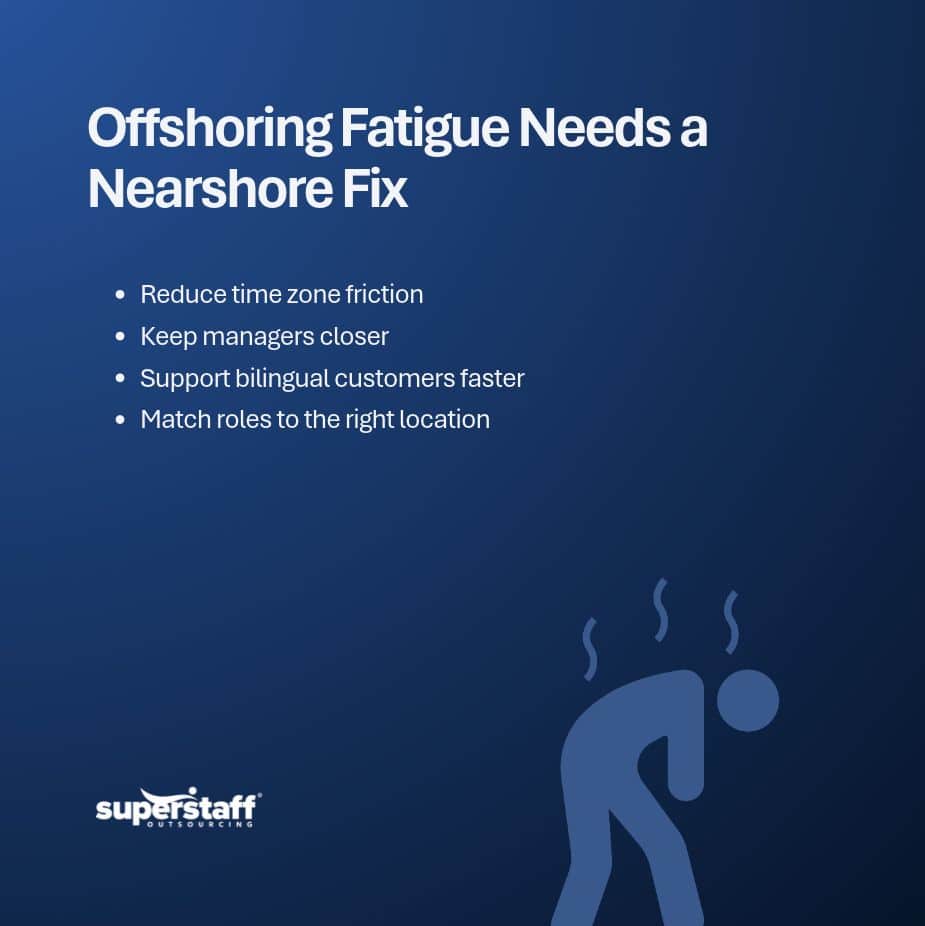
Offshoring fatigue often begins when leadership teams realize how much effort it takes to manage work across a major time difference. A delayed answer may seem small at first. Over time, repeated delays affect coaching, quality checks, urgent escalations, and client communication.
A U.S. operations manager may finish the day with questions that the offshore team cannot answer until the next shift. A customer support issue may need approval, but the decision-maker is offline. A training update may take longer to roll out because schedules rarely overlap.
These problems do not always come from poor performance. Many offshore teams work hard and deliver well. The challenge is often structural.
When roles require constant collaboration, offshoring fatigue can show up through slower decisions, longer feedback loops, and more after-hours coordination.
Nearshore support in Colombia helps reduce this pressure. Teams can work closer to U.S. business hours, making live communication easier and more practical. SuperStaff explains this advantage in its article on how nearshoring to Colombia improves customer support responsiveness.
When Cost Savings Are No Longer Enough
Cost reduction is one of the main reasons companies outsource. That will not change. But offshoring fatigue appears when savings come with too much operational friction.
Leaders start asking harder questions.
- Are managers spending too much time coordinating across time zones?
- Are customers waiting longer because approvals are delayed?
- Are team leads joining calls outside normal hours too often?
- Are training updates taking too long to reach everyone?
- Are escalation paths clear enough for urgent issues?
If the answer is yes, the company may need a different workforce model.
Nearshoring to Colombia can still support cost efficiency while improving collaboration. It gives U.S. companies access to skilled talent without placing every process on the other side of the world.
This is especially valuable for customer-facing teams, sales support, bilingual service, account coordination, technical support, and roles that require regular interaction with U.S.-based managers.
Offshoring Fatigue Can Affect Customer Experience
Customers do not see the outsourcing model behind the service. They only experience the outcome. If they receive slow replies, repeated explanations, or inconsistent updates, they may question the company’s reliability.
Offshoring fatigue can indirectly affect customer experience when internal coordination becomes too difficult. Agents may need guidance from U.S. teams. Supervisors may need faster answers from clients. Account managers may need real-time updates during business hours.
For example, a U.S. e-commerce company may need support agents who can handle order issues while the internal logistics team is active. A healthcare support team may need quick coordination with U.S.-based staff during patient service hours. A financial services provider may need appointment setters who can reach prospects during the same workday.
Colombia’s nearshore advantage helps companies close these gaps. Teams can support U.S. customers during more familiar hours, making service feel more responsive and connected.
Why Colombia Fits Real-Time Support Needs
Colombia is an attractive nearshore location for U.S. companies because it supports closer workday alignment, bilingual service capabilities, and strong customer-facing talent. For businesses serving English- and Spanish-speaking customers, this creates a practical advantage.
Offshoring fatigue often becomes clear when companies need more than task completion. They need active collaboration. They need team members who can join calls, respond during U.S. business hours, and support customers without long operational gaps.
The U.S. Department of Commerce notes that Colombia shares the same time as U.S. Eastern Standard Time, without daylight-saving adjustments. This alignment can make it easier for teams to coordinate during the workday. See its Colombia business travel and local business hours guide.
Colombia can support roles such as:
- Customer service representatives
- Bilingual support agents
- Sales support specialists
- Appointment setters
- Technical support representatives
- Back-office coordinators
- Account support assistants
- Operations support staff
These roles benefit from frequent communication. They also require professionalism, adaptability, and strong service habits.
SuperStaff Colombia helps U.S. businesses build teams that can work closer to their market while still benefiting from an outsourced model.
Nearshore Teams Improve Management Visibility
One common source of offshoring fatigue is reduced visibility. Managers want to know what is happening, but they may receive updates too late or too infrequently.
Nearshore teams can make management feel more connected. Leaders can schedule live check-ins during normal business hours. They can review performance, address concerns, and provide feedback without asking one side to work at uncomfortable times.
This matters for SMEs and midmarket companies because many do not have large global operations teams. Their managers are already handling multiple responsibilities. They need outsourced teams that simplify operations, not add another layer of complexity.
With nearshore support, U.S. leaders can keep closer contact with outsourced employees and team leads. They can coach faster, solve problems earlier, and maintain a stronger sense of operational control.
That can make outsourcing feel less distant and more integrated.
Offshoring Fatigue Does Not Mean Leaving Offshore Behind
Offshoring fatigue should not push companies into an all-or-nothing decision. The better approach is workforce design.
Some roles fit well in the Philippines. Customer service, back-office processing, data support, healthcare administration, finance support, and other process-driven roles can succeed offshore with the right structure.
Other roles may perform better nearshore in Colombia, especially when they require:
- Same-day collaboration
- Frequent client communication
- Bilingual English-Spanish support
- U.S. business-hour coverage
- Real-time sales follow-up
- Faster escalation management
- Closer alignment with U.S. teams
A blended outsourcing model can help companies match work to the right location. This allows leaders to keep the value of offshore support while using nearshore teams where speed and alignment matter most.
SuperStaff’s presence in both the Philippines and Colombia gives clients more flexibility in how they build global teams. Its overview of Colombia as an outsourcing destination explains how bilingual talent, time zone alignment, and operational flexibility can support U.S. businesses.
Culture and Communication Matter More Than Distance Alone
Location helps, but it does not solve every problem. Offshoring fatigue can also come from weak onboarding, unclear roles, poor documentation, and inconsistent management.
Nearshoring works best when the partner builds the right operating structure around the team. Employees need clear expectations, tools, training, escalation paths, and performance standards.
For U.S. companies, this means selecting a partner that understands both people management and service delivery. The right provider should help translate business needs into roles, workflows, schedules, and measurable outcomes.
Colombia’s proximity can improve communication. But strong execution still depends on how the team is hired, trained, supported, and managed.
SuperStaff helps clients create that structure, so nearshore teams are not treated as separate contractors. They operate as extensions of the client’s business.
When U.S. Companies Should Consider Colombia
Companies should consider Colombia when offshoring fatigue starts affecting speed, communication, or customer responsiveness.
The need may appear in practical ways. Sales leads are not contacted quickly enough during U.S. hours. Customer escalations wait too long for approval. Managers struggle to coach offshore teams because schedules rarely overlap. Bilingual support demand increases, but internal teams cannot keep up.
These are signs that a nearshore layer may help.
A U.S. company does not need to move every role to Colombia. It can start with the teams that need closer interaction. Customer service, appointment setting, sales support, account coordination, and technical support are common starting points.
This approach gives leaders more control over the customer-facing parts of the operation while still using global talent strategically.
How SuperStaff Colombia Helps Reduce Operational Strain
SuperStaff Colombia helps U.S. SMEs and midmarket companies build nearshore teams that support customer service, bilingual communication, sales coordination, technical support, and back-office workflows.
The value is practical. Teams work closer to U.S. business hours. Communication becomes easier. Managers can stay more involved. Customers can receive faster support from agents who understand service expectations and regional context.
SuperStaff also brings outsourcing experience across multiple delivery locations. That matters because the right solution may not be purely offshore or purely nearshore. It may be a blended model that uses the Philippines for cost-efficient scale and Colombia for real-time collaboration.
For companies feeling offshoring fatigue, this flexibility can help restore confidence in outsourcing.
Businesses can review SuperStaff’s nearshore outsourcing services in Colombia to learn more about its bilingual teams, available support roles, and delivery capabilities.
Build a Better Outsourcing Model With SuperStaff Colombia
Offshoring fatigue is not a sign that outsourcing has failed. It is a signal that the operating model needs to evolve. Some work still belongs offshore. Some work needs to move closer to customers, managers, and business hours.
SuperStaff helps U.S. companies design that balance through offshore support in the Philippines and nearshore support in Colombia. With the right structure, businesses can improve responsiveness, reduce coordination strain, and build teams that fit how they actually operate.
If your company is feeling the limits of a distant support model, contact SuperStaff to discuss building a nearshore team that helps you serve customers faster, collaborate more easily, and scale with greater control.