
Reshoring is changing how companies manage production, logistics, and customer expectations. By moving manufacturing closer to their main markets, businesses can gain greater control over production and delivery. However, these changes can also increase labor costs, administrative workloads, and pressure on customer support teams. Pairing reshoring with outsourcing for supply chain efficiency gives companies another way to manage these demands without placing extra strain on internal staff.
Back office and customer service outsourcing can support order management, shipment tracking, documentation, and customer communication. These functions keep daily operations organized while internal teams focus on manufacturing, supplier relationships, and business planning. With the right processes and outsourcing partner, companies can maintain service quality while adapting to new supply chain requirements.
Why Outsourcing Supports Reshoring Success
Reshoring can improve production oversight and bring manufacturers closer to their customers. However, relocating operations does not remove the need for accurate records, supplier coordination, and responsive customer service. The added workload can make outsourcing for supply chain efficiency a practical option for companies adjusting to new operating conditions.
1. Managing New Operational Demands
When companies reshore, they may need to manage new suppliers, shipping schedules, production records, and compliance documents. Outsourced back office teams can handle routine data entry, record maintenance, and reporting, allowing internal employees to focus on decisions that require direct operational knowledge.
2. Controlling Rising Labor Costs
Domestic manufacturing can increase staffing and operating expenses. Outsourcing selected administrative tasks to qualified external teams gives businesses another way to manage these costs while keeping production activities closer to home. The actual savings depend on the tasks involved, provider rates, and the level of oversight required.
3. Maintaining Customer Communication
Customers want accurate updates about order status, delivery schedules, and product availability. Customer service outsourcing provides additional capacity to handle inquiries and communicate changes. This is especially useful when production schedules or shipping timelines change during the transition to a reshored supply chain.
4. Supporting Local and Global Operations
Reshored manufacturers may still depend on international suppliers, freight companies, and distribution partners. Outsourced teams can coordinate records, track shipments, and pass updates between stakeholders across different time zones. Clear communication reduces the risk of missed updates and delayed responses.
5. Keeping Operations Scalable
Production volumes can change due to seasonal demand, new contracts, or market conditions. Outsourcing allows companies to adjust administrative and customer support capacity based on workload, subject to staffing arrangements and service agreements.
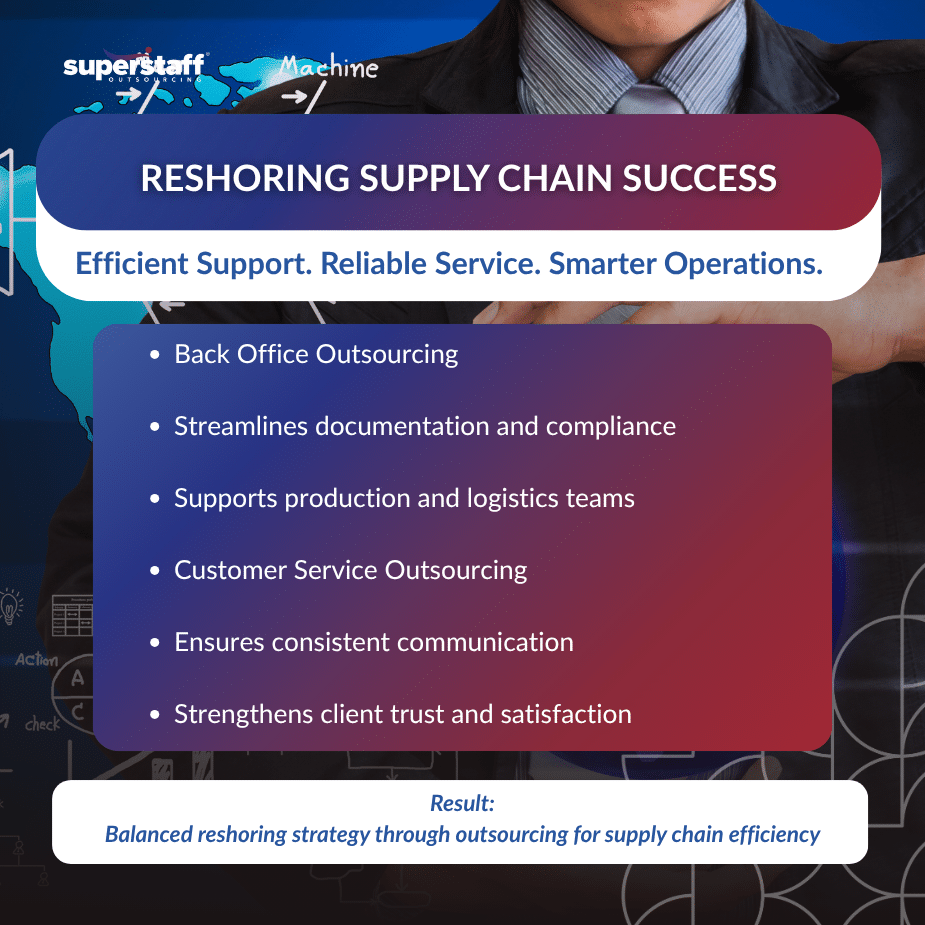
Back Office Outsourcing for Stronger Supply Chain Efficiency
Administrative accuracy is important when several teams manage purchasing, inventory, shipping, and production. Outsourcing routine tasks can keep records organized and reduce the amount of manual work assigned to manufacturing and logistics staff. Businesses can also use back office outsourcing to assess which administrative processes could be handled externally.
1. Streamlined Data Entry and Documentation
Supply chain operations generate purchase orders, invoices, shipping records, inventory reports, and supplier documents. Outsourced teams can enter, update, and organize these records according to established procedures. Accurate documentation gives internal teams better information for daily planning and reporting.
2. Accurate Order and Inventory Management
Order processing and inventory record maintenance require regular updates. External teams can update stock records, enter order details, and flag discrepancies for review. When these tasks are connected to reliable inventory systems, businesses can improve visibility and respond more quickly to possible shortages.
3. Compliance and Quality Records
Reshored operations may need to follow local regulations, industry requirements, and customer-specific standards. Outsourced administrative staff can organize required documents, maintain records, and prepare reports for internal review. Responsibility for compliance decisions should remain with qualified personnel who understand the relevant rules.
4. Financial and Accounting Support
Manufacturing and logistics involve invoices, supplier payments, expense reports, and other financial records. Outsourced accounting teams can assist with data entry, reconciliation, and invoice processing under approved procedures. These services can reduce routine administrative work while internal finance staff retain oversight of approvals and financial controls.
5. Coordination Between Departments
Production, procurement, logistics, and customer service teams depend on accurate information from one another. Outsourced support staff can update shared records, prepare reports, and route information to the appropriate departments. Clear workflows help reduce communication gaps and keep daily activities on schedule.
Customer Service Outsourcing for Reshored Operations
Customers may not see the changes taking place inside a company’s supply chain, but they notice when orders arrive late or updates are unclear. Customer service outsourcing gives businesses additional support for managing questions, resolving delivery concerns, and communicating changes. A structured customer service outsourcing service can also provide support across phone, email, and chat, depending on the agreed service scope.
1. Handling Customer Inquiries and Orders
Customers contact businesses to ask about order confirmations, product availability, shipping schedules, and delivery status. Outsourced agents can answer these questions using approved systems and information. When an issue requires action from the warehouse or production team, agents can route it to the right contact.
2. Managing After-Sales Support
Customers may need assistance with returns, replacements, damaged products, or service requests. Outsourced agents can record the issue, explain company policies, and coordinate the next steps. Clear procedures help ensure that customer concerns reach the teams responsible for resolving them.
3. Building Customer Trust
Changes to production and distribution can affect delivery dates and product availability. Prompt, accurate communication gives customers a clearer understanding of what to expect. Agents should share verified updates rather than promise delivery dates or outcomes that the business cannot confirm.
4. Providing Extended Support Coverage
Some businesses serve customers across several regions or time zones. Outsourced teams can provide extended service hours or 24/7 coverage when staffing and service agreements allow it. This gives customers more opportunities to receive assistance outside the company’s regular business hours.
5. Using Customer Feedback to Improve Operations
Customer service teams often receive reports about delivery delays, missing items, packaging issues, and product concerns. Recording these patterns and sharing them with the relevant departments can help companies identify recurring problems and improve their processes.
Benefits of Outsourcing for Supply Chain Efficiency
Using outsourcing for supply chain efficiency can improve how companies manage routine tasks during and after reshoring. The benefits depend on selecting suitable functions, setting clear performance targets, and maintaining oversight of the outsourced work.
1. Cost Control
Outsourcing can reduce the need to recruit additional in-house employees for selected administrative and support tasks. Businesses should compare provider fees with internal staffing, training, technology, and management costs before deciding which functions to outsource.
2. Increased Productivity
When external teams manage routine documentation, order updates, and customer inquiries, internal employees can spend more time on production planning, supplier management, and process improvement.
3. Better Resource Allocation
Managers can direct specialized staff toward tasks that require technical knowledge, direct supervision, or operational decision-making. Outsourced support teams can take on defined tasks that do not require the same level of internal involvement.
4. Faster Issue Resolution
Accurate records and clear escalation procedures make it easier to identify missing documents, order discrepancies, and customer concerns. Outsourced teams can flag issues promptly and send them to the appropriate internal contact.
5. Stronger Business Continuity
An additional support team can provide operational coverage during busy periods, staffing shortages, or sudden increases in customer inquiries. Companies should document workflows and establish backup procedures to reduce dependence on individual employees or providers.
Industries Benefiting From Outsourcing and Reshoring
Different industries can combine reshoring with outsourcing for supply chain efficiency to manage administrative workloads and maintain customer support.
1. Manufacturing and Assembly
Manufacturers can outsource purchase order entry, production documentation, supplier communication, and shipment record maintenance. These tasks support daily operations while internal teams manage production schedules and quality decisions.
2. E-Commerce and Retail
Retailers can outsource order updates, customer inquiries, returns coordination, and inventory data entry. This support becomes particularly useful during peak shopping periods when customer contact volumes increase.
3. Automotive and Electronics
These industries depend on accurate component records, supplier documentation, and production schedules. Outsourced administrative teams can maintain records and flag missing information, while qualified internal personnel oversee technical specifications and safety requirements.
4. Healthcare and Pharmaceuticals
Healthcare product and pharmaceutical supply chains may require detailed inventory records, shipment documentation, and controlled information handling. Outsourced teams must follow applicable privacy, security, and regulatory procedures, with specialized decisions handled by authorized personnel.
5. Consumer Goods
Consumer goods companies need to coordinate production, inventory, distribution, and customer inquiries. Outsourced support can manage routine updates and documentation while internal teams focus on demand planning and supplier relationships.
Checklist for Using Back Office and Customer Service Outsourcing to Strengthen Reshored Supply Chains
Before outsourcing any function, companies should review their existing workflows and determine where external support can provide measurable value.
- Identify routine tasks that can be outsourced without giving up necessary operational control.
- Choose a provider with relevant experience and appropriate data security practices.
- Document workflows, responsibilities, approval rules, and escalation procedures.
- Train outsourced staff on product information, company policies, and required systems.
- Set measurable targets for accuracy, turnaround time, and customer service.
- Review performance reports and address recurring errors.
- Maintain regular communication between internal and outsourced teams.
- Adjust staffing according to workload, seasonal demand, and business requirements.
Following these steps gives companies a clearer way to manage outsourced tasks while keeping responsibility for supply chain decisions within the business.
Partner With Experts to Strengthen Your Supply Chain
Reshoring can give companies greater control over production, but it also requires careful management of labor costs, administrative tasks, and customer expectations. Combining reshoring with outsourcing for supply chain efficiency allows businesses to assign routine work to external teams while keeping internal resources focused on production and planning.
SuperStaff provides back office and customer support solutions for businesses that need help managing administrative workloads and customer communication. The right service arrangement depends on the company’s processes, security requirements, staffing needs, and performance goals.
If your business is reviewing its reshoring strategy, contact SuperStaff to discuss your operational needs and determine which support functions may be suitable for outsourcing.